|
Additions to the elasmobranch assemblage from the Bandah Formation (middle Eocene, Bartonian), Jaisalmer District, Rajasthan, India, and the palaeobiogeographic implications of the fauna
Published online: 6/23/21
Keywords:
Chondrichthyes; Elasmobranchii; Indian Ocean; Palaeogene; South Asia
https://doi.org/10.18563/pv.44.2.e1
Abstract
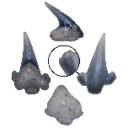
Isolated elasmobranch teeth (sharks and rays) from the middle Eocene (Bartonian) Bandah Formation in the Jaisalmer District of Rajasthan, India are described. The remains improve our knowledge of the environment represented by this lithostratigraphic unit and the ecology preserved therein. Seventeen unequivocal taxa were identified, including Nebrius sp., Striatolamia aff. S. macrota, Brachycarcharias atlasi, B. lerichei, cf. Jaekelotodus sp., Carcharhinus mancinae, Rhizoprionodon sp., Physogaleus sp., Galeocerdo clarkensis, G. eaglesomei, Odontorhytis aff. O. pappenheimi, “Rhinobatos” sp., “Dasyatis” sp., Coupatezia sp., “Aetomylaeus” sp., “Rhinoptera” sp., and Ouledia aff. O. lacuna. Of these, “Aetomylaeus” sp., B. atlasi, C. mancinae, G. clarkensis, G. eaglesomei, cf. Jaekelotodus sp., Nebrius sp., Odontorhytis aff. O. pappenheimi, Ouledia aff. O. lacuna, and “Rhinoptera” sp. are reported from the middle Eocene of India for the first time. The Bandah Formation elasmobranch palaeofauna has close affinities to the Palaeocene-Eocene Tethyan/Paratethyan faunas of Africa, Madagascar, Asia, and Europe, and some taxa indicate a western hemisphere influence from North America. The Bandah Formation palaeofauna indicates that deposition occurred in a moderately shallow marine environment. The Bartonian age is primarily based on foraminifera but is corroborated by the presence of elasmobranch taxa that also occur in contemporaneous deposits elsewhere. The marine regression started during the early Palaeogene, and our study indicates that the sea completely withdrew from the Jaisalmer Basin after the deposition of the Bandah Formation. This event may have been synchronous with the middle Eocene uplift of the Himalayan-Tibetan Plateau.
PV article infos
Published in 44-2 (2021)
|
PDF
|
|
The beginning of the adaptive radiation of Theridomorpha (Rodentia) in Western Europe: morphological and phylogenetic analyses of early and middle Eocene taxa; implications for systematics
Published online: 9/20/21
Keywords:
characters analyses; Dental morphology; Eocene; Rodentia; variability
https://doi.org/10.18563/pv.44.2.e2
Abstract
This paper provides a revision of the early and middle Eocene European rodents previously referred to as Ischyromyoidea, including taxa considered to be at the origin of the Theridomorpha. The use of an accurate dental terminology and a better understanding of the size and shape of their infra-orbital foramen (i.o.f.) led us to a substantial revision of this group, which allowed to better characterize them and to appreciate their variability. On these bases, phylogenetic analyses (cladistic and standard Bayesian
approaches) of early Ypresian to late Priabonian European rodent species were undertaken in order to highlight the root of the early Theridomorpha and its content. In this paper, the phylogeny was established based on 343 characters (338 dental) through 45 early Paleogene taxa using both cladistic and bayesian analyses. The ingroup included on one hand a few North American genera (Reithroparamys, Microparamys, and Acritoparamys) and European ones (Eogliravus, Ailuravus, Corbarimys, Meldimys, Euromys, Plesiarctomys, and Pseudoparamys) considered until now as being related with the North American superfamily Ischyromyoidea. On the other hand, it included genera close to the root of the Theridomorpha (Sparnacomys, Pantrogna, and Hartenbergeromys) and early Theridomyoidea (Masillamys, Protadelomys, and some Pseudosciuridae). The phylogenetic results obtained via the two
distinct reconstruction approaches are consistent in virtually all relationships. The proposed systematics here derives from these phylogenetic results. This phylogenetic context led us to change the suprafamilial, familial, subfamilial or generic attribution of several species. Characters of Theridomorpha, like the obliquely developed postprotocristid allied with the occurrence of a metalophulid I, have been found in genera previously considered as Ischyromyidae (Pseudoparamys, Euromys, Sparnacomys, Meldimys, Pantrogna, and Hartenbergeromys) as well as the large i.o.f., when preserved (Pseudoparamys, Hartenbergeromys, and Masillamys). Based on these morphological observations and new phylogenetic considerations, the content of the Theridomorpha clade is here enlarged, thereby extending back the first theridomorph radiations to the early Eocene. Aside, a new taxon (Reinomys rhomboides gen and sp. nov.) is described from Avenay. In addition, a new genus, Auroremys, is created for the species subita (Comte et al., 2012) from Chery-Chartreuve.
PV article infos
Published in 44-2 (2021)
|
PDF
S.I. Data
|
|
First record of the family Protocetidae in the Lutetian of Senegal (West Africa)
Published online: 12/5/14
Keywords:
innominate; Lutetian; Protocetid; Senegal
https://doi.org/10.18563/pv.38.2.e2
Abstract
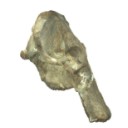
The earliest cetaceans are found in the early Eocene of Indo-Pakistan. By the late middle to late Eocene, the group colonized most oceans of the planet. This late Eocene worldwide distribution clearly indicates that their dispersal took place during the middle Eocene (Lutetian). We report here the first discovery of a protocetid fossil from middle Eocene deposits of Senegal (West Africa). The Lutetian cetacean specimen from Senegal is a partial left innominate. Its overall form and proportions, particularly the well-formed lunate surface with a deep and narrow acetabular notch, and the complete absence of pachyostosis and osteosclerosis, mark it as a probable middle Eocene protocetid cetacean. Its size corresponds to the newly described Togocetus traversei from the Lutetian deposits of Togo. However, no innominate is known for the Togolese protocetid, which precludes any direct comparison between the two West African sites. The Senegalese innominate documents a new early occurrence of this marine group in West Africa and supports an early dispersal of these aquatic mammals by the middle Eocene.
PV article infos
Published in Vol.38-2 (2014)
|
PDF
|
|
Terrestrial vertebrate paleocommunities from the Cerro del Pueblo Formation (Late Cretaceous; Late Campanian) at Las Aguilas, Coahuila, Mexico
Published online: 7/16/19
Keywords:
Campanian; Coahuila; dinosaurs; Mexico.; Vertebrates
https://doi.org/10.18563/pv.42.2.e1
Abstract
The Las Águilas site near Porvenir de Jalpa, Coahuila, Mexico, is extremely rich in tetrapod remains comprising both bones and trackways of several dinosaur taxa of late Campanian age. Within a 50 m thick section we identified at least nine layers with dinosaur bone assemblages. In one of these the dinosaur bones are associated with remnants of eusuchian crocodilians, turtles, plesiosaurs, pterosaurs, tyrannosaurids, dromaeosaurids, parksosaurid, hadrosaurids, ceratopsids, and ankylosaurs. This layer is also rich in coprolites of turtles, crocodilians and likely theropods, thus providing evidence for the wealth of Late Cretaceous vertebrate life in the area.
PV article infos
Published in Vol 42-2 (2019)
|
PDF
|
|
Critical comments on the genus Propachynolophus Lemoine, 1891 (Mammalia, Perissodactyla, Equoidea)
Published online: 9/27/17
Keywords:
Eocene; Eurohippus; Pachynolophus; Propalaeotherium; tooth morphology
https://doi.org/10.18563/pv.41.1.e3
Abstract
Abstract
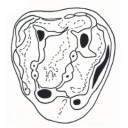
The validity of Propachynolophus Lemoine, 1891, supposedly an intermediate between Hyracotherium Owen, 1841 and Pachynolophus Pomel, 1847, has been questioned for a long time. A detailed analysis of features on which this genus is based further supported by a formal cladistic analysis demonstrates that Propachynolophus is not a valid taxon. The type species, “Propachynolophus gaudryi Lemoine, 1891” shall be assigned to Propalaeotherium Gervais, 1849, under the new combination Propalaeotherium gaudryi (Lemoine, 1891). “Pachynolophus maldani Lemoine, 1878”, later assigned to Propachynolophus, typifies the new genus Orolophus, under the binomen Orolophus maldani (Lemoine, 1878). The other referred species, “Propachynolophus levei Hooker, 1994” and “P. remyi Checa-Soler, 1997” are poorly documented, and both species shall be provisionally referred to as “Hyracotherium” levei (Hooker, 1994) and “Hyracotherium” remyi (Checa-Soler, 1997), pending new discoveries.
PV article infos
Published in Vol 41-1 (2018)
|
PDF
S.I. Data
|
|
Autopsie d’une radiation adaptative : Phylogénie des Theridomorpha, rongeurs endémiques du Paléogène d’Europe - histoire, dynamique évolutive et intérêt biochronologique
Published online: 12/15/16
Keywords:
Diversification; Extinction; Paléoenvironnements; Rodentia; Theridomyoidea
https://doi.org/10.18563/pv.40.3.e1
Abstract
Résumé :
L’étude des rongeurs Theridomorpha permet de suivre le déroulement d’une radiation adaptative pendant toute sa durée (Eocène moyen-Oligocène terminal), sur un territoire restreint à l’extrémité ouest de l’Europe Occidentale. Dans ce papier, la phylogénie de ce groupe est établie à partir d’une analyse cladistique reposant sur l’examen de 315 caractères (310 dentaires). Le groupe d’intérêt comprend 110 des 132 espèces (24 genres) de Theridomyoidea et deux genres encore inclus jusqu’ici dans les Reithroparamyinae qui rejoignent les Theridomorpha. Les groupes externes comprennent des Glires basaux, Cocomys, Tanquammys et 16 Ischyromyiformes. Un cadre phylogénétique robuste est produit, qui permet de clarifier la systématique des Theridomorpha. La position des Remyoidea (nov. sup.fam.) au sein des Ischyromyiformes, extérieure aux Theridomorpha, est confortée. Les Protadelomys et Tardenomys sont à la base des Theridomyoidea, avant la séparation en deux clades correspondant aux familles Pseudosciuridae et Theridomyidae. Les sous-familles sont consolidées : Pseudosciurinae et Sciuroidinae pour les Pseudosciuridae ; Issiodoromyinae, Oltinomyinae, Columbomyinae, Theridomyinae, auxquelles s’ajoute au moins une nouvelle sous-famille (Patriotheridomyinae), pour les Theridomyidae. La topologie des chrono-espèces (sensu Simpson), traitées antérieurement comme lignées évolutives, apparaît dans la plupart des cas sous forme de clades successifs dans lesquels les espèces sont le plus souvent arrangées de manière pectinée, émergeant dans l’ordre stratigraphique. L’analyse des caractères aux principaux nœuds permet de consolider les caractères diagnostiques des taxons et les tendances évolutives, ainsi que de discuter des divers parallélismes et convergences dans l’évolution des structures et patrons dentaires (e.g., émail des incisives unisérié chez les Issiodoromyinae et les Patriotheridomyinae, ou pseudo-multisérié chez les Blainvillimys les plus hypsodontes, les Protechimys et Archaeomys ; patrons dentaires téniodontes ; allongement des dents déciduales chez les Patriotheridomyinae, Issiodoromyinae et Theridomyidae ; sélénodontie ou lophodontie). Les dynamiques évolutives traduites par les changements morphologiques sont mises en relation avec les variations environnementales. Enfin, les implications biochronologiques de l’évolution des Theridomyoidea sont discutées.
Abstract:
The adaptive radiation of the rodents Theridomorpha occurred during a limited time window (middle Eocene to late Oligocene), on an area restricted to Western Europe. In this paper, the phylogeny of this group is established via a cladistic assessment of 315 morphological characters (310 dental). The group of interest encompasses 110 upon 132 species (24 genera) of Theridomyoidea, and two genera formerly included within the Reithroparamyinae, and which are included here within the Theridomorpha. The outgroups include basal Glires, Cocomys, Tanquammys and 16 Ischyromyiformes. A robust phylogenetic frame is produced, which allows clarifying the systematics of the Theridomorpha. Within the Ischyromyiformes, the Remyoidea (nov. supfam.) are set apart from the Theridomorpha. Protadelomys and Tardenomys represent the earliest offshoots of the Theridomyoidea, before the dichotomy between Pseudosciuridae and Theridomyidae. It supports the former subfamilies Pseudosciurinae and Sciuroidinae within the Pseudosciuridae; and for the Theridomyidae: the Issiodoromyinae, Oltinomyinae, Columbomyinae, Theridomyinae, with at least one new subfamily (Patriotheridomyinae). The topologies of the chronospecies (sensu Simpson), formerly considered as evolutionary lineages, appear in most cases as successive clades, in which the species are generally pectinately arranged and emerging in the stratigraphic order. The analysis of characters supporting the main nodes allow consolidating the diagnosic characters of the taxa and their evolutionary trends, as well as discussing the various cases of parallelism and convergence in the evolution of structures and dental patterns (e.g., uniserial incisor enamel for Issiodoromyinae and Patriotheridomyinae, or pseudo-multiserial for the most hypsodont Blainvillimys, Protechimys and Archaeomys; taeniodont dental patterns; lengthening of deciduous premolars for Patriotheridomyinae, Issiodoromyinae and Theridomyidae; selenodonty or lophodonty).
Evolutionary dynamics are analysed with respect to environmental changes. Finally, biochronological implications of the evolution of Theridomyoidea are discussed.
PV article infos
Published in Vol 40-3 (2016)
|
PDF
S.I. Data
|
|
Révision systématique des Anchilophini (Palaeotheriidae, Perissodactyla, Mammalia).
Published online: 10/15/12
Keywords:
Anchilophus; Eocene; new genus; new species; Palaeotheriidae; Paranchilophus; Perissodactyla; Systematics
https://doi.org/10.18563/pv.37.1-3.1-165
Abstract
The knowledge of the Anchilophini has been lately renewed by the discovery of a rather large amount of new material still largely unpublished. This new material offers the opportunity of a systematic revision of this tribe gathering those of European Eocene Equoidea which bear no mesostyle on upper check teeth and display a heavy trend to the molarization of premolars.
A cladistic analysis has made out two genera, Anchilophus (Paranchilophus included as a subgenus), characterized by a marked lophodonty and the transverse narrowness of the cheek teeth, a rather high hypsodonty, the frequent occurrence of "crochets" and "anticrochets" on the superior ones, and a rather weak molarization of the premolars, opposite to Metanchilophus n. gen. whose cheek teeth are more transversally elongated, less high, less lophodont, with cusps better distinct, enamel thicker and premolars more molarized on the whole.
Three species of Anchilophus are recognized, A. desmaresti, type species of the genus, A. (Paranchilophus) remyi and A. (Paranchilophus) jeanteli n. sp.
The genus Metanchilophus is more diversified with the species dumasi, radegondensis, gaudini (whose a new sub-species M. g. fontensis is defined), depereli, castrensis n. sp. and chaubeti n. sp.
The skull anatomy has been moreover described with several taxa; it brings to light (for all that one can generalize) that Anchilophini were light animals with a slender and elongated snout, a thin zygomatic arch, a rather developed encephalon with an advanced gyrencephaly.
The structure of the nasal opening together with the occurrence of epitympanic sinuses and the molarizing process of the premolars corroborate the attribution of this tribe to the family PalaeotheIiidae.
PV article infos
Published in Vol. 37, Fasc. 1-3 (2012)
|
PDF
|
|
The digital endocast of Necrolemur antiquus
Published online: 7/24/20
Keywords:
brain evolution; Eocene; Omomyiforms; Primates
https://doi.org/10.18563/pv.43.2.e1
Abstract
The study of endocasts, or casts of the endocranial space, have played an important role in shaping understanding of mammalian, and particularly primate, brain evolution. Recently, the reconstructions of three-dimensional virtual endocasts from high-resolution computed tomography images have allowed for the visualization and quantification of endocasts in several Paleocene and Eocene primate species. Here we present the virtual endocast of MaPhQ 289 (informally known as the Montauban 9 skull), a specimen of Necrolemur antiquus Filhol 1873, a middle to late Eocene European primate of the family Microchoeridae. The virtual endocast of MaPhQ 289 reveals a lissencephalic surface morphology with expanded temporal poles and minimal overlap of the cerebellum or olfactory bulb by the cerebrum, which closely resembles the morphology of the endocast of its contemporary relative, Microchoerus erinaceus (Primates, Microchoeridae). MaPhQ 289 yields an endocranial volume (ECV) of 2.36 cm3, about 60% smaller than the volume of the most commonly cited ECV of N. antiquus. Thus, the size of the brain of N. antiquus relative to its body size is likely to be smaller than has been reported in previous literature, highlighting the importance of corroborating older ECV estimates with new evidence using 3-D imaging techniques.
PV article infos
Published in 43-2 (2020)
|
PDF
|
|
A new species of hippopotamine (Cetartiodactyla, Hippopotamidae) from the late Miocene Baynunah Formation, Abu Dhabi, United Arab Emirates
Published online: 4/7/17
Keywords:
Arab Peninsula; Hippopotamidae; Hippopotamine event; Systematics
https://doi.org/10.18563/pv.41.1.e2
Abstract
The discovery of new hippopotamid material from the late Miocene Baynunah Formation (Abu Dhabi, United Arab Emirates) has prompted the revision of the existing material of this as yet unnamed fossil taxon. The Baynunah hippopotamid appears to be distinct from all other contemporary and later species in having a relatively more elongate symphysis, a feature similar to the earlier (and more primitive) Kenyapotamus. Yet, the Baynunah hippopotamid presents a dentition typical of the Hippopotaminae. It is therefore a distinct species attributed to the later subfamily, described and named in this contribution. This species provides further evidence for a ca. 8 Ma evolutionary event (termed “Hippopotamine Event”) that initiated the spread and ecological significance of the Hippopotaminae into wet habitats across Africa and Eurasia. The morphological affinities of the new species from Abu Dhabi suggest that the Arabian Peninsula was not a dispersal route from Africa toward southern Asia for the Hippopotamidae at ca. 7.5 Ma to 6.5 Ma.
PV article infos
Published in Vol 41-1 (2018)
|
PDF
S.I. Data
|
|
A new species of Propalaeotherium (Palaeotheriidae, Perissodactyla, Mammalia) from the Middle Eocene locality of Aumelas (Hérault, France).
Published online: 5/24/16
Keywords:
Eocene; new species; Palaeotheriidae; Propalaeotherium
https://doi.org/10.18563/pv.40.2.e1
Abstract
A new Propalaeotherium species, clearly distinct from the genus Eurohippus, is described. It is characterized by having a similar size as P. voigti from the German Geiseltal localities (MP 11 to MP 13 reference-level), but differs in several features suggesting a slighty more derived morphology. It presents indeed less brachyodont crowns with less prominent and less elevated cingula, slightly larger relative surface of premolars, and a more marked metaconid splitting on cheek teeth. This new species is unknown from other European localities except the nearby Saint-Martin de Londres locality which has been considered older than the MP 13 level.
PV article infos
Published in Vol.40-2 (2016)
|
PDF
S.I. Data
|
|
Morphological description and identification of an extraordinary new elephant cranium from the early Pliocene of Ileret, Kenya
Published online: 10/21/21
Keywords:
Elephantidae; Loxodonta adaurora; cranium; early Pliocene; Ileret; Kenya
https://doi.org/10.18563/pv.44.2.e3
Abstract
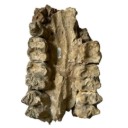
Abstract: Paleontological exploration in the Turkana Basin near Ileret, Kenya yielded the most complete adult elephant cranium (KNM-ER 63642) known from the late Miocene to mid-Pliocene. KNM-ER 63642 derives from the lower Lonyumun Mb. of the Koobi Fora Fm. and dates to the early Pliocene, >4.3 Ma. The cranium is immense in size and preserves most of its structures including left and right M2-3, permitting its comprehensive comparative study and secure taxonomic assignment to Loxodonta adaurora. Features distinctive of the species and exhibited by KNM-ER 63642 include very elongate, divergent tusk alveoli, a short, biconvex cranial roof, anterosuperior angulation of the occipital planum, non-inflated occipital planum and absence of supralateral parietal "bossing," broad, flat premaxillary nasal processes, broad, laterally downturned nasal aperture superior to the level of the orbits, and M3s with wide, subhypsodont plates that are parallel-faced and separated by U-shaped transverse valleys. The M3s also exhibit characteristic L. adaurora traits of greatest width at their bases, rounded cross-sectional shape, thick enamel, abundant cementum, and strong anterior and posterior accessory conules. Of extant taxa, KNM-ER 63642 most closely resembles crania of African elephants. Its inclusion in the Loxodonta clade is tenuous, however, because shared features are either symplesiomorphic or are difficult to test for synapomorphy due to the poor fossil record of crania of late Miocene-early Pliocene elephants. Overall, the cranial morphology of KNM-ER 63642 is unexpectedly advanced for an elephant of its antiquity. Its anteroposterior compression and height are concordant with efficient proal masticatory action, indicating that by the early Pliocene L. adaurora evolved craniodental adaptations in phase with feeding preference for C4 grasses. The advantage of synchrony of morphology and behavior is reflected by the dominance of the species in the greater Turkana Basin during that interval.
PV article infos
Published in 44-2 (2021)
|
PDF
|
|
Evolution de la lignée Megacricetodon collongensis-Megacricetotodon roussillonensis (Cricetidae, Rodentia, mammalia) au cours du Midocène inférieur et moyen dans le Sud de la France.
Published online: 6/14/95
Keywords:
Cricetids rodents; Evolutionary lineage; Lower and Middle Miocene; Mammalian biochronology; Megacricetodon new species; Southern France
Abstract
New populations of the genus Megacricetodon have recently been discovered in Southern France.Two new species are defined: M. lemartineli n. sp. and M. fournasi n. sp., their stages of evolution are intermediate between those of M. gersii and M. roussillonensis. Morphological and biometrical analysis indicate the presence of only one lineage: M. collongensis--M. collongensis-gersii--M. gersii--M.lemartineli nov. sp.--M. fournasi nov. sp. and M. roussillonensis. This observation allows to refine the chronology based on rodents, for the Late Early Miocene and the Middle Miocene in the Southern France.
Comparisons with some iberian species are done. The validity of the French species M. bezianensis and M. bourgeoisi is discussed.
PV article infos
Published in Vol. 24, Fasc. 1-2 (1995)
|
PDF
|
|
New Late Miocene plecotine bats (Chiroptera, Vespertilionidae: Plecotini) from Gritsev, Ukraine
Published online: 3/7/19
Keywords:
Barbastella; bats; late Neogene; Mammalia; Plecotus
https://doi.org/10.18563/pv.42.1.e2
Abstract
The Late Miocene site of Gritsev (MN 9, Ukraine) has yielded a very rich bat fauna, the remains of which are well preserved. Compared to other Neogene bat assemblages of Europe, the Gritsev bat community is unique in preserving plecotine bats, which are rare from Neogene sites. Some peculiar and new bat species, including a large plecotin Otonycteris, already were described from the Gritsev mammal site. Here we report new records of small plecotin bats from Gritsev, including a new taxon, Barbastella maxima nov. sp. This is the earliest reliable fossil record of this genus and it differs from more recent species of Barbastella in being considerably larger. The evolutionary patterns in the odontology within the tribe Plecotini, supported by biostratigraphical distribution of fossil records of Plecotus are discussed. The morphological peculiarities of the new fossils of plecotine bats from Gritsev are discussed in connection with its possible taxonomical affinity.
PV article infos
Published in Vol 42-1 (2019)
|
PDF
|
|
Discovery of the most ancient Notidanodon tooth (Neoselachii: Hexanchiformes) in the Late Jurassic of New Zealand. New considerations on the systematics and range of the genus
Published online: 9/21/18
Keywords:
Chondrichthyes; Hexanchiformes; new genus; New Zealand; Tithonian
https://doi.org/10.18563/pv.42.1.e1
Abstract
This paper describes the first hexanchid tooth from the Tithonian (Late Jurassic) of New Zealand. For the moment, this tooth represents the earliest representative of the fossil genus Notidanodon in the world and one of the most ancient neoselachians in the Southern Hemisphere. Despite the perfect state of preservation of the unique tooth, the species is left in open nomenclature, pending the discovery of additional specimens. Few nominal species have been assigned to the genus Notidanodon. Four from Cretaceous deposits: N. antarcti Grande & Chatterjee, 1987, Notidanodon dentatus (Woodward, 1886), Notidanodon lanceolatus (Woodward, 1886), Notidanodon pectinatus (Agassiz, 1843) and only two from Paleocene: Notidanodon brotzeni Siverson, 1995, and Notidanodon loozi (Vincent, 1876). Considering the important morphological variations observed between some of these species, it seems obvious that the genus Notidanodon is not monophyletic and will need a revision in the future.
PV article infos
Published in Vol 42-1 (2019)
|
PDF
|
|
La poche à phosphate de Ste-Néboule (Lot) et sa faune de vertébres du Ludien Supérieur. 2- Amphibiens. Etude Preliminaire
Published online: 9/25/78
Keywords:
Eocene; Quercy Phosphorites
Abstract
The Caudata are known by two Salamandridae ; one of them is attributed to the genus Megalotriton. The Pelobatidae form the major part of the Anura ; a few bones indicate also the presence of Neobatrachia.
PV article infos
Published in Vol. 08, Fasc. 2-4 (1978)
|
PDF
|
|
Première occurrence d'un mégachiroptère ptéropodidé dans le Miocène moyen d'Europe (Gisement de Lo Fournas-II, Pyrénées-Orientales, France).
Published online: 10/31/86
Keywords:
Europe; First occurence; Megachiroptera; Middle Miocene; Teeth
Abstract
A lot of isolated teeth of a pteropodid fruit bat has been recently found within an assemblage of micromammals recovered from a karstic fissure filling named Lo Fournas-Il near the locality of Baixas (Pyrénées-Orientales, France). The fauna is Middle Miocene Serravallian age. The fossil fruit bat appears morphologically close to Rousettus; its size is that of a recent medium-sized fruit bat. While the fruit bats are very poorly known as fossils, this discovery shows that one of their recent types of dentitions was perfectly established by Middle Miocene times, and supports the presumed long geologic story of the suborder. One of the major invasions of the Old World fruit bats, supposed originated from SE Asia, reached up to Europe. A suborder unit is added to the miocene fauna of this continent.
PV article infos
Published in Vol. 16, Fasc. 3 (1986)
|
PDF
|
|
Analyse d'ouvrage: “J.J. THOMASON (Ed.): Functional morphology invertebrate paleontology (1995)”
Published online: 3/18/96
Keywords:
Book review; Functional morphology
Abstract
Functional morphology invertebrate paleontology, édité par Jeffrey J. THOMASON, 1995. Cambridge University Press, xi + 277 p. ISBN 0-521-44095-5, f. 45,00 ($ 69,95).
La morphologie fonctionnelle appliquée aux fossiles demeure un sujet à la fois passionnant et important. Passionnant, car elle s'adresse à des êtres disparus, aux combinaisons de caractères parfois inattendues et sans contrepartie chez les formes actuelles. Sujet important, car il faut, au delà de la constatation classique de l'adéquation de la forme des organes à leur fonction, expliquer l'origine des structures par évolution. L'évolution ou descendance avec modification, implique que les êtres vivants sont reliés les uns aux autres et qu'i! est possible de tenter à l'aide d'un raisonnement par inférence, la caractérisation des ancêtres en fonction des traits des formes auxquelles ils ont donné naissance. Mais il faut ajouter que par sa fonction, la structure relie immédiatement l'animal à son milieu puisqu'elle assure un rôle biologique.
PV article infos
Published in Vol. 25, Fasc. 1 (1996)
|
PDF
|
|
Late Campanian theropod trackways from Porvenir de Jalpa, Coahuila, Mexico
Published online: 11/29/17
Keywords:
Dinosaur tracks; Late Cretaceous; Mexico.; Tetanura; Theropod
https://doi.org/10.18563/pv.41.2.e1
Abstract
Confident attribution of bipedal tridactyl dinosaur tracks to theropods or ornithopods can be challenging. Here we describe trackways produced by tetanuran dinosaurs, previously attributed to hadrosaurs, from Coahuila State, northeastern Mexico. Multiple trackways headed in the same direction suggest gregarious behaviour in these late Campanian theropods.
PV article infos
Published in Vol 41-2 (2018)
|
PDF
|
|
Die Ohr-Region der Paulchoffatiidae (Multituberculata, Ober-Jura).
Published online: 11/15/88
Keywords:
Multituberculata; Ober-Jura; Paulchoffatiidae; Petrosum; Portugal
Abstract
The petrosal of the Paulchoffatiidae HAHN, 1969 is described and compared with that of younger multituberculates and of other Mesozoic mammals. The "Morrison petrosal", described by Prothero (1983), is also discussed; it probably belongs to the multituberculates. The reconstruction of the ventral side of the Paulchoffatiinae-skull, given by Hahn in 1987, is completed by addition of the otic and the occipital region.
PV article infos
Published in Vol. 18, Fasc. 3 (1988)
|
PDF
|
|
Revision of the family Cephalomyidae (Rodentia, Caviomorpha) and new cephalomyids from the early Miocene of Patagonia.
Published online: 7/30/01
Keywords:
Cephalomyidae; Lower Miocene; Patagonia; Rodentia; Soriamys; Systematics
Abstract
A new genus of hystricognath rodent with two new species, Soriamys gaimanensis and Soriamys ganganensis, from the Colhuehuapian Age (Early Miocene), Sarmiento Formation, of Patagonia is described. The first species comes from the south barranca of the valley of Rio Chubut, near Gaiman locality (Chubut Province). It is known through a great number of dental remains in different stages of wear. The teeth are protohypsodont, with cement in the principal valleys. P4 are simpler, more oval inoutline and without a differentiated hypocone-hypoflexus. Upper molars are pentalophodont in early stages of wear and become bilobated in middle and advanced stages; M3 have a temporary third posterior lobe due to the maintenance of the braquiflexus on the posterior wall of the tooth. Lower teeth have a completely asymrnetrical pattern in relation to the uppers. The molars are trilophodont, with only one complex crest in the trigonid composed of the fusion of the anterolophid and mesolophid. The dp4 have a derived pentalophodont pattern due to the loss or fusion of the mesolophid and the development of an accessory transverse crest between the anterolophid and metalophid. The second species is known through a complete skull and jaw and other skull fragments with the dentition, proceeding from Pampa de Gan Gan, Chubut province. Respect to the first species, the teeth are higher crowned, with an earlier occlusal simplification and a third posterior lobe of M3 more developed and persistent. The skull and jaws show many chinchilloid characters, such as jugal bone with an ascending process, concave palate, very prominent dorsal shelf of the masseteric fossa, nasolachrymal duct opened laterally on the maxillary and very developed lateral mandibular fossa. Moreover, Soriamys is closely related to Cephalomys by sharing a similar asymmetric dental pattern and other dental and mandibular characters. These two genera constitute a natural group, the Cephalomyidae, with peculiar dental characters, like the asymmetric pattem of the upper and lower teeth; Cephalomyopsis, and probably Litadontomys, can be considered part of this group. Scotamys and Perimys constitute a distinct lineage (the Neopiblemidae or Perimyidae), more closely related to the chinchillids. Many characters shared by cephalomyids, eocardiids and caviids suggest a closer affinity between the Chinchilloidea and the Cavioiidea as a whole. Abrocoma shows also an asymmetric dental pattern and other chinchilloid features that suggest some degree of relationship with the cephalomyids, still not well determined.
PV article infos
Published in Vol. 30, Fasc. 1-2 (2001)
|
PDF
|