|
Lower Paleogene crocodilians from Silveirinha, Portugal.
Published online: 15/10/2003
Keywords:
?Upper Paleocene / Lowermost Eocene; Crocodilians; Ecology; Portugal
https://doi.org/10.18563/pv.32.1.1-26
Abstract
The presence at Silveirinha of one of the earliest, ? Late Paleocene or Lowermost Eocene, european representatives of the genus Diplocynodon is based mostly on isolated bones and teeth (often from juveniles). This small-sized form is the only crocodilian so far recognized in this site. The longevity of Diplocynodon in Portugal becomes much extended; the genus survived there until the Middle Miocene at least. A discussion on the possible affinities with other eocene Díplocynodon and especially those from Cubillos-Valdegallina (Zamora, Spain) is presented. On the other hand, differences have been detected in comparison with: Díplocynodon tormis, from the middle Eocene of the Douro basin in Spain, which may belong to another phyletic line; and the aff. Diplocynodon from Dormaal (Belgium) and Le Quesnoy (France), nearly contemporaneous of Silveirinha. The Silveirinha Diplocynodon and many other data strongly suggest moist, subtropical, quite limited in space environments related to an alluvial plain crossed by small, meandering channels.
PV article infos
Published in Vol. 32, Fasc. 1 (2003)
|
PDF
|

|
Revision of the family Cephalomyidae (Rodentia, Caviomorpha) and new cephalomyids from the early Miocene of Patagonia.
Published online: 30/07/2001
Keywords:
Cephalomyidae; Lower Miocene; Patagonia; Rodentia; Soriamys; Systematics
https://doi.org/10.18563/pv.30.1-2.51-88
Abstract
A new genus of hystricognath rodent with two new species, Soriamys gaimanensis and Soriamys ganganensis, from the Colhuehuapian Age (Early Miocene), Sarmiento Formation, of Patagonia is described. The first species comes from the south barranca of the valley of Rio Chubut, near Gaiman locality (Chubut Province). It is known through a great number of dental remains in different stages of wear. The teeth are protohypsodont, with cement in the principal valleys. P4 are simpler, more oval inoutline and without a differentiated hypocone-hypoflexus. Upper molars are pentalophodont in early stages of wear and become bilobated in middle and advanced stages; M3 have a temporary third posterior lobe due to the maintenance of the braquiflexus on the posterior wall of the tooth. Lower teeth have a completely asymrnetrical pattern in relation to the uppers. The molars are trilophodont, with only one complex crest in the trigonid composed of the fusion of the anterolophid and mesolophid. The dp4 have a derived pentalophodont pattern due to the loss or fusion of the mesolophid and the development of an accessory transverse crest between the anterolophid and metalophid. The second species is known through a complete skull and jaw and other skull fragments with the dentition, proceeding from Pampa de Gan Gan, Chubut province. Respect to the first species, the teeth are higher crowned, with an earlier occlusal simplification and a third posterior lobe of M3 more developed and persistent. The skull and jaws show many chinchilloid characters, such as jugal bone with an ascending process, concave palate, very prominent dorsal shelf of the masseteric fossa, nasolachrymal duct opened laterally on the maxillary and very developed lateral mandibular fossa. Moreover, Soriamys is closely related to Cephalomys by sharing a similar asymmetric dental pattern and other dental and mandibular characters. These two genera constitute a natural group, the Cephalomyidae, with peculiar dental characters, like the asymmetric pattem of the upper and lower teeth; Cephalomyopsis, and probably Litadontomys, can be considered part of this group. Scotamys and Perimys constitute a distinct lineage (the Neopiblemidae or Perimyidae), more closely related to the chinchillids. Many characters shared by cephalomyids, eocardiids and caviids suggest a closer affinity between the Chinchilloidea and the Cavioiidea as a whole. Abrocoma shows also an asymmetric dental pattern and other chinchilloid features that suggest some degree of relationship with the cephalomyids, still not well determined.
PV article infos
Published in Vol. 30, Fasc. 1-2 (2001)
|
PDF
|

|
Introduction à l'oeuvre scientifique de Donald E. Russell, "gentleman paleontologist"
Published online: 16/12/1996
Keywords:
D.E.Russell; Eocene; Mammals; Paleocene; Paleontology; synthesis
https://doi.org/10.18563/pv.25.2-4.63-74
Abstract
The scientific career of D.E. Russell began with a Pliocene fauna from Oregon, and then turned in the direction of European Paleogene mammals. Field work followed by study of the mammals that were collected, firstly in the Paleocene and later in the early Eocene, greatly rejuvenated learning in this field. Syntheses on the Northwest European Tertiary basin and on European marnmals and stratigraphy came next. Research on the Eocene of Asia was carried out jointly with Gingerich on Pakistan and with Dashzeveg on the faunas of Mongolia. An important synthesis on the entire Paleogene of Asia, joint with Zhai, followed. Field work in Africa with Sigogneau-Russell led to the discovery of Mesozoic mammals there. A synthesis of mammalian paleofaunas of the world was written with Savage, and a similar synthesis of Cenozoic vertebrate faunas is currently being prepared. These achievements reflect the perennial importance of field work, numerous collaborations with both amateurs and professionals, and the human qualities of this author.
PV article infos
Published in Vol. 25, Fasc. 2-4 (1996)
|
PDF
|
|
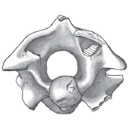
Fossil snakes from the Palaeocene of São José de Itaboraí, Brazil Part III. Ungaliophiinae, Booids incertae sedis, and Caenophidia. Summary, update and discussion of the snake fauna from the locality
Published online: 16/12/2008
Keywords:
booid-grade incertae sedis; Brazil; Caenophidia; New taxa; Palaeocene; Russellophiidae; Snakes; tropidophiids; Ungaliophiinae
https://doi.org/10.18563/pv.36.1-4.37-73
Abstract
Aside from Madtsoiidae, anilioids, and Boidae that were studied previously, the middle Palaeocene of ltaborai (BraziI) has produced Ungaliophiinae ("tropidophiids"), booid-grade snakes incertae sedis, and a possible Russellophiidae (Caenophidia) that are described in the present article. This article is the third and final report on the snakes from the locality. The Ungaliophiinae (Paraungaliophis pricei gen. et sp. nov.) are rare whereas the booid-grade snakes incertae sedis (ltaboraiophis depressus gen. et sp. nov., Paulacoutophis perplexus gen. et sp. nov.) are more frequent. A single vertebra is referred to the Russellophiidae (Caenophidia) with reservation. An update of the whole fauna of snakes from ltaborai is provided. Hechtophis austrinus that was tentatively referred to the erycine Boidae is now regarded as a Boidae incertae sedis. Most snakes from Itaborai are known only from the locality. Astonishingly, only the ailioids Coniophis cf. C. precedens gives possible evidence of interchanges between South and North America. The fauna of snakes from Itaborai, as well as the other Palaeocene faunas of snakes from South America are distinct from those of the Cretaceous and the Eocene of South America; they appear to be more different from the Cretaceous faunas than from those of the Eocene. The fauna from Itaborai is the richest and most diverse assemblage of snakes from the Palaeocene worldwide; it shares only a few taxa with other Palaeocene localities.
PV article infos
Published in Vol. 36, Fasc. 1-4 (2008)
|
PDF
|

|
La poche à phosphate de Sainte-Néboule (Lot) et sa faune de vertébrés du Ludien supérieur. 13-Rongeurs
Published online: 25/09/1978
Keywords:
Eocene; Quercy Phosphorites
https://doi.org/10.18563/pv.8.2-4.313-318
Abstract
Sainte-Néboule has yielded only 4 species of Rodents. But the Theridomyids (Blainvillimys rotundidens and Patriotheridomys altus) are very significative of the age of the locality: Ste-Néboule is lower than the marker level of Escamps
PV article infos
Published in Vol. 08, Fasc. 2-4 (1978)
|
PDF
|

|
La variabilité morphologique dentaire du Landenodon (Condylarthra) de Dormaal, (Eocène,Belgique)
Published online: 01/10/1980
Keywords:
Condylarths; Dormaal; Early Eocene; Landenodon
https://doi.org/10.18563/pv.9.ext.167-196
Abstract
The study of dental variations in Landenodon from Dormaal (early Eocene, Belgium) shows that only one
species is present in this locality : L. woutersi QUINET, 1968 (Condylarthra, Arctocyonidae, Arctocyoninae). A high morphological variability is described, especially concerning the metaconid of P/4, the paraconid of M/2, and some characters of M1/ which have been found to be independant of each other. This variability is discussed.
PV article infos
Published in Vol. 9, Ext (1980)
|
PDF
|

|
Pairomys et Ectropomys : la fin d'une ambiguïté ; mise au point sur les Oltinomyinae et Remyinae (Rodenia, Theridomyidae).
Published online: 20/05/1994
Keywords:
PHYLOGENY; taxonomy; Theridomyidae; Upper Eocene
https://doi.org/10.18563/pv.23.1-4.119-152
Abstract
The description of new material of the Upper Eoœne of France, Southem Germany and Spain together with the restudy of the material described by Thaler (1966b) as Pairomys allows to confirm the validity of the genus Ectropomys up to know controversally discussed. As a consequence the subfamily Remyinae and Oltinomyinae can be defined precisely. The study of the dental characters shows that the Remyinae in fact belong to the Theridomyidae and represent a derived evolutionary unit within this family. The Oltinomyinae together with the Theridomyinae and Issiodoromyinae very probably form a monophyletic unit.
PV article infos
Published in Vol. 23, Fasc. 1-4 (1994)
|
PDF
|

|
Contributions à l'étude du gisement miocène supérieur de Montredon (Hérault). Les grands mammifères. Avant propos.
Published online: 15/11/1988
Keywords:
Editorial; Mammalia; Montredon; Upper Miocene
https://doi.org/10.18563/pv.18.ext.1-2
Abstract
Le Mémoire Extraordinaire 1988 de PALAEOVERTEBRATA regroupe dix articles consacrés au gisement à mammifères du Miocène supérieur de Montredon (Hérault), connu et classique depuis la fin du siècle dernier, et auquel est lié le nom du savant paléontologue lyonnais Charles Depéret.
Cette monographie vient normalement à la suite de celle parue en 1982 dans PALAEOVERTEBRATA, dont les différents articles traitaient de la stratigraphie du gisement, et faisaient l'étude des différents groupes de micromammifères représentés dans la faune (insectivores, chiroptères, rongeurs).
View editorial
Published in Vol. 18, Ext (1988)
|
PDF
|

|
Mode de vie et affinités de Paschatherium (Condylarthra, Hyopsopontidae) d'après ses os du tarse
Published online: 16/12/1996
Keywords:
Astragalus; Calcaneum; Condylarthra; Eocene; Functional morphology; Paschatherium; PHYLOGENY
https://doi.org/10.18563/pv.25.2-4.225-242
Abstract
Tarsals that can be confidently attributed to Paschatheríum dolloi from Dormaal (Belgium) are described. The astragalus is short; its broad neck is set at an angle of 30 degrees to the trochlea. The trochlea is pulley-shaped and proximally extended. There is no astragalar foramen. The medial tibial facet extends distally in a cup deeply excavated in the neck and buttressed. The sustentacular facet extends toward the navicular facet but is not fully confluent with it. The calcaneum bears a proximo-distally extended proximal facet for the astragalus. A relatively large peroneal tubercle projects from the body, and is situated distally. Functionally, the trochlea indicates extensive flexion-extension movements of the foot. Calcaneo-astragalar facets indicate sliding and rotation between the two tarsals. The inclination of the navicular facet suggests frequent foot inversion. The peroneal tubercle reflects good muscular capacities for foot rotation. Overall morphology is interpreted as a scansorial adaptation similar to that of sciurids.Comparisons are made with the tarsals of Macrocranion vandebroeki from Dormaal and Hyopsodus paulus from the Bridgerian of Wyoming. Some similarities between the astragali of Paschatherium and Macrocraníon (trochlea) are interpreted as convergences for rapid locomotion. However absence of mobility at the lower ankle and midtarsal joints in M. vandebroekzi suggests that this species was cursorial, as is known for M. tenerum from Messel. Similarities in the calcanea of Paschatherium and Hyopsodus are probably the result of close phylogenetic relations, and confirm the placement of Paschatherium in the hyopsodontids. The differences in the calcanea of Paschatherium and Macrocranion underline that Paschatherium is distinct from erinaceomorph insectivores. The differences in astragalar morphology between Paschatherium and Hyopsodus show that a marked adaptive divergence separates the two genera. We speculate about the common occurrence of a deep tibial cup (“cotylar fossa”) and a pulley-shaped trochlea in Paschatherium and hyracoids, suggesting that an adaptive scenario similar to that having led to Paschatherium (scansoriality) might explain the acquisition of the peculiar hyracoid tarsal characters; such a scenario contradicts the concept of Pantomesaxonia. Other peculiar characters of Hyopsodus suggest that hyopsodontids might be given more consideration in the search for hyracoid (and tethythere) origins.
PV article infos
Published in Vol. 25, Fasc. 2-4 (1996)
|
PDF
|

|
Fossil snakes from the Palaeocene of Sao José de Itaborai, Brazil, Part II. Boidae
Published online: 28/12/2001
Keywords:
Boidae; Boinae; Brazil; Erycinae; New taxa; Palaeocene; Snakes
https://doi.org/10.18563/pv.30.3-4.111.150
Abstract
The middle Palaeocene of São José de ltaboraí (State of Rio de Janeiro, Brazil) has produced a rich and diverse fauna of boid snakes. It comprises six or seven species: Hechtophis austrinus gen. et sp. nov., Corallus priscus sp. nov., Waincophís pressulus sp. nov., Waincophis cameratus sp. nov.,"Boinae A", and "Boinae B". Moreover, two dentaries might pertain to either H. austrinus or "Boinae B", or even represent a distinct taxon. Hechtophis austrinus is assigned, with reservation, to the Erycinae. All other taxa are referred to the Boinae. The vertebrae of all taxa have paracotylar foramina, which raises the problem of the apomorphic or plesiomorphic nature of this feature. This fauna also raises the question of the presence of extinct erycine boids in South America, but it does not allow this question to be settled.
PV article infos
Published in Vol. 30, Fasc. 3-4 (2001)
|
PDF
|

|
Multituberculate endocranial casts
Published online: 30/06/1983
Keywords:
Allotheria; Cretaceous; endocranial cast; Mongolia; multituberculates
https://doi.org/10.18563/pv.13.1-2.1-12
Abstract
A reconstruction of a multituberculate endocranial cast is made on the basis of a complete natural cast prepared from the skull of Chulsanbaatar vulgaris, and other less complete endocasts, all from the Late Cretaceous of Mongolia. The multituberculate endocast is of mammalian pattern but it has retained a therapsid-like lateral profile with a deep rhombencephalon and a shallow telencephalon. It is characterized by: a heart-shaped cross-section of the telencephalon; an extensive lissencephalic neocortex; a very prominent pons placed far anteriorly; a lack of cerebellar hemispheres, and very large paraflocculi. Its structure, very different from the brains of other mammals, suggests thats the Multituberculata branched very early from the main mammalian stock. This supports Simpson's (1945) idea that the Multituberculata should be placed in a subclass of their own: Allotheria MARSH. The endocast and braincase structure show that the Multituberculata had strongly developed senses of smell and hearing. The encephalization quotient of approx. 0.55 evaluated for Ch. vulgaris is relatively high for a Mesozoic mammal.
PV article infos
Published in Vol. 13, Fasc. 1-2 (1983)
|
PDF
|
|
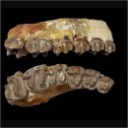
Les Périssodactyles (Mammalia) du gisement Bartonien supérieur de Robiac (Éocène moyen du Gard, Sud de la France)
Published online: 04/05/2015
Keywords:
Chasmotherium; new species; Palaeotheriidae; paleoenvironments
https://doi.org/10.18563/pv.39.1.e3
Abstract
We present here a new updated counting of the perissodactyls of Robiac, the type locality of the MP 16 level of the biochronological scale of paleogene mammals and that of the Robiacian stage of Eocene Land Mammals Ages in Western Europe.
The outcrop of Robiac consists actually of two 500m apart loci, Robiac-Nord and Robiac-Sud, considered of the same age according to the current discriminating power, and is dated from -38,7 MA after the last faunal, magnetostratigraphic and climatic calibrations.
It has yielded a very abundant and rich of 21 taxa perissodactyl fauna, topped by the giant Lophiodon lautricense, last representative of the family Lophiodontidae, of which it is the last proved deposit. The Palaeotheriidae are much diversified with 5 genera and 9 species of "Pachynolophinae", 3 genera and 10 species of Palaeotheriinae. Nine taxa have been defined from Robiac: Chasmotherium depereti n. sp., Palaeotherium castrense robiacense Franzen, 1968, the genus Leptolophus Remy, 1965 with the species L. stehlini Remy, 1965 and L. magnus Remy, 1998, Anchilophus (Paranchilophus) jeanteti Remy, 2012, Metanchilophus chaubeti Remy, 2012, Lophiotherium robiacense Depéret, 1917 and Pachynolophus gaytei n. sp.
The faunal Robiac cenogram with the associated flora testify to a hot, wet and forestal environment, likely corresponding to a short warming climatic phase; the broken up fossil bones should have been carried away and then gathered in swamp areas along the banks of a meandering river.
The swarm of mammals of Robiac, the richest of contemporaneous deposits, has been followed by a drastic drop in perissodactyl diversity at the MP 17A level; a crisis which could have originated in a renewal of the global Eocene cooling. Fons 4, the type-locality of this level, is largely scarcer in perissodactyls and its cenogram testifies to a less diversified fauna, with on the whole smaller species, that likely means a cooler and drier climatic environment; a new perissodactyl diversification occurred but later.
PV article infos
Published in Vol.39-1 (2015)
|
PDF
|
|
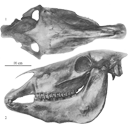
Old world hemiones and new world slender species (Mammalia, Equidae)
Published online: 16/12/2008
Keywords:
Amerhippus; biometry; Equus; Holocene; New World; Old World; Osteology; Pleistocene; Pliocene
https://doi.org/10.18563/pv.36.1-4.159-233
Abstract
Morphological and biometrical description of skulls, teeth, and limb bones of extant and fossil Old World herniones (including E. hydruntinus) and of New World 'stilt-Iegged' and other slender species from Blancan to Holocene. An Appendix presents ways in which the approximate size of some missing bones or dimensions may be deduced from available ones.
The discussed and/or illustrated fossils were found in Bolivia (Tarija), Canada (Yukon), China (Choukoutien, Gulongshan, Jiling, Loufangzi), Ecuador (Oil Fields), Ethiopia (Melka Kunturé), France (Lunel-Viel), Germany (Süssenborn), Greece (Agios Georgios, Petralona), Hungary (Dorog), Italy (Romanelli), Mexico (Cedazo, San Josecito), Mongolia (Sjara-osso-gol), Spain (Venta Micena), ex-Soviet Union (Akhalkalaki, Binagady, Chokurcha, Chukochya, Kabazi, Kolyma, Krestovka, Kurtak, Staroselie, Tologoj), USA (Alaska, Arkalon, Cedar Meadow, Channing, Conkling, Dry Mountains, Hay Springs, Leisey Shell Pit A, Lissie Formation, Natural Trap, Pool Branch, Powers Ranch, Rock Creek, San Diego, Santo Domingo, Seymour Formation, Shelter, Slaton, Trinity River). Numerous raw or statistically elaborated data are given in Tables.
There is no evidence for the existence of Old World hemiones in the New World nor of 'stilt-Iegged' equids in the Old World. The first 'stilt-Iegged' equid was found at Santo Domingo, New Mexico, and is believed to be Late Blancan. It was probably at the origin of E. calobatus (Arkalon, Rock Creek) and of the smaller E. semiplicatus (Channing, Rock Creek). Slender, but not 'stilt-Iegged', equids found at Natural Trap, Wyoming, ca. 12 ky ago belong to Amerhippus. AlI these species share with Oid World Sussemiones (and some hemiones) peculiar patterns on the lower cheek teeth.
The slender Equus sp. B of Leisey Pit A, Florida, ca. 1.2 Ma, as weIl as Amerhippus francisci and E. tau (probably a senior synonym of E. quinni) share conventional lower cheek teeth patterns. The skulls of A. francisci and E. tau, however, are quite different.
Paleontological data suggest a common origin of Amerhippus, Sussemiones, and 'stilt-Iegged' equids during the late Blancan. Old World hemiones seem to have differentiated later.
PV article infos
Published in Vol. 36, Fasc. 1-4 (2008)
|
PDF
|

|
Die Ohr-Region der Paulchoffatiidae (Multituberculata, Ober-Jura).
Published online: 15/11/1988
Keywords:
Multituberculata; Ober-Jura; Paulchoffatiidae; Petrosum; Portugal
https://doi.org/10.18563/pv.18.3.155-185
Abstract
The petrosal of the Paulchoffatiidae HAHN, 1969 is described and compared with that of younger multituberculates and of other Mesozoic mammals. The "Morrison petrosal", described by Prothero (1983), is also discussed; it probably belongs to the multituberculates. The reconstruction of the ventral side of the Paulchoffatiinae-skull, given by Hahn in 1987, is completed by addition of the otic and the occipital region.
PV article infos
Published in Vol. 18, Fasc. 3 (1988)
|
PDF
|

|
Contributions à l'étude du gisement Miocène supérieur de Montredon (Hérault). Les grands mammifères. 1 - Les Lagomorphes
Published online: 15/11/1988
Keywords:
Lagomorpha; Montredon; Prolagus; Upper Miocene
https://doi.org/10.18563/pv.18.ext.3-14
Abstract
A sample of 231 isolated teeth of lagomorphs from the upper Miocene of Montredon (southern France), identified as the ochotonid Prolagus crusafonii DOPEZ, 1975, is studied, comparing it with other populations of the same species as well as with its closest species P. oeningensis (KÖNIG, 1825).
The maintenance dining 5 m.y. of a high morphological variability in a group of non-selected features is interpreted as an evolutionary response. This may be related with the heterogeneity and probably too with the regression of the environment.
PV article infos
Published in Vol. 18, Ext (1988)
|
PDF
|

|
Nouvelles données sur les mammifères du Thanétien et de l'Yprésien du bassin d'Ouarzazate (Maroc) et leur contexte stratigraphique.
Published online: 15/12/1998
Keywords:
early Paleogene; magnetostratigraphy; Mammals; Morocco; North Africa; Ouarzazatz basin; Systematics
https://doi.org/10.18563/pv.27.3-4.155-202
Abstract
New faunal and stratigraphical data on the vertebrates localities from the early Paleogene of the Ouarzazate Basin (Adrar Mgorn 1, Adrar Mgorn 1 bis et N'Tagourt 2), Morocco, are presented. A magnetostratigraphical study, the first for such early Paleogene Arabo-African mammal localities, and the discovery of probable remains of the nannofossil Discoaster support the Thanetian age of the Adrar Mgorn 1 site. The magnetostratigraphy suggests a slightly later age than was thought for the Paleogene formations of the local series of Tinerhir and for the vertebrate localities: late or latest Thanetian for Adrar Mgorn 1 and Adrar Mgorn 1 bis, middle Ypresian for N'Tagourt 2. It also indicates a lower position of the KT boundary in the series. Two tons of matrix recovered in the vertebrate sites have vielded new data on the micromammals. A damaged lower molar from N'Tagourt 2 is referable to Khamsaconus bulbosus and supports the proboscidean affinities of this species and especially possible relationships with bunolophodont taxa such as elephantiforms. A lower molar from Adrar Mgorn 1 bis belongs to a new form which can be identified as a plesiadapiform or an euprimate close to Altiatlasius koulchii though significantly larger. A new material from Adrar Mgorn 1 illustrates a new dilambdodont adapisoriculid species which is referable to Garatherium : ?Garatherium todrae n. sp. Another species referred to Garatherium is known in the locality (?Garatherium n. sp.). Garatherium is a new lineage from the Ouarzazate basin which crosses the Paleocene-Eocene boundary together with Palaeoryctes, Didelphodontinae gen. and sp. 2, Todralestes, and Afrodon, and it is the first Paleocene-Eocene lineage identified outside of this basin (Garatheríum is based on a species from El Kohol, Algeria). Among the Paleocene-Eocene lineages from the Ouarzazate basin, it should be also mentioned a new possible carnassial form (carnivoran or creodont; Adrar Mgorn 1), and an upper molar of Cimolestes cf. incisus (Adrar Mgorn 1 bis). The upper molar THR 168 previously reported as from an indeterminate didelphodontine is here identified as the M1/ of Afrodon chleuhi. The micromammal faunas from the Ouarzazate basin are positioned in the global chronological framework of the mammal localities from the Paleogene of the Arabo-African domain.
PV article infos
Published in Vol. 27, Fasc. 3-4 (1998)
|
PDF
|

|
Historical and new perspectives on the parataxonomyof fossil eggs.
Published online: 15/12/2003
Keywords:
amniotic eggshells; Parataxonomy
https://doi.org/10.18563/pv.32.2-4.189-195
Abstract
A critical review on the literature about the parataxonomy of amniote eggshells reasserts the great interest of this systematics tool for the progress of dinosaur eggshell paleontology. However, shedding light on its limits, we propose to give up the use of the basic types - morphotypes key system.
PV article infos
Published in Vol. 32, Fasc. 2-4 (2003)
|
PDF
|

|
The evolution of the molar pattern of the Erethizontidae (Rodentia,Hystricognathi) and the validity of Parasteiromys Ameghino, 1904.
Published online: 15/06/1999
Keywords:
Argentina; Erethizontidae; Hystricognathi; Miocene; Molar evolution; Porcupines; Rodentia; Systematics
https://doi.org/10.18563/pv.28.1.53-73
Abstract
The genus Parasteiromys AMEGHINO, 1904 is revalidated, and P. friantae sp. nov. (Hystricognathi, Erethizontidae) from Colhuehuapian (early Miocene) sediments of the southern cliff of Colhue-Huapi Lake (Province of Chubut, Argentina), is described. The molar morphology of these taxa and of living porcupines adds new elements to understand the dental evolution of the Erethizontidae, and to propose the hypothetical ancestral molar pattern for this family. This pattern does not correspond to any of the morphologies traditionally proposed as ancestral for South American hystricognathous rodents. The proposed pattern is characterized by a metaloph disconnected from the posteroloph and oriented towards the hypocone, and the third loph incompletely developed with the lingual portion homologous to the mesolophule of Baluchimyinae (Chapattimyidae) from the Miocene of Pakistan. The inferred steps of the molar evolution of erethizontids towards the pentalophodont condition, considered derived for the family, are illustrated. This study strengthens the hypothesis placing erethizontids in a basal position among rodents of the suborder Hystricognathi.
PV article infos
Published in Vol. 28, Fasc. 1 (1999)
|
PDF
|

|
Arvicolinae (Rodentia) du Pliocène terminal et du quaternaire ancien de France et d'Espagne.
Published online: 30/10/1971
Keywords:
Arvicolinae; France; Pleistocene; Pliocene; Spain
https://doi.org/10.18563/pv.4.5.137-214
Abstract
Two steps can be distinguished in the history of the first invasion of western and south western Europe by the arvicolines. The first step corresponds to the installation of these rodents with the immigration of Promimonys inxuliferus Kowalski, then of Mimomys stehlini Kormos and of Mimomys gracilis (Kretzoi). The second is characterized by the establishment of a geographic differentiation in the arvicoline fauna between the south of France and Spain, from where are described new species of Mimomys (Mimamys cappettai, Mimomys septimanus, Mimonys medasensis), and the rest of France, where are found only elements already known from central Europe or England (Mimomys polonicus Kowalski, Mimomys pliocaenicus F. Major, Mimomys reidi Hinton, or forms very close to the latter). This geographic differentiation, which is very certainly the consequence of the division of Europe into distinct climatic provinces, one of them being the southern province comprising at least Spain and southern France, could result from a cladogenetic evolution of Mimomys stehlini and Mimomys gracilis after their immigration. The present work is also a contribution to the search for correlations between the diverse micromammal localities of the latest Pliocene (or early Villafranchian) and of the early Quaternary of Europe.
PV article infos
Published in Vol. 04, Fasc. 5 (1971)
|
PDF
|
|
New remains of the very small cuckoo, Chambicuculus pusillus (Aves, Cuculiformes, Cuculidae) from the late Early/early Middle Eocene of Djebel Chambi, Tunisia
Published online: 15/02/2016
Keywords:
Cuckoos; Eocene; Fossil bird
https://doi.org/10.18563/pv.40.1.e2
Abstract
Abstract: A very tiny cuckoo, Chambicuculus pusillus, was recently described after a few fragments of tarsometatarsi from the late Early/early Middle Eocene of Djebel Chambi, Tunisia. New remains, notably a coracoid, confirm the attribution of this genus to the recent family Cuculidae. This coracoid shows a very elongate and strap-like processus procoracoideus. This morphological feature is otherwise only known in the family Cuculidae. The characteristics of the coracoid and tarsometatarsi show that Chambicuculus is morphologically more advanced over the other stem cuculids described in Europe and North America. Chambicuculus is the oldest Cuculidae known so far.
PV article infos
Published in Vol.40-1 (2016)
|
PDF
|