|
Les mammifères post-glaciaires de Corse. Etude Archéozoologique.
Published online: 15/09/1989
Keywords:
Book review
https://doi.org/10.18563/pv.19.1.45-46
Abstract
Les Mammifères post-glaciaires de Corse de Jean-Denis Vigne, étudie l'évolution des mammifères en Corse depuis 7000 av. J.-C. jusqu'à aujourd'hui, en explorant leur adaptation insulaire, l'impact de l'homme sur leur extinction ou leur introduction, et les pratiques de chasse et d'élevage à travers l'analyse des ossements.
PV article infos
Published in Vol. 19, Fasc. 1 (1989)
|
PDF
|

|
Avant propos au "Premier catalogue des specimens-types Paléontologiques déposés dans les collections de l'Université de Montpellier II"
Published online: 20/12/1994
Keywords:
Editorial; Type specimens
https://doi.org/10.18563/pv.23.ext.1-2
Abstract
Avant propos au "Premier catalogue des specimens-types Paléontologiques déposés dans les collections de l'Université de Montpellier II".
View editorial
Published in Vol. 23, Ext (1994)
|
PDF
|

|
Nouvelles faunes de rongeurs de la fin Miocène inférieur en Provence. Implications géologiques et Paléogéographiques.
Published online: 01/09/1986
Keywords:
Biogeographic province; Biozonation; Correlation; Miocene; Palaeogeography; Rodentia
https://doi.org/10.18563/pv.16.2.77-126
Abstract
Rodents from the new localities of Châteauredon (Alpes-de-Haute-Provence) and La Denise (Bouches-du-Rhône) show more similarities with the rodents known from the Czecho-Slovak locality of Franzenbad than with the species found in contemporaneous Lower Miocene faunas located westward of the present Rhône Valley. This is another data wich support the existance of several biogeographical provinces in Southern France during Lower Miocene. The correlations which have been settled down allow new datations of several formations in Provence and give new information on the Aquitanian and Burdigalian paleogeographies of this region. More precise stratigraphical allocations are given to some other localities of Central Europe.
PV article infos
Published in Vol. 16, Fasc. 2 (1986)
|
PDF
|

|
Première occurrence d'un mégachiroptère ptéropodidé dans le Miocène moyen d'Europe (Gisement de Lo Fournas-II, Pyrénées-Orientales, France).
Published online: 31/10/1986
Keywords:
Europe; First occurence; Megachiroptera; Middle Miocene; Teeth
https://doi.org/10.18563/pv.16.3.173-184
Abstract
A lot of isolated teeth of a pteropodid fruit bat has been recently found within an assemblage of micromammals recovered from a karstic fissure filling named Lo Fournas-Il near the locality of Baixas (Pyrénées-Orientales, France). The fauna is Middle Miocene Serravallian age. The fossil fruit bat appears morphologically close to Rousettus; its size is that of a recent medium-sized fruit bat. While the fruit bats are very poorly known as fossils, this discovery shows that one of their recent types of dentitions was perfectly established by Middle Miocene times, and supports the presumed long geologic story of the suborder. One of the major invasions of the Old World fruit bats, supposed originated from SE Asia, reached up to Europe. A suborder unit is added to the miocene fauna of this continent.
PV article infos
Published in Vol. 16, Fasc. 3 (1986)
|
PDF
|

|
Les vertébres dévoniens de la Montagne Noire (Sud de la France) et leur apport à la phylogénie des pachyosteomorphes (Placodermes Arthrodires).
Published online: 15/05/1987
Keywords:
Devonian; Montagne Noire; New taxon; PHYLOGENY; Placoderms; Stratigraphy; Vertebrate
https://doi.org/10.18563/pv.17.1.1-26
Abstract
Several different taxa of jawed vertebrates are reported for the first time from the Devonian of south-eastern Montagne Noire, France. Besides some undeterminable fragments of placoderm fishes from the Pragian and Lower Emsian, the material from the Upper Devonian is mainly represented by Melanosteus occitanus gen. and sp. nov. (Frasnian) and Thoralodus cabrieri LEHMAN, 1952 ("Famennian"). The good state of preservation of Melanosteus allows a detailed anatomical study leading to a phylogenetic analysis of the selenosteid pachyosteomorphs.
PV article infos
Published in Vol. 17, Fasc. 1 (1987)
|
PDF
|

|
Equus caballus antunesi, nouvelle sous-espèce Quaternaire du Portugal
Published online: 30/10/1989
Keywords:
Equidae; Equus caballus; new subspecies; Perissodactyla; Portugal; Würm
https://doi.org/10.18563/pv.19.2.47-72
Abstract
Equus caballus antunesi, nova subspecies, was a hypsodont, slender, and rather small horse (around 141cm at the withers), with narrow hooves and protocones longer on P3/-P4/ than on M1/-M2/. It does not fit in any of the different "types" of Pleistocene caballine horses previously recognized but may be related to the horse from the Acheulean of Solana del Zamborino.
Hypsodonty, small size, slenderness, narrow hooves are all characters that can easily be related to ecological conditions. Equus caballus antunesi was probably a horse adapted to rather dry and cold conditions and to a hard ground. It does not seem related at all to the North-European Equus caballus germanicus-gallicus group.
PV article infos
Published in Vol. 19, Fasc. 2 (1989)
|
PDF
|

|
Mammifères nouveaux de l'Ilerdien des Corbières et du Minervois (Bas-Languedoc, France)
Published online: 04/12/1989
Keywords:
Bas-Languedoc; Early Eocene; France; Ilerdian; Mammals; New taxa
https://doi.org/10.18563/pv.19.3.161-167
Abstract
Four new taxa (two genera, one subgenus, and four species) conceming the orders Condylarthra, Rodentia, Pantolesta, and an undetermined order from middle and middle/upper Ilerdian localities (lower Ypresian) of the Corbières and Minervois regions (Bas-Languedoc, Southem France) are presented in this short paper
PV article infos
Published in Vol. 19, Fasc. 3 (1989)
|
PDF
|

|
Sur les Condylarthres Cernaysiens Tricuspiodon et Landenodon (Paléocène supérieur de France)
Published online: 01/10/1980
Keywords:
Arctocyonidae; Condylarths; Late Paleocene; Tricuspiodontidae
https://doi.org/10.18563/pv.9.ext.127-166
Abstract
The numerical importance of the Condylarths in the Cernaysian fauna is discussed. The Condylarth family, Tricuspiodontidae, is reviewed in the light of new material and its close relationships to the Phenacodontidae is suggested ; one new species is recognized : Tricuspiodon sobrinus. European Arctocyonidae are reviewed and the recentclassification of Van Valen is briefly commented on. Also, the arctocyonine Landenodon is described for the first time in Thanetian (Late Paleocene) sediments ; two new species are proposed : T. lavocati and T. phelizoni.
PV article infos
Published in Vol. 9, Ext (1980)
|
PDF
|

|
Le genre Microstonyx en Espagne et ses relations avec les autres espèces du même genre hors d'Espagne
Published online: 01/10/1980
Keywords:
Microstonyx; Spain; Suidae
https://doi.org/10.18563/pv.9.ext.213-231
Abstract
The genus Microstonyx was found only in the north eastern part of Spain : M. antiquus, referable to the
Eppelsheim type, from the pyrenean basins ; M. antiquus, more progresive, from the Vallès Basin : M. major-erymanthius group, from the Teruel-Ademuz Area and from Pieru (Penedès Basin).
PV article infos
Published in Vol. 9, Ext (1980)
|
PDF
|

|
Les Issiodoromyinae (Rodentia, Theridomyidae) de l'Eocène supérieur à l'Oligocène supérieur en Europe occidentale
Published online: 15/05/1976
Keywords:
climate; Faunal turnover; Paléogène
https://doi.org/10.18563/pv.7.1-2.1-115
Abstract
Based on material from 30 localities, morphologic dental, cranial and biometric analyses have permitted the characterization of two parallel Issiodoromyine lineages, and also the definition of diverse species representing several evolutive stages. Thus it is that new lineages complete the contribution made by the Theridomyinae and Cricetidae and permit, for the Quercy in particular, additional precision in the biochronologic succession of the localities. One of the lineages is limited to the genus Pseudoltinomys LAVOCAT; the other evolves from the genus Elfomys HARTENBERGER to the genus Issiodoromys BRAVARD in GERVAIS. The latter is affected by profound anatomical changes due to a functional modification of the mastication apparatus. These changes seem to be able to be put in relation with the aridification and cooling of the climate at the end of the Eocene. At the end of the middle Oligocene, a new chewing structure is achieved. It is found in diverse living rodents that inhabit a rather arid steppe environment (Cavia, Pedetes, Ctenodactylus). To these supposed nearby ecologic conditions, these rodents have responded in a convergent fashion. It is possible to attribute to the extreme specialization of Issiodoromys its incapacity to adapt to the new climatic crisis of the end of the Oligocene. The arrival of immigrants may be considered as another cause of its disappearance at this time, complementary or not with the first.
PV article infos
Published in Vol. 07, Fasc. 1-2 (1976)
|
PDF
|

|
Description des restes d'Elasmobranches (Pisces) du Dévonien moyen de Bolivie
Published online: 01/02/1977
Keywords:
South America
https://doi.org/10.18563/pv.7.4.126-132
Abstract
Some fragmentary remains of spines and endoskeletal elements, referred here to as ctenacanthid like elasmobranchs, are recorded in the Middle Devonian of Bolivia. These specimens, and some others from the Eodevonian of Brasil represent the only Devonian fish remains hitherto known from South America and indicate that further discoveries may be made in their original localities respectively.
PV article infos
Published in Vol. 07, Fasc. 4 (1977)
|
PDF
|

|
La poche à phosphate de Ste-Néboule (Lot) et sa faune de vertébres du Ludien Supérieur. Résumé.
Published online: 15/09/1978
Keywords:
Eocene; Quercy Phosphorites
https://doi.org/10.18563/pv.8.2-4.167-170
Abstract
Le Quercy est aujourd 'hui un vaste plateau calcaire, parcouru par un réseau karstique actif, profondément
entaillé par des vallées aux falaises abruptes, comme celles du Lot ou du Célé. Sur un sol peu épais domine la forêt de chênes, accompagnés de cornouillers, érables, genévriers. La faune est pauvre, peu diverse, et les nombreux chasseurs se satisfont de gibier d'élevage ...
Il y a trente cinq millions d'années environ, le paysage était bien différent. La période de l'Eocène supérieur, qui s'achevait, avait été chaude et humide, si l'on se réfère à la fois aux paléotempératures (calculées à partir de sédiments marins extra·européens) et aux restes fossilisés de végétaux typiquement tropicaux.
View editorial
Published in Vol. 08, Fasc. 2-4 (1978)
|
PDF
|
|
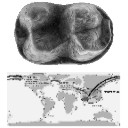
First early Eocene tapiroid from India and its implication for the paleobiogeographic origin of perissodactyls
Published online: 08/09/2015
Keywords:
Ceratomorpha; Helaletidae; Paléogène; Tapiromorpha; Vastan
https://doi.org/10.18563/pv.39.2.e5
Abstract
The presence of cambaytheres, the sister group of perissodactyls, in western India near or before the time of collision with Asia suggests that Perissodactyla may have originated on the Indian Plate during its final drift towards Asia. Herein we reinforce this hypothesis by reporting two teeth of the first early Eocene tapiromorph Perissodactyla from the Cambay Shale Formation of Vastan Lignite Mine (c. 54.5 Ma), Gujarat, western India, which we allocate to a new genus and species, Vastanolophus holbrooki. It presents plesiomorphic characters typical of the paraphyletic “Isectolophidae,” such as small size and weak lophodonty. However, the weaker hypoconulid and low paralophid, higher cusps, lower cristid obliqua, and the lingual opening of the talonid are found in Helaletidae, the most primitive tapiroid family. V. holbrooki, gen. et sp. nov., may be the oldest and the most primitive tapiroid, suggesting that at least tapiroid perissodactyls originated on India.
PV article infos
Published in Vol.39-2 (2015)
|
PDF
|
|
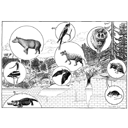
Essai de reconstitution d'un paysage du Quercy vers -35 Ma. (Esquisse de Christian Pondeville, 1977).
Published online: 15/09/1978
Keywords:
Landscape reconstruction; Quercy Phosphorites
https://doi.org/10.18563/pv.8.2-4.landscape
Abstract
Le Quercy est aujourd'hui un vaste plateau calcaire, parcouru par un réseau karstique actif, pro· fondément entaillé par des vallées aux falaises abruptes, comme celles du Lot ou du Célé. Sur un sol peu épais domine la forêt de chênes, accompagnés de cornouillers, érables, genévriers. La faune est pauvre, peu diverse, et les nombreux chasseurs se satisfont de gibier d'élevage ...
Il y a trente-cinq millions d'années environ, le paysage était bien différent. La période de l'Eocène supérieur, qui s'achevait, avait été chaude et humide, si l'on se réfère à la fois aux paléotempératures (calculées à partir de sédiments marins extra-européens) et aux restes fossilisés de végétaux typiquement tropicaux.
Le Causse du Quercy devait être un plateau très disséqué par la karstification, à surface lapiazée creusée de gouffres en rapide évolution interne, et couvert d'un sol assez épais. Une forêt tropicale humide, avec notamment des Myricacées et des gymnospermes, recouvrait l'ensemble du pays, à peine interrompue au niveau des rares points d'eaux situés dans les bas-fonds. Dans ce cadre vivait une faune considérablement différente de la maigre faune actuelle. Si nous pouvons l'imaginer, c'est grâce aux cadavres des animaux entraînés dans les cavités par les eaux courantes ou les prédateurs, ou bien logeant et mourant dans les milieux souterrains. Nombre de ces restes, fossilisés, sont parvenus jusqu'à nous et sont aujourd'hui l'objet d'étude.
View editorial
Published in Vol. 08, Fasc. 2-4 (1978)
|
PDF
|
|
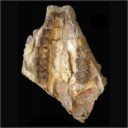
A new species of Propalaeotherium (Palaeotheriidae, Perissodactyla, Mammalia) from the Middle Eocene locality of Aumelas (Hérault, France).
Published online: 24/05/2016
Keywords:
Eocene; new species; Palaeotheriidae; Propalaeotherium
https://doi.org/10.18563/pv.40.2.e1
Abstract
A new Propalaeotherium species, clearly distinct from the genus Eurohippus, is described. It is characterized by having a similar size as P. voigti from the German Geiseltal localities (MP 11 to MP 13 reference-level), but differs in several features suggesting a slighty more derived morphology. It presents indeed less brachyodont crowns with less prominent and less elevated cingula, slightly larger relative surface of premolars, and a more marked metaconid splitting on cheek teeth. This new species is unknown from other European localities except the nearby Saint-Martin de Londres locality which has been considered older than the MP 13 level.
PV article infos
Published in Vol.40-2 (2016)
|
PDF
S.I. Data
|
|
A mandible of the hyracoid mammal Titanohyrax andrewsi in the collections of the Muséum National d'Histoire Naturelle, Paris (France) with a reassessment of the species
Published online: 18/04/2016
Keywords:
Afro-Arabia; Fayum; Oligocene; Titanohyracidae
https://doi.org/10.18563/pv.40.1.e4
Abstract
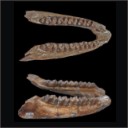
An unpublished mandible of the large hyracoid Titanohyrax andrewsi from the early Oligocene Jebel Qatrani Formation, Fayum Depression, Egypt is described. This specimen has a twofold importance. Firstly, it opens an unexpected window on early paleontological research in the Fayum because it was discovered as early as 1904 by the French paleontologist René Fourtau during an expedition to the Fayum organized by the Muséum National d’Histoire Naturelle, Paris (MNHN). This expedition has remarkably never been mentioned in the literature. Secondly, the mandible documents the best-preserved specimen of T. andrewsi, permitting a revision of one of the very rare Paleogene hyracoids. Interestingly, the new mandible was discovered two years before the first report of the species by Charles W. Andrews. The hypodigm of T. andrewsi is reviewed and the dentition as a whole is compared in detail, notably with other Titanohyrax species from the Fayum. The validity of the large Titanohyrax “schlosseri” species is discussed, but a pronounced sexual size dimorphism for T. andrewsi is favoured.
PV article infos
Published in Vol.40-1 (2016)
|
PDF
|
|
Critical comments on the genus Propachynolophus Lemoine, 1891 (Mammalia, Perissodactyla, Equoidea)
Published online: 27/09/2017
Keywords:
Eocene; Eurohippus; Pachynolophus; Propalaeotherium; tooth morphology
https://doi.org/10.18563/pv.41.1.e3
Abstract
Abstract
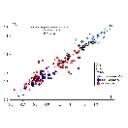
The validity of Propachynolophus Lemoine, 1891, supposedly an intermediate between Hyracotherium Owen, 1841 and Pachynolophus Pomel, 1847, has been questioned for a long time. A detailed analysis of features on which this genus is based further supported by a formal cladistic analysis demonstrates that Propachynolophus is not a valid taxon. The type species, “Propachynolophus gaudryi Lemoine, 1891” shall be assigned to Propalaeotherium Gervais, 1849, under the new combination Propalaeotherium gaudryi (Lemoine, 1891). “Pachynolophus maldani Lemoine, 1878”, later assigned to Propachynolophus, typifies the new genus Orolophus, under the binomen Orolophus maldani (Lemoine, 1878). The other referred species, “Propachynolophus levei Hooker, 1994” and “P. remyi Checa-Soler, 1997” are poorly documented, and both species shall be provisionally referred to as “Hyracotherium” levei (Hooker, 1994) and “Hyracotherium” remyi (Checa-Soler, 1997), pending new discoveries.
PV article infos
Published in Vol 41-1 (2018)
|
PDF
S.I. Data
|
|
Terrestrial vertebrate paleocommunities from the Cerro del Pueblo Formation (Late Cretaceous; Late Campanian) at Las Aguilas, Coahuila, Mexico
Published online: 16/07/2019
Keywords:
Campanian; Coahuila; dinosaurs; Mexico.; Vertebrates
https://doi.org/10.18563/pv.42.2.e1
Abstract
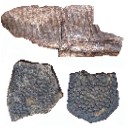
The Las Águilas site near Porvenir de Jalpa, Coahuila, Mexico, is extremely rich in tetrapod remains comprising both bones and trackways of several dinosaur taxa of late Campanian age. Within a 50 m thick section we identified at least nine layers with dinosaur bone assemblages. In one of these the dinosaur bones are associated with remnants of eusuchian crocodilians, turtles, plesiosaurs, pterosaurs, tyrannosaurids, dromaeosaurids, parksosaurid, hadrosaurids, ceratopsids, and ankylosaurs. This layer is also rich in coprolites of turtles, crocodilians and likely theropods, thus providing evidence for the wealth of Late Cretaceous vertebrate life in the area.
PV article infos
Published in Vol 42-2 (2019)
|
PDF
|
|
New material of “Eurysternidae” (Thalassochelydia, Pan-Cryptodira) from the Kimmeridgian of the Swiss Jura Mountains
Published online: 25/06/2020
Keywords:
Eurysternidae; Late Jurassic; morphology; Switzerland; Testudines; Thalassochelydia
https://doi.org/10.18563/pv.43.1.e2
Abstract
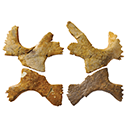
The region of Porrentruy (Swiss Jura Mountains) is known for its rich and diverse assemblage of Late Jurassic coastal marine turtles (Thalassochelydia). Dominated by the “Plesiochelyidae”, this assemblage also includes representatives of the two other thalassochelydian groups, the “Thalassemydidae” and “Eurysternidae.” In this study, we present new shell-based material from Porrentruy referable to eurysternids. One specimen represents a juvenile individual or a relatively small taxon, and is notably characterized by a well fenestrated plastron exhibiting a wider than long central plastral fontanelle. Two other specimens are much larger and possibly represent the largest eurysternids known to date. The fourth specimen is characterized by a unique plastral morphology otherwise only known in very small juveniles. This is the first time this unique plastral morphology is known to persist in an adult or subadult. The new material described herein represents at least three distinct taxa, all of them probably new. However, we refrain from naming new species based on this incomplete material in order to avoid adding confusion to an already complex taxonomical situation. This study provides new insights into the great diversity of eurysternids during the Late Jurassic.
PV article infos
Published in Vol 43-1 (2020)
|
PDF
|
|
The beginning of the adaptive radiation of Theridomorpha (Rodentia) in Western Europe: morphological and phylogenetic analyses of early and middle Eocene taxa; implications for systematics
Published online: 20/09/2021
Keywords:
characters analyses; Dental morphology; Eocene; Rodentia; variability
https://doi.org/10.18563/pv.44.2.e2
Abstract
This paper provides a revision of the early and middle Eocene European rodents previously referred to as Ischyromyoidea, including taxa considered to be at the origin of the Theridomorpha. The use of an accurate dental terminology and a better understanding of the size and shape of their infra-orbital foramen (i.o.f.) led us to a substantial revision of this group, which allowed to better characterize them and to appreciate their variability. On these bases, phylogenetic analyses (cladistic and standard Bayesian
approaches) of early Ypresian to late Priabonian European rodent species were undertaken in order to highlight the root of the early Theridomorpha and its content. In this paper, the phylogeny was established based on 343 characters (338 dental) through 45 early Paleogene taxa using both cladistic and bayesian analyses. The ingroup included on one hand a few North American genera (Reithroparamys, Microparamys, and Acritoparamys) and European ones (Eogliravus, Ailuravus, Corbarimys, Meldimys, Euromys, Plesiarctomys, and Pseudoparamys) considered until now as being related with the North American superfamily Ischyromyoidea. On the other hand, it included genera close to the root of the Theridomorpha (Sparnacomys, Pantrogna, and Hartenbergeromys) and early Theridomyoidea (Masillamys, Protadelomys, and some Pseudosciuridae). The phylogenetic results obtained via the two
distinct reconstruction approaches are consistent in virtually all relationships. The proposed systematics here derives from these phylogenetic results. This phylogenetic context led us to change the suprafamilial, familial, subfamilial or generic attribution of several species. Characters of Theridomorpha, like the obliquely developed postprotocristid allied with the occurrence of a metalophulid I, have been found in genera previously considered as Ischyromyidae (Pseudoparamys, Euromys, Sparnacomys, Meldimys, Pantrogna, and Hartenbergeromys) as well as the large i.o.f., when preserved (Pseudoparamys, Hartenbergeromys, and Masillamys). Based on these morphological observations and new phylogenetic considerations, the content of the Theridomorpha clade is here enlarged, thereby extending back the first theridomorph radiations to the early Eocene. Aside, a new taxon (Reinomys rhomboides gen and sp. nov.) is described from Avenay. In addition, a new genus, Auroremys, is created for the species subita (Comte et al., 2012) from Chery-Chartreuve.
PV article infos
Published in 44-2 (2021)
|
PDF
S.I. Data
|