
Abstract book of the 18th Conference of the EAVP
Miocene Bovidae (Mammalia) of the Siwaliks: Hypsodontinae and Bovinae
Pterosaurs from Coahuila
Les sélaciens du Miocène de la région de Montpellier
Contribution à l'étude des genres Gliravus et Microparamys.
Muridae du Pliocène supérieur d'Espagne et du midi de la France.
Eocene (57) , Quercy Phosphorites (38) , Systematics (32) , Rodents (29) , Mammalia (27) , Rodentia (25) , Miocene (25)
Page 18 of 19, showing 20 record(s) out of 368 total
|
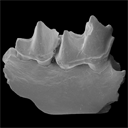
First Neogene Otonycteris (Chiroptera: Vespertilionidae) from Ukraine: its biostratigraphic and paleogeographic significance.Valentina V. RosinaPublished online: 19/03/2015Keywords: bats; East Europe; Gritsev; Late Miocene; Mammalia https://doi.org/10.18563/pv.39.1.e2 Abstract A new species, Otonycteris rummeli nov. sp., is described from the Late Miocene site Gritsev (MN 9) in the Ukraine. Otonycteris rummeli nov. sp. differs from those of most vespertilionids, except recent Otonycteris, Antrozous and Early Miocene Karstala silva, in having a well-developed entocingulid at the foot of the trigonid valley in the lower molars. The morphological resemblance of Otonycteris, Antrozous and Karstala is apparently a case of convergence in the evolution of the Old and New Worlds bat faunas. From at least the Middle Miocene the range of Otonycteris distribution spread to the whole of Central Europe and such a situation continued during the whole Late Miocene. This indicates a more arid climate in Europe during the Upper Miocene compared to the Quaternary. The reduction of the distribution range of Otonycteris and its extinction in most of the territory of Europe could have been caused by the global climatic cooling and increasing glacial cycle amplitude during the onset of the Quaternary. PV article infos Published in Vol.39-1 (2015) |
|

|
Les Gliridés (Rodentia) de l'Oligocène supérieur de Saint-Victor-la-Coste (Gard).Marguerite HugueneyPublished online: 28/10/1968Keywords: Gliridae; Late Oligocene https://doi.org/10.18563/pv.2.1.1-16 Abstract The locality of St.-Victor-la-Coste (Gard) has yielded, rather abundantly, teeth of two glirids hitherto very poorly known: Glirudinus praemurinus (Freudenberg) and Glirudinus glirulus (DEHM). It has permitted, moreover, new views on the evolution of Peridyromys murinus (POMEL). Study of these forms confirms the late Oligocene age of the fauna, without allowing, however, further precision. PV article infos Published in Vol. 02, Fasc. 1 (1968) |
|

|
Acinoptèrygiens du Stéphanien de Montceau-les-Mines (Saône-et-Loire, France).Daniel Heyler and Cécile PoplinPublished online: 30/09/1983Keywords: Aeduelliforms; Biogeography; Palaeonisciforms; paramblypteriforms; Stephanien https://doi.org/10.18563/pv.13.3.33-50 Abstract The study of new specimens from the Stephanian shales of Montceau-les-Mines confirms and enlarges the number of groups already known in this area. Among the Palaeonisciforms, “form A" is now known more completely, although no diagnosis or name can yet be given for it. “Form B" is redescribed and its relationships with “Elonichthys robisoni" are discussed. A palaeoniscid is recorded which resembles those from Bourbon l'Archambault. The paramblypteriforms occur rather frequently, but no genera can be determined. The aeduelliforms comprise some specimens close to Aeduella blainvíllei from Muse (Autun basin), and a new genus. Comparison of the latter with two fossils from Lally allows creation of two new species and a new family. This diversification of the aeduelliforms during this middle Stephanian leads to the hypothesis that the group originated at least as early the lower Stephanian. This material prooves again the characteristic endemism of this fauna, particularly of the aeduelliforms which are known only in the Massif Central where they diversified during the Permo-Carboniferous. Biogeographical consequences are discussed. PV article infos Published in Vol. 13, Fasc. 3 (1983) |
|

|
L'occlusion dentaire chez Peradectes, Amphiperatherium et Peratherium, Marsupiaux du tertiaire d'Europe.Jean-Yves CrochetPublished online: 01/10/1980Keywords: Didelphidae; Eocene; Mastication; Oligocene; Wear facets https://doi.org/10.18563/pv.9.ext.79-89 Abstract The general principles guiding the study of wear facets which develop during mastication in mammals possessing tribosphenic molars are named. The application of this method of study to the molars of European Tertiary Didelphidae shows that the lineage of this family as represented by the species Peratherium cuvieri (Upper Eocene), P. elegans (Lower-middle Oligocene) and P. antiquum (Upper Oligocene) has propessively evolved toward a more carnivorous diet. PV article infos Published in Vol. 9, Ext (1980) |
|

|
Hyracodontids and rhinocerotids (Mammalia, Perissodactyla, Rhinocerotoidea) from the Paleogene of MongoliaDemberelyin DashzevegPublished online: 29/10/1991Keywords: Hyracodontidae; Mongolia; Paléogène; Perissodactyla; Rhinocerotidae https://doi.org/10.18563/pv.21.1-2.1-84 Abstract Two families are reviewed (Hyracodontidae and Rhinocerotidae) from the Paleogene of Mongolia. The following taxa are described from the former family: Triplopus? mergenensis sp. nov., Prohyracodon meridionale CHOW, Prohyracodon? parvus sp. nov., Forstercooperia ergiliinensis GABUNIA & DASHZEVEG, Ardynia praecox MATTHEW & GRANGER, A. mongoliensis (BELIAYEVA), Ardynia sp., Urtinotheríum sp. (or Indricotherium) and Armania asiana GABUNIA & DASHZEVEG. All of them are from the Paleogene of the eastem Gobi Desert The hyracodontid Pataecops parvus RADINSKY is described from a new locality, Menkhen-Teg (Middle Eocene), in the Valley of Lakes. PV article infos Published in Vol. 21, Fasc. 1-2 (1991) |
|

|
Long-term fidelity of megaoolithid dinosaurs to a large breeding-ground in the Upper Cretaceous of Aix-en-Provence (southern France).Géraldine Garcia
Published online: 15/12/2003 |
|

|
Crivadiatherium iliescui n. sp., nouvel Embrithopode (Mammalia) dans le Paléogène ancien de la dépression de Hateg (Roumanie).Constin Radulesco and Jean SudrePublished online: 30/12/1985Keywords: Embrithopods; Late Eocene; Paleobiogeography; Romania https://doi.org/10.18563/pv.15.3.139-157 Abstract The investigations undertaken at Crivadia (Hateg Depression, Hunedoara District, Romania), the type locality of Crivadiatherium mackennai RADULESCO el al. (Radulesco, Iliesco et lliesco, 1976), led to the discovery of remains of a new Embrithopod. Close to the above mentioned species, but larger in size, this animal is here described as a new species of Crivadiatherium, C. iliescui. ln addition, the comparison made between the forms indicated above and Palaeaamasía kansui OZANSOY from the Eocene deposits of Anatolia (Ozansoy, 1966; Sen et Heintz, 1979) showed that the latter species included a heterogeneous material; this permitted us to distinguish the form in the Anatolian locality Ciçekdag-Arabin Kôyü under the name Palaeoamasia sp. The geographical distribution and diversity of the Embrithopod species under discussion (Balkan, Anatolia) support the idea of an eurasiatic origin of this group and seem to suggest the existence during the Eocene of a particular faunal province in south-eastern Europe. PV article infos Published in Vol. 15, Fasc. 3 (1985) |
|

|
New records of the pantodont Archaeolambda from the Paléocène of southern ChinaSuyin Ting, Judith A. Schiebout and Jianjian ZhengPublished online: 16/12/1996Keywords: Archaeolambda; China; Paleocene; Pantodont https://doi.org/10.18563/pv.25.2-4.125-132 Abstract Two new finds of pantodont materials from southern China, assigned to Archaeolambda, are described in this paper. One, a new species from the Nanxiong Basin, Guangdong Province, is similar to Alcidedorbignya inopinata from the early Paleocene of Tiupampa, Bolivia in size. It provides reliable evidence of the occurrence of Archaeolambda in the early-middle Paleocene of southern China. The second find includes specimens of Archaeolambda sp. cf. A. planicanina from the ?late Paleocene of Hengyang Basin, Hunan Province, which are the first record of a fossil mammal from the area near Hengyang city. The only vertebrate fossils previously found here were two genera of crocodiles discovered in 1938. This find sheds new light on the local biostratigraphy. PV article infos Published in Vol. 25, Fasc. 2-4 (1996) |
|

|
La poche à phosphate de Ste-Néboule (Lot) et sa faune de vertebres du Ludien supérieur. 10 - Paléothérides (Perissodactyles).Jean-Albert RemyPublished online: 25/09/1978Keywords: Eocene; Quercy Phosphorites https://doi.org/10.18563/pv.8.2-4.291-293 Abstract La poche à phosphorite de Sainte-Néboule (Lot) a livré au cours des récentes campagnes de fouilles effectuées dans le cadre de la RCP 311 une douzaine de dents ou fragments de dents de paléothéridés à rapporter à 3 taxons. PV article infos Published in Vol. 08, Fasc. 2-4 (1978) |
|

|
Palaeotis weigelti restudied : a small middle Eocene Ostrich (Aves : Struthioniformes)Peter Houde
Published online: 20/06/1987 |
|

|
Révision des Rhombodontidae (Neoselachii Batomorphii) des bassins à phosphate du MarocAbdelmajid Noubhani and Henri Cappetta
Published online: 20/05/1994 |
|

|
Nouvelle quantification de l'Hypsodontie chez les Theridomyidae : l'exemple de Theridomys ludensis nov. sp.Monique Vianey-Liaud
Published online: 30/12/1985 |
|
|
A classic in the making : VERTEBRATE PALAEONTOLOGY (4th edition). By Michael J. Benton.Eric Buffetaut
Published online: 27/01/2016 |
|

|
Les Affinités de Nyctereutes megamastoides (Pomel), canidé du gisement Villafranchien de Saint-Vallier (Drôme, France).R. MartinPublished online: 31/01/1971Keywords: Canidae; Nyctereutes; Villafranchian https://doi.org/10.18563/pv.4.2.39-58 Abstract Nyctereutes megamastoides (Pomel) from the Villafranchian of the Auvergne and from Saint-Vallier presents cranial and dental characters sufficiently close to those of the late Pliocene canid from Perpignan (Roussillon), described by Depéret under the specific name of Canis donnezani belonging to the same genus Nyctereutes. The extinction of the European "Nyctereutes" group seems due to the too great alimentary specialization of this canid, whereas the Asiatic lineage represented in the Villafranchian by Nyctereutes sinensis Schlosser and at present by Nyctereutes procyonider Gray was able to maintain itself probably by means of a profound change in its alimentary regime. PV article infos Published in Vol. 04, Fasc. 2 (1971) |
|

|
Contributions à l'étude du gisement Miocène supérieur de Montredon (Hérault). Les grands mammifères. 6 - Les périssodactyles RhinocerotidaeClaude GuérinPublished online: 15/11/1988Keywords: Aceratherium; anatomy; Biostratigraphy; Dicerorhinus; Miocene; Montredon; Paleoecology; Upper Vallesian https://doi.org/10.18563/pv.18.ext.3-7-134 Abstract The Montredon site has yielded about hundred rhinoceros remains: PV article infos Published in Vol. 18, Ext (1988) |
|

|
Revision des faunes de vertébrés du site de Provenchères-sur-Meuse (Trias terminal, Nord-Est de la France)Gilles Cuny
Published online: 14/06/1995 |
|
|
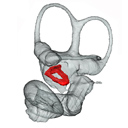
Fallen in a dead ear: intralabyrinthine preservation of stapes in fossil artiodactylsMaeva J. Orliac
Published online: 09/03/2016 |
S.I. Data |

|
The microfauna of the Djebel Qafze CaveG. HaasPublished online: 15/09/1972Keywords: Micromammals; Rodents https://doi.org/10.18563/pv.5.5.261-270 Abstract This study examines the microfauna from Djebel Qafze Cave, focusing on mammalian remains, with Microtus guentheri as the dominant species and a notable absence of Cricetinae (hamsters). The richest layers (XVIa, XVII, XVIII) suggest accumulation by raptors, particularly owls, given the high presence of nocturnal species like voles and shrews. Two significant species, Arvicanthis cf. ectos and the newly described Rattus (? Mastomys) nazarensis, are highlighted. Reptiles (gekkos, Ophisaurus) and birds are also present, while hedgehogs and lagomorphs are absent. The findings underscore the role of avian predators in fossil deposition and refine the chronology of regional Pleistocene fauna. PV article infos Published in Vol. 05, Fasc. 5 (1972) |
|

|
Owls, caves and fossils. Predation, preservation and accumulation of small mammal bones in caves, with an analysis of the Pleistocene cave faunas from Westbury-Sub-Mendip, Somerset, UK, par Peter Andrews, 1990. The University of Chicago Press, 232 p.Christiane Denys
Published online: 17/12/1992 |
|

|
Un giraffidae dans le pliocène de Montpellier ?Claude GuérinPublished online: 31/10/1986Keywords: Artiodactyla; France; Giraffidae; Mammalia; Montpellier; Ruscinian https://doi.org/10.18563/pv.16.3.185-189 Abstract An upper giraffid premolar without any indication about its origin is preserved at the Montpellier University among numerous fossils from the ruscinian formation of Montpellier. It can be related to Samotherium, of the Upper Miocene in Eastern Europe, North Africa and Asia, or more probably to Bramatherium or Hydaspitherium of the Pliocene of South East Asia. The sedimentological study of the matrix shows a calcareous background, which may indicate that this tooth does not come from the Montpellier formation. PV article infos Published in Vol. 16, Fasc. 3 (1986) |
|
