|
Un nouveau type de coquille d'oeuf présumé Dinosaurien dans la Campanien et le Maestrichtien continental de Provence.
Published online: 04/10/1982
Keywords:
Campanian/Maastrichtian; eggshell microstructure; Provence
https://doi.org/10.18563/pv.12.4.141-147
Abstract
The discovery of eggshells of ornithoid type is signaled for the first time in the continental Campanian and Maastrichtían of Provence. The taxonomie relationship of these eggshells and their interest in the biostratigraphical study of Upper Cretaceous of Provence are discussed.
PV article infos
Published in Vol. 12, Fasc. 4 (1982)
|
PDF
|

|
Rongeurs Miocènes dans le Valles-Penedes 2 : Les rongeurs de Castell de Barbera
Published online: 20/04/1979
Keywords:
Castell de Barbera; Miocene; Rodents; Valles-Penedes
https://doi.org/10.18563/pv.9.1.17-32
Abstract
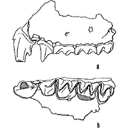
The rodent-fauna (Cricetidae and Gliridae) recently found at Castell de Barbera (Spain) is similar to those from the other locslities of the Valles - Penedes - Can Ponsic 1 and Can Llobateres - : same composition and similar evolutionary level of the different species. On the other hand this fauna is different from those of Upper Vindobonian and Vallesian localities of the Calatayud - Teruel area. Castell de Barbera has an intermediate chronological position between the localities of Anwil (Switzerland) and Can Ponsic 1. It is still not possible to validate or invalidate the initial attribution based on absence of Hipparion of Castell de Barbera to the Upper Vindobonian.
PV article infos
Published in Vol. 09, Fasc. 1 (1979)
|
PDF
|
|
Les Chiroptères du Miocène inférieur de Bouzigues. 1- Etude systématique.
Published online: 17/04/1968
Keywords:
bats
https://doi.org/10.18563/pv.1.3.65-133
Abstract
In recent years, the techniques of chemical preparing have permitted a rich paleontologic material to be obtained from the phosporitic sediment of Bouzigues (Hérault, France). The fauna of this locality is comprised of quite varied microvertebrates, amphibians, reptiles, birds, mammals. Twenty five species of the latter, belonging to seven orders, are today known from the site. Among them, the numerous rodents have allowed L. Thaler to chronologically situate this fauna in the Zone of Laugnac (<< late Aquitanian ›> of some authors).
The chiropterans are, with the rodents, the best represented of the locality's mammals. Three families comprise the bat fauna, with nearly complete dominance by one of them (Hippoxideridae) over the two others (Megadermatidae and Vespertílionidae)
Six forms are described, of which three are new species and one a new sub-genus.
Megaderma braillomi n. sp., an animal of rather large size, shows like the Miocene megaderms several evolved dental characters, translating the adaptation of these animals to a partially carnivorous regime. The Bouzigues species seems, however, to represent a particular lineage.
Hipposideros (Brachipposideros n. subgen.) dechaseauxi n. sp. and Hípposideros (Brachipposideros) cf. collongenris Depéret, small sized forms, belong to a group rather well represented in the late Oligocene and early Miocene of Europe, and not distinguished until now within the genus Hipposideros.
Hipposideros (Pseudorhinolophus) bouziguensis n. sp., is the most abundant mammal in the locality and, occuring at the Oligocene-Miocene limit, the last representative known of the subgenus Pseudorhínolophus, common in Europe from the middle Eocene.
However, beyond Neogene and Quaternary times, certain among the numerous living species of Hipposideros are close to Pseudorhinolophus and others to Brachipposíderos. 'This fact would in the future justify a global revision of the genus, on the basis of comparative anatomy of the squeleton and of the teeth.
The bat fauna of Bouzigues is completed by two small Vespertilionidae, rare forms, Myoris sp. I and sp. II.
PV article infos
Published in Vol. 01, Fasc. 3 (1968)
|
PDF
|

|
La poche à Phosphate de Ste-Néboule (Lot) et sa faune de vertebres du Ludien supérieur. 6- Oiseaux
Published online: 25/09/1978
Keywords:
Eocene; Quercy Phosphorites
https://doi.org/10.18563/pv.8.2-4.217-229
Abstract
There are very few birds in the site of Sainte-Néboule. They belong to three species already known in the "Phosphorites" : Paraortyx brancoi, Aegialornis broweri, Cypselavus gallicus, and to one new species, Recurvirostra santaeneboulae. The comparison of some different bones of the genus Cypselavus with some Apodiformes and Caprimulgiformes shows that this genus must be classified in the order Apodiformes.
PV article infos
Published in Vol. 08, Fasc. 2-4 (1978)
|
PDF
|

|
Carolocoutoia ferigoloi nov. and sp. (Protodidelphidae), a new Paleocene "opossum-like" marsupial from Brazil.
Published online: 15/12/1998
Keywords:
Brazil; Didelphimorphia; Itaborai; Marsupialia; New taxa; Paleocene; Protodidelphidae; South America
Abstract
Carolocoutoia ferigoloi gen. et sp. nov. is the largest of protodidelphid marsupials, known from Middle Paleocene levels at Itaboraí Formation, southeastern Brazil. It differs from other members of this family in having molars with low cusps which are basally inflated, rounded crests without cutting edges, and a thick enamel layer which is wrinkled, specially at the labial half. A comparative analysis among representatives of this family led us to recognize only three genera undoubtely assignable to it: Protodidelphis PAULA COUTO, 1952, Robertbutleria MARSHALL, 1987, and Carolocoutoia gen. nov. Protodidelphids lack the basic derived features diagnostic of Polydolopimorphian marsupials, while most of its derived features agree with its belonging to the Didelphimorphia. Protodidelphids comprise a specialized clade of opossum-like marsupials adapted to frugivorous or frugivore-omnivorous feeding habits. They differ from other didelphimorphians in having very large, spire-like entoconids, reduced and antero-posteriorly compressed paraconids, absence of stylar cusp C and of para- and metaconules, large stylar cusps B and D which are proximate to each other, short postmetacristae, eccentric protocones, and molars that increase rapidly in size from M/ml to M/m3.
PV article infos
Published in Vol. 27, Fasc. 3-4 (1998)
|
PDF
|

|
Contribution à l'étude des genres Gliravus et Microparamys (Rodentia) de l'Eocène d'Europe.
Published online: 15/03/1971
Keywords:
Eocene; Gliravus; Microparamys; Rodentia
https://doi.org/10.18563/pv.4.4.97-135
Abstract
Based on material found in about 15 localities the relationships of the genera Microparamys and Glirarus have been studied. One new genus, two subgenera and three species [Microparamys (Sparnacomys) chandoni n. subgen. and n. sp., Microparamys (Pantrogna) russelli n. subgen., Eoglirarus wildi n. gen. and n. sp., Gliravus meridionalis n. sp.] as well as the publication
of numerous new facts concerning species previously reported, support the phyletic scheme proposed. The latter shows that the origin of the Gliravinae is to be sought among the very small and still rather poorly known Microparamys species of the early Eocene. Gliravus: robiacensis can be considered as the common ancestor to different lineages not only of Glirarus but also of modern genera (Peridyromys, Glirudinus and Microdyromyx), at the origin of which Peridyromys micio, although difficult to interpret, occupies a similar place.
The stratigraphic conclusions permit more detail in the chronologie succession of the localities studied. The paleoecologic and biogeographic aspects lead one to the problem of the oligocene "Grande Coupure" through the study of this group.
PV article infos
Published in Vol. 04, Fasc. 4 (1971)
|
PDF
|

|
Contributions à l'étude des micromammifères du gisement Miocène supérieur de Montredon (Hérault). 4 - Les chiroptères
Published online: 30/06/1982
Keywords:
Chiroptera; Hérault; Late Miocene; Micromammals; Montredon
https://doi.org/10.18563/pv.12.3.133-140
Abstract
The Montredon local fauna yielded very rare bats, represented by damaged isolated teeth. Only a few documents are available for this period of the European Neogene. ln this poor state of knowledge, the material represents three undetermined species, a supposed molossid and two vespertilionids.
PV article infos
Published in Vol. 12, Fasc. 3 (1982)
|
PDF
|

|
Rongeurs du Miocène supérieur de Chorora, Ethiopie: Murinae, Dendromurinae et conclusions.
Published online: 30/07/2001
Keywords:
Ethiopia; Late Miocene; Muridae; Rodentia
Abstract
The subfamilies Murinae and "Dendromurinae" both include 4 species at Chorora. Among the former, while Preacomys nov. gen. seems to be a forerunner of Acomys, the affinities of the remaining, poorly known taxa, are more difficult to evaluate. The bulk of the fauna, remarkably, consists of Dendromurines. Their similarities with those of Ngorora tends to pull the site back in time, but the large size and diversity of Murines fit better an age more recent than the very beginning of the Late Miocene.
PV article infos
Published in Vol. 30, Fasc. 1-2 (2001)
|
PDF
|

|
Equus caballus antunesi, nouvelle sous-espèce Quaternaire du Portugal
Published online: 30/10/1989
Keywords:
Equidae; Equus caballus; new subspecies; Perissodactyla; Portugal; Würm
https://doi.org/10.18563/pv.19.2.47-72
Abstract
Equus caballus antunesi, nova subspecies, was a hypsodont, slender, and rather small horse (around 141cm at the withers), with narrow hooves and protocones longer on P3/-P4/ than on M1/-M2/. It does not fit in any of the different "types" of Pleistocene caballine horses previously recognized but may be related to the horse from the Acheulean of Solana del Zamborino.
Hypsodonty, small size, slenderness, narrow hooves are all characters that can easily be related to ecological conditions. Equus caballus antunesi was probably a horse adapted to rather dry and cold conditions and to a hard ground. It does not seem related at all to the North-European Equus caballus germanicus-gallicus group.
PV article infos
Published in Vol. 19, Fasc. 2 (1989)
|
PDF
|

|
Les sélaciens du Miocène de la région de Montpellier
Published online: 15/12/1970
Keywords:
Ichtyofauna; Miocene; Montpellier
https://doi.org/10.18563/pv.3.ext.1-139
Abstract
The utilization of screen-washing and attack by dilute acetic acid has permitted the collecting, in the Miocene of the department of Hérault (France), of a very rich ichthyofauna. This fauna is presently comprised of about 60 studied species, of which 11 are new, and represents, in the present state of knowledge, the most varied Miocene selachian fauna described in the world.
The abondance of material has allowed an overall revision to be made; it has thus been possible to complete the description and the figuration of species that were poorly known until now, and to synonymize species that were established on simple morphotypes. Paleo-ecologic study of the ichthyofauna has permitted conclusions to be drawn relative to climate and bathymetry; it was thus possible to show that the Miocene fauna of Hérault was a fauna of a subtropical sea, essentially neritic with rare pelagic contributions.
Knowing the stratigraphic position of the localities, it has been possible to distinguish three faunal assemblages based on associations of species. Some hypotheses on the evolution of certain lineages have been expressed.
The comparison of this fauna with that of other regions permitted the relationships of two diflerent faunal provinces to be specified: the first belongs to the northern domain, characterized by a fauna still subtropical but with numerous temperate water elements; the leoond belongs to the Mesogean domain characterized by warm water forms. It has also lhovm that contemporary faunas could be very different according to the bathymetric zone in which they lived, which furnishes valuable information for the paleogeographic reconstruction of sedimentary basins.
PV article infos
Published in Vol. 3, Ext (1970)
|
PDF
|
|
Latest Early-early Middle Eocene deposits of Algeria (Glib Zegdou, HGL50), yield the richest and most diverse fauna of amphibians and squamate reptiles from the Palaeogene of Africa
Published online: 08/02/2021
Keywords:
Africa; Algeria; amphibians; Eocene; squamates
https://doi.org/10.18563/pv.44.1.e1
Abstract
HGL50 is a latest Early-early Middle Eocene vertebrate-bearing locality located in Western Algeria. It has produced the richest and most diverse fauna of amphibians and squamate reptiles reported from the Palaeogene of Africa. Moreover, it is one of the rare faunas including amphibians and squamates known from the period of isolation of Africa. The assemblage comprises 17 to 20 taxa (one gymnophionan, one probable caudate, three to six anurans, seven ‘lizards’, and five snakes). Two new taxa were recovered: the anuran Rocekophryne ornata gen. et sp. nov. and the snake Afrotortrix draaensis gen. et sp. nov. The locality has also yielded the first confirmed anilioid snake, the first Palaeogene gymnophionan, and probably the first caudate from the Palaeogene (and possibly from the Tertiary) of Africa. The presence of a caudate at that time in Africa would be of particular interest; unfortunately, the available material does not permit a definitive identification. The fauna comprises Gondwanan and more specifically West Gondwanan vicariants, probably autochthonous groups and a Eurasian immigrant (assuming that the identification of the caudate is accurate). The fauna from HGL50 is clearly distinguished from the few other Eocene assemblages of Africa. However, if this results largely from differences in geological ages, geographic positions of the localities and mainly differences in environments took a part in the composition of the faunas.
PV article infos
Published in 44-1 (2021)
|
PDF
|
|
New Late Miocene plecotine bats (Chiroptera, Vespertilionidae: Plecotini) from Gritsev, Ukraine
Published online: 07/03/2019
Keywords:
Barbastella; bats; late Neogene; Mammalia; Plecotus
https://doi.org/10.18563/pv.42.1.e2
Abstract
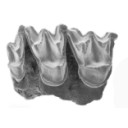
The Late Miocene site of Gritsev (MN 9, Ukraine) has yielded a very rich bat fauna, the remains of which are well preserved. Compared to other Neogene bat assemblages of Europe, the Gritsev bat community is unique in preserving plecotine bats, which are rare from Neogene sites. Some peculiar and new bat species, including a large plecotin Otonycteris, already were described from the Gritsev mammal site. Here we report new records of small plecotin bats from Gritsev, including a new taxon, Barbastella maxima nov. sp. This is the earliest reliable fossil record of this genus and it differs from more recent species of Barbastella in being considerably larger. The evolutionary patterns in the odontology within the tribe Plecotini, supported by biostratigraphical distribution of fossil records of Plecotus are discussed. The morphological peculiarities of the new fossils of plecotine bats from Gritsev are discussed in connection with its possible taxonomical affinity.
PV article infos
Published in Vol 42-1 (2019)
|
PDF
|

|
Die Ohr-Region der Paulchoffatiidae (Multituberculata, Ober-Jura).
Published online: 15/11/1988
Keywords:
Multituberculata; Ober-Jura; Paulchoffatiidae; Petrosum; Portugal
https://doi.org/10.18563/pv.18.3.155-185
Abstract
The petrosal of the Paulchoffatiidae HAHN, 1969 is described and compared with that of younger multituberculates and of other Mesozoic mammals. The "Morrison petrosal", described by Prothero (1983), is also discussed; it probably belongs to the multituberculates. The reconstruction of the ventral side of the Paulchoffatiinae-skull, given by Hahn in 1987, is completed by addition of the otic and the occipital region.
PV article infos
Published in Vol. 18, Fasc. 3 (1988)
|
PDF
|

|
Octodontid-like Echimyidae (Rodentia) : an upper Miocene episode in the radiation of the family
Published online: 20/05/1994
Keywords:
Argentina; Echimyidae; Miocene; New taxa; Rodentia; South America
https://doi.org/10.18563/pv.23.1-4.199-210
Abstract
Reigechimys octodontiformis gen. et sp. novo and R. plesiodon sp. novo are described. They represent the frrst record of the family Echimyidae for the Cerro Azul Formation (Huayquerian Age, Late Upper Miocene) at La Pampa Province, central Argentina. Both species have hypsodont cheek teeth with an eight-shaped occlusal design. This dental morphology represents a noticeable case of convergence to octodontids and indicates that these echimyids inhabited open environments.
PV article infos
Published in Vol. 23, Fasc. 1-4 (1994)
|
PDF
|

|
Leptacodon nascimentoi n,sp., un nouveau Nyctitheriidae (Mammalia,Lipotyphla) de l'Eocène inférieur de Silveirinha (Baixo Mondego, Portugal)
Published online: 16/12/1996
Keywords:
Eocene; Leptacodon; Lipotyphla; Mammals; Nyctitheriidae; Portugal; Silveirinha
Abstract
In this article is described a new species of Nyctitheriidae with primitive characters: Leptacodon nascimentoi n. sp. from the early Eocene of Silveirinha (Portugal).
PV article infos
Published in Vol. 25, Fasc. 2-4 (1996)
|
PDF
|

|
Rana (Amphibia : Ranidae) from the upper eocene (MP17a) Hordle Cliff locality, Hampshire, England.
Published online: 15/06/1999
Keywords:
Amphibia; England; Rana; Ranidae; Upper Eocene
Abstract
An ilium from the Upper Eocene (MP l7a) of Hordle, England, represents the first report of Rana from the Eocene of Britain. The ilium is similar to those of the water frog (Rana [ridibunda]) species group.
PV article infos
Published in Vol. 28, Fasc. 1 (1999)
|
PDF
|

|
Sur les Condylarthres Cernaysiens Tricuspiodon et Landenodon (Paléocène supérieur de France)
Published online: 01/10/1980
Keywords:
Arctocyonidae; Condylarths; Late Paleocene; Tricuspiodontidae
https://doi.org/10.18563/pv.9.ext.127-166
Abstract
The numerical importance of the Condylarths in the Cernaysian fauna is discussed. The Condylarth family, Tricuspiodontidae, is reviewed in the light of new material and its close relationships to the Phenacodontidae is suggested ; one new species is recognized : Tricuspiodon sobrinus. European Arctocyonidae are reviewed and the recentclassification of Van Valen is briefly commented on. Also, the arctocyonine Landenodon is described for the first time in Thanetian (Late Paleocene) sediments ; two new species are proposed : T. lavocati and T. phelizoni.
PV article infos
Published in Vol. 9, Ext (1980)
|
PDF
|

|
Une nouvelle espèce d'Hipparion du Miocène terminal d'Espagne.
Published online: 31/01/1971
Keywords:
Hipparion; Late Miocene; Spain; Villafranchian
https://doi.org/10.18563/pv.4.2.59-66
Abstract
The recently discovered, very rich, Pliocene locality of Layna (Soria, Spain), has already yielded 30 species of mammals. Hipparion fissurae, described here is more dolichopodic than other Hipparion. It is related to Hipparion crusafonti from Villaroya (Villafranchian), but more slender between other characters.
PV article infos
Published in Vol. 04, Fasc. 2 (1971)
|
PDF
|

|
Révision des Chiroptères Lutériens de Messel (Hesse, Allemagne).
Published online: 04/04/1970
Keywords:
Chiroptera; Lutetian; Messel
https://doi.org/10.18563/pv.3.4.83-182
Abstract
The revision of the Lutetian chiropterans from Messel, first described by Revilliod in 1917, is based on the anatomy of the teeth and the skeleton. A figuration or refiguration of thematerial utilized accompanies the new description, which goes beyond that of the original monograph.
The study shows a certain variability of the dental structure within the genera Palaeochiropteryx Revilliod and Archaeonycteris Revilliod, as well as a general resemblance of the two forms. The morphology of the teeth permits, however, the verification of the validity of the different species: Palaeochiropteryx tupaiodon Revilliod, P. spiegeli Revilliod, Archaeonycterís trigonodon Revilliod, and Archaeonycteris revilliodi, n. sp.
Some differences of the skeletal and dental anatomy tend to indicate a stage of evolution less advanced for the genus Archaeonycteris.
The comparison of the chiropterans of Messel with the principal groups of living chiropterans, as well as with different Eocene fossíls (notably Cecílionycteris Heller and Icaronycteris Jepsen) leads to a more precise idea of the anatomy of primitive chiropterans. This comparison also permits the proposition that the oid forms so far described by integrated in a superfamily, the Palaeochiropterygoidea and allows a general phylogenetic hypothesis to be advanced for the order Chiroptera.
PV article infos
Published in Vol. 03, Fasc. 4 (1970)
|
PDF
|
|
Pterosaurs (Pterosauria) from the Cerro del Pueblo Formation (Late Campanian) of Coahuila, Mexico
Published online: 21/11/2025
Keywords:
Azhdarchoidea; Coahuila; Mexico; Pterodactyloidea; Pterosauria
https://doi.org/10.18563/pv.48.2.e1
Abstract
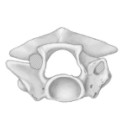
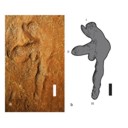
The Late Campanian Cerro del Pueblo Formation, located in southeastern Coahuila, Mexico, has produced a diverse array of vertebrate fossils. However, pterosaur remains from this unit are notably scarce. In this study, we describe new pterosaur material from the formation. The specimens include a fragmentary vertebra identified as belonging to an indeterminate, but derived pterodactyloid, along with the distal condyle of a left metacarpal, referable to an azhdarchoid pterosaur, and a left manus print. While these specimens provide additional evidence of pterosaur presence in the region during the Late Cretaceous, their fragmentary nature limits precise taxonomic and ichnotaxonomic identification. Nevertheless, they highlight the potential for future discoveries that could refine our understanding of the diversity and distribution of pterosaurs in Mexico.
PV article infos
Published in 48-2 (2025)
|
PDF
|