
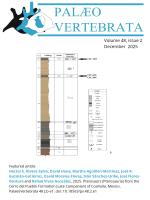
Abstract book of the 18th Conference of the EAVP
Miocene Bovidae (Mammalia) of the Siwaliks: Hypsodontinae and Bovinae
Pterosaurs from Coahuila
Les sélaciens du Miocène de la région de Montpellier
Contribution à l'étude des genres Gliravus et Microparamys.
Muridae du Pliocène supérieur d'Espagne et du midi de la France.
Eocene (57) , Quercy Phosphorites (38) , Systematics (32) , Rodents (29) , Mammalia (27) , Rodentia (25) , Miocene (25)
|
A New caseid Synapsid from the Permian (Guadalupian) of the Lodève basin (Occitanie, France)
|
|

|
Description des rongeurs Pliocènes de la faune du Mont-Hélène (Pyrénées-Orientales, France), nouveau jalon entre les faunes de Perpignan (Serrat-d'en-Vacquer) et de Sète.Jean-Pierre Aguilar, Marc Calvet
Published online: 31/10/1986 |
|

|
Owls, caves and fossils. Predation, preservation and accumulation of small mammal bones in caves, with an analysis of the Pleistocene cave faunas from Westbury-Sub-Mendip, Somerset, UK, par Peter Andrews, 1990. The University of Chicago Press, 232 p.Christiane Denys
Published online: 17/12/1992 |
|

|
Nouvelle quantification de l'Hypsodontie chez les Theridomyidae : l'exemple de Theridomys ludensis nov. sp.Monique Vianey-Liaud
Published online: 30/12/1985 |
|

|
Types dentaires adaptatifs chez les sélaciens actuels et post-paléozoïques.Henri Cappetta
Published online: 01/09/1986 |
|

|
Les Bovidae (Artiodactyla, Mammalia) du Miocène moyen de la formation Hofuf (Province du Hasa, Arabie Saoudite).Herbert ThomasPublished online: 30/12/1983Keywords: Biostratigraphy; Bovidae; Middle Miocene; Palaeogeography; Saudi Arabia https://doi.org/10.18563/pv.13.5.157-206 Abstract The study of the bovids from Al Jadidah (Hofuf Formation, Saudi Arabia) confirms that the fauna comes from a pre-Hipparion level. The Al Jadidah age is close to that of Fort Ternan (14 m.y.) and Beni Mellal, but cannot be older than that of Fort Ternan. The age of the Hofuf Formation is close to but slightly older than the oldest deposits of the Ngorora Formation (Kenya). 7 to 9 species have been recorded, of which 2 to 4 remain indeterminate. If the great specific diversity of te bovids from this locality gives evidence of immigrations from anterior Asia (Turkey) (e.g. Pachytragus Iigabuei sp. nov.), the bovid assemblage of Al Jadidah results in fact from a double influence: from the anterior Asia and mainly from Africa (e.g. the Caprotragoides lineage and the Neotragini? Homoiodorcas). The Al Jadidah bovids reflect, on the whole, the predominant character of open to very open environment, which supports the conclusions drawn from our two preliminary studies. PV article infos Published in Vol. 13, Fasc. 5 (1983) |
|

|
The Quaternary avifauna of Crete, Greece.Peter D. WeesiePublished online: 01/09/1988Keywords: Avifauna; Crete; Quaternary; Systematics https://doi.org/10.18563/pv.18.1.1-94 Abstract Pleistocene bird fossils have been studied from nine localities on Crete. Part of this material was described earlier by the author (Weesie, 1982) and will not be treated here in extenso, the results will be incorporated. More than one third of the over 10,000 fossil bird bones available could be identified ; they were found to represent at least 65 bird species. The following species of the Pleistocene Cretan avifauna are new to the fauna of Crete : Branta ruficollis, Haliaeetus albicilla, Gyps melitensis, Aquila chrysaetos simurgh n. ssp., Ketupa zeylomensis, Aegolius funereus, Dendrocopos leucotos, Zoothera dauma, Turdus iliacus and Pyrrhula pyrrhula. The Pleistocene Cretan avifauna differs less from comparable mainland avifaunas than (fossil) avifaunas from oceanic islands do. Still, the Pleistocene Cretan avifauna has two qualities that are characteristic of island avifaunas : the almost complete absence of a group of birds (the Galliformes) and the presence of two endemic (sub)species : the giant eagle Aquila chrysaetos simurgh n. ssp. and the long-legged owl Athene cretensis (Weesie, 1982). The new subspecies is described in the present study. PV article infos Published in Vol. 18, Fasc. 1 (1988) |
|

|
Premier catalogue des specimens-types Paléontologiques déposés dans les collections de l'Université de Montpellier II (Sciences et Techniques du Languedoc)Bernard MarandatPublished online: 20/12/1994Keywords: Collections; Inventory; Type specimens; University Montpelllier II https://doi.org/10.18563/pv.23.ext.3-113 Abstract More than 400 paleontological type-specimens housed in the Montpellier University collections have been inventoried in this catalogue which includes charophytes, Paleozoic plants, brachiopodes, molluscs, arthropodes and vertebrates (selachians, amphibians, reptiles, birds and mammals). The vertebrates have been treated exhaustively in the catalogue and one can consider that it includes most of the type specimens deposited in the Montpelier II collections. PV article infos Published in Vol. 23, Ext (1994) |
|

|
Contributions à l'étude des micromammifères du gisement Miocène supérieur de Montredon (Hérault). 1- Le gisementJean-Pierre Aguilar and Jean-Yves CrochetPublished online: 30/06/1982Keywords: Hérault; Late Miocene; Micromammals; Montredon https://doi.org/10.18563/pv.12.3.75-79 Abstract La localité fossilifère du Puech de Montredon, désignée plus communément sous le nom de Montredon, est située sur la commune de Montouliers (Hérault) à quelques 300 mètres de la limite avec le département de l'Aude. Elle a été découverte en 1845 par Narbonne, Directeur des Mines de La Caunette, et de très nombreux restes de vertébrés continentaux y ont été extraits. La plus ancienne mention de ce gisement dans la littérature semble être celle de Lartet (1859) qui signale que "M. Jourdan, de Lyon, a constaté à Montredon, près de Bize (Aude), l'association des restes de Dinotherium avec l'Hipparion". PV article infos Published in Vol. 12, Fasc. 3 (1982) |
|

|
La palichnofaune de vertébrés tétrapodes du permien supérieur du Bassin de Lodève (Languedoc-France).Georges Gand, Jacques Garric, Georges Demathieu and Paul EllenbergerPublished online: 15/09/2000Keywords: Footprints; France; Languedoc; Lodève basin; new ichnotypus; Saxonian; Upper Permian https://doi.org/10.18563/pv.29.1.1-82 Abstract Near "la Lieude", in the Lodève basin, more than a thousand of footprints are distributed in a twenty of trackways which amounts to 220 m length. They have been found on calcareous siltstone level in the B site named also "Réserve Naturelle Volontaire". This last is located in the Saxonian summit dated Upper Permian. "La Lieude" tracks are described by using statistical methods then they are compared with others from the world Permian. What allows to distinguish 4 following ichnotaxa: Lunaepes ollierorum nov.ichnosp., Merifontichnus thalerius nov. ichnogen. and nov. ichnosp., Planipes brachydactylus nov.ichnosp. and Brontopus circagiganteus nov. ichnosp. All these traces are attributed with possibility or probability to Therapsida or to Therosauria, except Brontopus circagiganteus nov. ichnosp. that could be due to Caseamorpha. All these animals whose sizes have been estimated between l and 5 m lived probably in a playa environment.The biological and sedimentological data from "la Lieude" footprints levels compared with informations provided by the tracks orientations, suggest the following scenario. Animals coming from the North have crossed a sandy channel bank with plants zones by directing to the South for the majority. Maybe, they were going to the lacustrine part of the playa, close to "la Lieude" footprints that they have just trampled on. PV article infos Published in Vol. 29, Fasc. 1 (2000) |
|
|
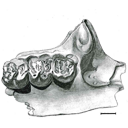
Les rongeurs de Chéry-Chartreuve et Rocourt-Saint-Martin (est du bassin de Paris; Aisne, France). Leur place parmi les faunes de l'Eocène Moyen d'EuropeBernard Comte, Maurice Sabatier and Monique Vianey-Liaud
Published online: 15/12/2012 |
|

|
Contributions à l'étude du gisement Miocène supérieur de Montredon (Hérault). Les grands mammifères. 5 - Les périssodactyles EquidaeVéra EisenmannPublished online: 15/11/1988Keywords: Equidae; Hipparion; Late Vallesian; Mammalia; Montredon; Perissodactyla https://doi.org/10.18563/pv.18.ext.65-96 Abstract Revision of the hipparion material from Montredon, including newly excavated and other unpublished specimens brings evidence of specific heterogeneity. PV article infos Published in Vol. 18, Ext (1988) |
|

|
L'occlusion dentaire chez Peradectes, Amphiperatherium et Peratherium, Marsupiaux du tertiaire d'Europe.Jean-Yves CrochetPublished online: 01/10/1980Keywords: Didelphidae; Eocene; Mastication; Oligocene; Wear facets https://doi.org/10.18563/pv.9.ext.79-89 Abstract The general principles guiding the study of wear facets which develop during mastication in mammals possessing tribosphenic molars are named. The application of this method of study to the molars of European Tertiary Didelphidae shows that the lineage of this family as represented by the species Peratherium cuvieri (Upper Eocene), P. elegans (Lower-middle Oligocene) and P. antiquum (Upper Oligocene) has propessively evolved toward a more carnivorous diet. PV article infos Published in Vol. 9, Ext (1980) |
|

|
Les crocodiliens paléogenes du Tilemsi (Mali): un aperçu systématiqueEric Buffetaut
Published online: 01/10/1980 |
|
|
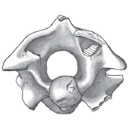
Fossil snakes from the Palaeocene of São José de Itaboraí, Brazil Part III. Ungaliophiinae, Booids incertae sedis, and Caenophidia. Summary, update and discussion of the snake fauna from the localityJean-Claude Rage
Published online: 16/12/2008 |
|

|
Osteology of Prolagus sardus, a Quaternary Ochotonid (Mammalia, Lagomorpha).Mary R. DawsonPublished online: 21/06/1969Keywords: Lagomorpha; Ochotonidae; Prolagus https://doi.org/10.18563/pv.2.4.157-190 Abstract Prolagus sardus is the last representative of the diverse lineages of European endemic ochotonids. It is also the most abundant in the collections. The previous studies made of this species have established rather well its dental morphology, its phylogenetic position, its geographic and temporal distribution, and its intraspecific individual variation. On the other hand, no osteologic study has fully utilized the superb material from Corsica and Sardinia collected by Forsyth Major. PV article infos Published in Vol. 02, Fasc. 4 (1969) |
|

|
Etude paléoneurologique comparative de Parabos Cordieri (De Christol), un bovidae (Mammalia, Artiodactyla) du Pliocène d'Europe Occidentale.Catherine GromolardPublished online: 31/03/1982Keywords: Bovidae; endocranial cast; Europe; Pliocene https://doi.org/10.18563/pv.12.2.57-74 Abstract A skull of Parabos cordieri, undamaged by fossilisation, allows us to make an endocranial cast, which is compared to those of Bos taurus, Boselaphus tragocamelus and Hippotragus equinus. These are studied by general form (shape, volume, « rolling-up›› and inclination), and by detailed morphology (gyri and sulci patterns, rete mirabile, importance of rhinencephalon and cerebellum). PV article infos Published in Vol. 12, Fasc. 2 (1982) |
|

|
A survey of Cretaceous tribosphenic mammals from middle Asia (Uzbekistan, Kazakhstan and Tajikistan), of their geological setting, age and faunal environmentLev A. Nessov, Denise Sigogneau-Russell and Donald E. RussellPublished online: 20/05/1994Keywords: Cretaceous; Environment; Middle Asia; Sharks; Tribosphenic mammals https://doi.org/10.18563/pv.23.1-4.51-92 Abstract This paper is an English concentrate of various Russian publications by the senior author presenting the mammaIian taxa from the Cretaceous (Albian through Santonian) of the region termed Middle Asia by Soviet geographers. The diagnoses are the unmodified, literal translation of the original version, but are followed with short complementary remarks; most of the species are illuslrated anew with SEM photographs, others are by normal photography. The fossiliferous formations are cited and arguments for their dating are given. Finally, the main vertebrate groups accompanying mammaIs are listed and the environment and climate at the time of deposition are suggested. In conclusion, an hypothesis on the origin and high diversity of tribosphenic mammals on the Cretaceous coastal plains of southwest Asia is proposed. In appendix the taxon Khuduklestes bohlini novo gen. novo sp. is formally defined. PV article infos Published in Vol. 23, Fasc. 1-4 (1994) |
|

|
Les rongeurs de l'Eocène d'Afrique Nord-Occidentale [Glib Zegdou ( Algérie) et Chambi (Tunisie)] et l'origine des anomaluridae.Monique Vianey-Liaud
Published online: 20/05/1994 |
|

|
Saturnin Garimond (1914-1987)Jean-Albert RemyPublished online: 15/11/1987Keywords: biography https://doi.org/10.18563/pv.17.3.151-154 Abstract Saturnin Garimond (1914-1987), naturaliste autodidacte né à Fons-outre-Gardon dans le Gard, a marqué la paléontologie et l'archéologie régionale par sa passion précoce pour les sciences naturelles. Quittant l'école à 10 ans, il s'instruit seul et explore inlassablement la garrigue, découvrant des sites préhistoriques dès 1930. Collaborant avec Camille Hugues, il fouille de nombreux gisements, dont la grotte de la Verrerie à Montmirat, révélant un outillage moustérien et des restes de néandertaliens. En 1961, il rejoint le Laboratoire de Paléontologie de Montpellier dirigé par Louis Thaler, contribuant à des fouilles majeures comme celle du gisement de Fons 4. En 1965, il permet la découverte du premier mammifère mésozoïque de France au gisement de Champ-Garimond. Membre de la Société Géologique de France, son érudition et sa collaboration ont enrichi de nombreuses recherches. Homme simple et affable, il a marqué tous ceux qui l'ont connu par son enthousiasme et ses connaissances encyclopédiques. PV article infos Published in Vol. 17, Fasc. 3 (1987) |
|
