
Abstract book of the 18th Conference of the EAVP
Miocene Bovidae (Mammalia) of the Siwaliks: Hypsodontinae and Bovinae
Pterosaurs from Coahuila
Les sélaciens du Miocène de la région de Montpellier
Contribution à l'étude des genres Gliravus et Microparamys.
Muridae du Pliocène supérieur d'Espagne et du midi de la France.
Eocene (57) , Quercy Phosphorites (38) , Systematics (32) , Rodents (29) , Mammalia (27) , Rodentia (25) , Miocene (25)

|
The stratigraphic sequence of North American rodent faunasRobert W. WilsonPublished online: 01/10/1980Keywords: North America; Rodents; Stratigraphic sequence https://doi.org/10.18563/pv.9.ext.273-283 Abstract Rodents first appear in the latest Paleocene or earliest Eocene as very fragmentary specimens (Family Paramyidae) known largely from a single locality. After this sparse beginning, rodents are usually abundant in the North American record if proper recovery methods are used. Utilization of rodents for biostratigraphic purposes depends on 1/ extinction, and 2/ replacement by evolution of endemic groups and/or incursions of Old World rodents, and rarely and late by South American kinds. These incursions are separated by relatively long periods of isolation in the Paleogene, but more episodic in the Neogene. At least 10 rodent zones can be characterized by major distinctions, and these zones can be amplified into as many as 16 with little trouble. In general, rodent genera permit as refined a zonation as do genera of large mammals. Distinction at a specific level has not been attempted herein except in the Blancan and Post-Blancan. PV article infos Published in Vol. 9, Ext (1980) |
|
|
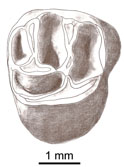
Rodent paleocommunities from the Oligocene of Ulantatal (Inner Mongolia, China)Helder Gomes Rodrigues
Published online: 10/06/2014 |
|

|
Problems of classification as applied to the RodentiaAlbert E. WoodPublished online: 01/10/1980Keywords: https://doi.org/10.18563/pv.9.ext.263-272 Abstract A classification should be both usable and useful,not too complex either in the amount of splitting or in the number of hierarchies involved, and not so simple as to give a false assurance of knowledge of relationships. Classifications are only possible because we do not have complete knowledge of the evolution of the organisms concerned because gaps in the record are necessary to allow the separation of the various taxa. Rodent classification is complicated by the large number of organisms involved and by the geat amount of parallelism that has taken place in the evolution of any and all features. If several independent features are characteristic of a certain taxon, should an effort be made to define the group on the basis of all the features, or should only one be selected as the determinant ? Unless the evolution of the several features was closely linked, the former solution will sooner or later lead to insurmountable problems. PV article infos Published in Vol. 9, Ext (1980) |
|

|
Cricetid and arvicolid rodents of the California wash local fauna, late Blancan of the san Pedro Valley, Arizona.Cristiana MezzabottaPublished online: 15/12/1997Keywords: Arvicolidae; Blancan; Cenozoic; Cricetidae; Mammals https://doi.org/10.18563/pv.26.1-4.189-218 Abstract An assemblage of micromammals is reported from California Wash, a fossil bearing continental deposit in the San Pedro Valley, Arizona, late Blancan in age. Cricetid and Arvicolid rodents are richly represented, including four and two species, respectively. This study mainly focuses on Sígmodon, the most abundant form. The sample of Sigmodon is compared to samples of the same genus from other localities of the San Pedro Valley of comparable age, and some inferences on the taxonomy of the genus are attempted. The specimens are referred to Sigmodon minor and Sigmodon cf. S. curtisi. Other cricetids (Onychomys pedroensis and Baiomys brachygnathus) and arvicolids (Mictomys vetus and Ondatra ídahoensis) are also recognized and described. PV article infos Published in Vol. 26, Fasc. 1-4 (1997) |
|

|
La poche à phosphate de Sainte-Néboule (Lot) et sa faune de vertébrés du Ludien supérieur. 13-RongeursJean-Louis Hartenberger and Monique Vianey-Liaud
Published online: 25/09/1978 |
|

|
Die Ohr-Region der Paulchoffatiidae (Multituberculata, Ober-Jura).Gerhard HahnPublished online: 15/11/1988Keywords: Multituberculata; Ober-Jura; Paulchoffatiidae; Petrosum; Portugal https://doi.org/10.18563/pv.18.3.155-185 Abstract The petrosal of the Paulchoffatiidae HAHN, 1969 is described and compared with that of younger multituberculates and of other Mesozoic mammals. The "Morrison petrosal", described by Prothero (1983), is also discussed; it probably belongs to the multituberculates. The reconstruction of the ventral side of the Paulchoffatiinae-skull, given by Hahn in 1987, is completed by addition of the otic and the occipital region. PV article infos Published in Vol. 18, Fasc. 3 (1988) |
|

|
Les rongeurs de l'Oligocène inférieur d'EscampsMonique Vianey-Liaud
Published online: 01/12/1974 |
|

|
Additions to the elasmobranch fauna from the upper Cretaceous of New Jersey (middle Maastrichtian, Navesink Formation)Gerard R. Case and Henri Cappetta
Published online: 15/12/2004 |
|

|
Compléments sur les Chiroptères de l'Eocène moyen d'Europe. Les genres Palaeochiropteryx et Cecilionycteris.Bernard Sigé and Donald E. RussellPublished online: 01/10/1980Keywords: Chiroptera; Geiseltal; Messel; Middle Eocene https://doi.org/10.18563/pv.9.ext.91-126 Abstract New dental and skeletal material referable to Palaeochiropteryx tupaiodon from the Middle Eocene locality of PV article infos Published in Vol. 9, Ext (1980) |
|

|
Contribution à l'étude des genres Gliravus et Microparamys (Rodentia) de l'Eocène d'Europe.Jean-Louis HartenbergerPublished online: 15/03/1971Keywords: Eocene; Gliravus; Microparamys; Rodentia https://doi.org/10.18563/pv.4.4.97-135 Abstract Based on material found in about 15 localities the relationships of the genera Microparamys and Glirarus have been studied. One new genus, two subgenera and three species [Microparamys (Sparnacomys) chandoni n. subgen. and n. sp., Microparamys (Pantrogna) russelli n. subgen., Eoglirarus wildi n. gen. and n. sp., Gliravus meridionalis n. sp.] as well as the publication PV article infos Published in Vol. 04, Fasc. 4 (1971) |
|

|
Table ronde sur les phosphorites du Quercy Montauban 15-16 Décembre 1972Louis Thaler and Jean-Louis HartenbergerPublished online: 15/11/1974Keywords: Quercy Phosphorites https://doi.org/10.18563/pv.6.1-2.1-3 Abstract Voici une centaine d'années débutait sur les Causses du Quercy l'exploitation des phosphorites qui devait permettre d'amasser des collections de Vertébrés fossiles uniques au monde. Ces fossiles firent l'objet de nombreuses publications et les noms de Filhol, Gaudry, Schlosser, Stehlin, Teilhard de Chardin sont attachés à ces premières études. PV article infos Published in Vol. 06, Fasc. 1-2 (1974) |
|

|
Norselaspis glacialis n.g., n.sp, et les relations phylogénétiques entre les kiaeraspidiens (Osteostraci) du dévonien inférieur du Spitsberg.Philippe Janvier
Published online: 15/06/1981 |
|

|
Lower Paleogene crocodilians from Silveirinha, Portugal.Miguel T. Antunes
Published online: 15/10/2003 |
|

|
The Quaternary avifauna of Crete, Greece.Peter D. WeesiePublished online: 01/09/1988Keywords: Avifauna; Crete; Quaternary; Systematics https://doi.org/10.18563/pv.18.1.1-94 Abstract Pleistocene bird fossils have been studied from nine localities on Crete. Part of this material was described earlier by the author (Weesie, 1982) and will not be treated here in extenso, the results will be incorporated. More than one third of the over 10,000 fossil bird bones available could be identified ; they were found to represent at least 65 bird species. The following species of the Pleistocene Cretan avifauna are new to the fauna of Crete : Branta ruficollis, Haliaeetus albicilla, Gyps melitensis, Aquila chrysaetos simurgh n. ssp., Ketupa zeylomensis, Aegolius funereus, Dendrocopos leucotos, Zoothera dauma, Turdus iliacus and Pyrrhula pyrrhula. The Pleistocene Cretan avifauna differs less from comparable mainland avifaunas than (fossil) avifaunas from oceanic islands do. Still, the Pleistocene Cretan avifauna has two qualities that are characteristic of island avifaunas : the almost complete absence of a group of birds (the Galliformes) and the presence of two endemic (sub)species : the giant eagle Aquila chrysaetos simurgh n. ssp. and the long-legged owl Athene cretensis (Weesie, 1982). The new subspecies is described in the present study. PV article infos Published in Vol. 18, Fasc. 1 (1988) |
|

|
Owls, caves and fossils. Predation, preservation and accumulation of small mammal bones in caves, with an analysis of the Pleistocene cave faunas from Westbury-Sub-Mendip, Somerset, UK, par Peter Andrews, 1990. The University of Chicago Press, 232 p.Christiane Denys
Published online: 17/12/1992 |
|

|
Nouvelle quantification de l'Hypsodontie chez les Theridomyidae : l'exemple de Theridomys ludensis nov. sp.Monique Vianey-Liaud
Published online: 30/12/1985 |
|

|
Types dentaires adaptatifs chez les sélaciens actuels et post-paléozoïques.Henri Cappetta
Published online: 01/09/1986 |
|

|
Les Bovidae (Artiodactyla, Mammalia) du Miocène moyen de la formation Hofuf (Province du Hasa, Arabie Saoudite).Herbert ThomasPublished online: 30/12/1983Keywords: Biostratigraphy; Bovidae; Middle Miocene; Palaeogeography; Saudi Arabia https://doi.org/10.18563/pv.13.5.157-206 Abstract The study of the bovids from Al Jadidah (Hofuf Formation, Saudi Arabia) confirms that the fauna comes from a pre-Hipparion level. The Al Jadidah age is close to that of Fort Ternan (14 m.y.) and Beni Mellal, but cannot be older than that of Fort Ternan. The age of the Hofuf Formation is close to but slightly older than the oldest deposits of the Ngorora Formation (Kenya). 7 to 9 species have been recorded, of which 2 to 4 remain indeterminate. If the great specific diversity of te bovids from this locality gives evidence of immigrations from anterior Asia (Turkey) (e.g. Pachytragus Iigabuei sp. nov.), the bovid assemblage of Al Jadidah results in fact from a double influence: from the anterior Asia and mainly from Africa (e.g. the Caprotragoides lineage and the Neotragini? Homoiodorcas). The Al Jadidah bovids reflect, on the whole, the predominant character of open to very open environment, which supports the conclusions drawn from our two preliminary studies. PV article infos Published in Vol. 13, Fasc. 5 (1983) |
|

|
Contributions à l'étude des micromammifères du gisement Miocène supérieur de Montredon (Hérault). 1- Le gisementJean-Pierre Aguilar and Jean-Yves CrochetPublished online: 30/06/1982Keywords: Hérault; Late Miocene; Micromammals; Montredon https://doi.org/10.18563/pv.12.3.75-79 Abstract La localité fossilifère du Puech de Montredon, désignée plus communément sous le nom de Montredon, est située sur la commune de Montouliers (Hérault) à quelques 300 mètres de la limite avec le département de l'Aude. Elle a été découverte en 1845 par Narbonne, Directeur des Mines de La Caunette, et de très nombreux restes de vertébrés continentaux y ont été extraits. La plus ancienne mention de ce gisement dans la littérature semble être celle de Lartet (1859) qui signale que "M. Jourdan, de Lyon, a constaté à Montredon, près de Bize (Aude), l'association des restes de Dinotherium avec l'Hipparion". PV article infos Published in Vol. 12, Fasc. 3 (1982) |
|

|
La palichnofaune de vertébrés tétrapodes du permien supérieur du Bassin de Lodève (Languedoc-France).Georges Gand, Jacques Garric, Georges Demathieu and Paul EllenbergerPublished online: 15/09/2000Keywords: Footprints; France; Languedoc; Lodève basin; new ichnotypus; Saxonian; Upper Permian https://doi.org/10.18563/pv.29.1.1-82 Abstract Near "la Lieude", in the Lodève basin, more than a thousand of footprints are distributed in a twenty of trackways which amounts to 220 m length. They have been found on calcareous siltstone level in the B site named also "Réserve Naturelle Volontaire". This last is located in the Saxonian summit dated Upper Permian. "La Lieude" tracks are described by using statistical methods then they are compared with others from the world Permian. What allows to distinguish 4 following ichnotaxa: Lunaepes ollierorum nov.ichnosp., Merifontichnus thalerius nov. ichnogen. and nov. ichnosp., Planipes brachydactylus nov.ichnosp. and Brontopus circagiganteus nov. ichnosp. All these traces are attributed with possibility or probability to Therapsida or to Therosauria, except Brontopus circagiganteus nov. ichnosp. that could be due to Caseamorpha. All these animals whose sizes have been estimated between l and 5 m lived probably in a playa environment.The biological and sedimentological data from "la Lieude" footprints levels compared with informations provided by the tracks orientations, suggest the following scenario. Animals coming from the North have crossed a sandy channel bank with plants zones by directing to the South for the majority. Maybe, they were going to the lacustrine part of the playa, close to "la Lieude" footprints that they have just trampled on. PV article infos Published in Vol. 29, Fasc. 1 (2000) |
|
