
Abstract book of the 18th Conference of the EAVP
Miocene Bovidae (Mammalia) of the Siwaliks: Hypsodontinae and Bovinae
Pterosaurs from Coahuila
Les sélaciens du Miocène de la région de Montpellier
Contribution à l'étude des genres Gliravus et Microparamys.
Muridae du Pliocène supérieur d'Espagne et du midi de la France.
Eocene (57) , Quercy Phosphorites (38) , Systematics (32) , Rodents (29) , Mammalia (27) , Rodentia (25) , Miocene (25)

|
|
|

|
Archosauriform teeth from the upper Triassic of Saint Nicolas-de-Port (Northeastern France).Pascal Godefroit
Published online: 15/12/1997 |
|

|
Skeleton of early Eocene Homogalax and the origin of PerissodactylaKenneth D. RosePublished online: 16/12/1996Keywords: Eocene; Homogalax; Perissodactyla; Skeletal Anatomy https://doi.org/10.18563/pv.25.2-4.243-260 Abstract The first good skeletal remains of Homogalax protapirinus from the Wasatchian of the Bighorn Basin, Wyoming, indicate that this primitive tapiromorph was more plesiomorphic in many features than primitive equoids including Hyracotherium. Compared to Hyracotherium, Homogalax more closely resembles Phenacodonta (the closest outgroup of Perissodactyla for which postcrania are known) in various details of articular surfaces, muscle attachments, and proportions of the humerus, manus, and pes.Among known taxa, Homogalax most nearly approximates the plesiomorphic postcranial skeletal anatomy of Perissodactyla. PV article infos Published in Vol. 25, Fasc. 2-4 (1996) |
|

|
Les serpents des phosphorites du QuercyJean-Claude Rage
Published online: 20/12/1974 |
|

|
Les oiseaux aquatiques (Gaviiformes à Anseriformes) du gisement Aquitanien de Saint-Gerand-le-Puy (Allier, France): Révision systématique.Jacques ChenevalPublished online: 01/11/1984Keywords: Aves; Early Miocene; Osteology; Palaeoecology; Systematics https://doi.org/10.18563/pv.14.2.33-115 Abstract Six orders of birds adapted to aquatic life are represented among the numerous avifauna of "Saint-Gérand-le-Puy": Gaviiformes, Procellariiformes, Pelecaniformes, Ciconiiformes, Phoenicopteriformes, and Anseriformes. The present study of this avifauna proposes several changes in systematics:- Procellariiformes: Puffinus arvernensis does not belong in Procellariidae but in Diomodeidae, and it is transferred to the fossil genus Plotornis previously described in the Middle Miocene of France. - Pelecaniformes: Phalacrocorax littoralis remains in Phalacrocoracidae; P. míocaenus is different from the modern species, and is transferred to the new genus Nectornis. Empheresula arvernensis, described in the Oligocene deposits of Gannat, seems to be present in Saint-Gérand-le-Puy too. Pelecanus gracilis shows many differences from the modern species, and belongs to the new genus Miopelecanus, - Ciconiiformes: Ardea formosa nom. oblit. is a synonym of Proardeola walkeri. - Anseriformes: a new species closely related to swans is described, and belongs to the fossil genus Cygnopterus, of the Middle Oligocene of Europe; this species is called C. alphonsi. The ecology of each species is suggested by comparison with that of its nearest living relatives, and by study of osteological adaptations. PV article infos Published in Vol. 14, Fasc. 2 (1984) |
|

|
Contributions à l'étude des micromammifères du gisement Miocène supérieur de Montredon (Hérault). 2- Les rongeursJean-Pierre AguilarPublished online: 30/06/1982Keywords: Hérault; Late Miocene; Micromammals; Montredon; Rodents https://doi.org/10.18563/pv.12.3.81-117 Abstract The recent excavation of the Upper Miocene locality of Montredon (Hérault) provides a rich material of Mammals. The present study deals with rodents. The new quarry is 10 meters above the classical Depéret's Quarry. No differences have been noticed between the rodent populations coming grom these two sites. The description of two new species : Hispanomys mediterraneus and Muscardinus heintzi is given and the dormouse Eliomys is recorded there for the first time. The new zonation of the Miocene given by Aguilar (1982) and the previously established correlations between marine and continental chronological scales give Tortonien age (estimated between 9 and 10 M.Y. old) to the site of Montredon, which belongs to the Mammal zone D 2. PV article infos Published in Vol. 12, Fasc. 3 (1982) |
|

|
Rongeurs du Miocène inférieur et moyen en Languedoc. Leur apport pour les correlations Marin-Continental et la Stratigraphie.Jean-Pierre AguilarPublished online: 31/03/1980Keywords: Languedoc; Miocene; Rodents; Southern France https://doi.org/10.18563/pv.9.6.155-203 Abstract The rodents (Cricetidae, Gliridae, Sciuridae) found in lacustrine, brackish marine and karstic sediments of Miocene age in Languedoc, assign the position of the different localities in the scale of "niveaux repères" used by mammalogists. Some detailed stratigraphical studies bring several correlations between this continental biochronological scale and the marine scale ; the most important results are the Aquitanian age of the "niveaux repères" of Coderet and Paulhiac, the Burdigalian age of Laugnac, Estrepouy, Vieux-Collonges, La Romieu and Sansan and the Langhian or Lower Serravallian age of La Grive M. The correlations between the Tethys and the Central Paratethys for the Lower Neogene profit also of these results, since the locality of Neudorf Spalte 1, 2 (Czechoslovakia) is shown to be younger than Sansan (France). The paleontological study has also several geological inferences for the Miocene of Languedoc ; with the calibration of this Miocene, we know quite precisely that the Lower Miocene is chiefly a time lacustrine sedimentation, and also that the marine Miocene sedimentation ends early in the Miocene Period, in Langhian or lower Serravallian times. PV article infos Published in Vol. 09, Fasc. 6 (1980) |
|

|
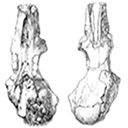
Evolution des Aplodontidae Oligocènes EuropéensNorbert Schmidt-Kittler and Monique Vianey-Liaud
Published online: 01/10/1979 |
|
|
Rongeurs Miocènes dans le valles-Penedes 1 : Les rongeurs de Can Ponsic 1Jean-Louis Hartenberger and Miquel Crusafont i PairóPublished online: 20/04/1979Keywords: Can Ponsic 1; Miocene; Rodents; Valles-Penedes https://doi.org/10.18563/pv.9.1.1-15 Abstract The rodents from the spanish locality of Can Ponsic 1 bring new data about some rodents species of the beginning of the Upper Miocene in South-West Europe. The criticims made by Mein and Freudenthal about the validity of the species Hispanomys thaleri from Can Llobateres are not justiíied. The study of the anatomy of the skull of Rotundomys from Can Ponsic 1 gives accurate information about the affinity of this genus with Cricetulus, and shows that the hypothesis, according to which Rotundomys is an ancestral form of the Arvicolids, is unlikely. The systematics of Heteroxerus and the phylogeny of the mio-pliocene Muscardinus species are also discussed. The Can Ponsic 1 locality is a little older than Can Llobateres. PV article infos Published in Vol. 09, Fasc. 1 (1979) |
|

|
Anatomie du membre antérieur chez un chiroptère Molossidé (Tadarida sp.) du Stampien de Cereste (Alpes-de-Haute-Provence).Bernard SigéPublished online: 01/01/1971Keywords: Chiroptera; Molossidae; Oligocene https://doi.org/10.18563/pv.4.1.1-38 Abstract The present study describes in detail the anterior limb osteology of a molossid chiropteran of the genus Tadarida, from Céreste, a Stampian locality in the Apt-Forcalquier Oligocene basin already known for its fishes, plants and insects. PV article infos Published in Vol. 04, Fasc. 1 (1971) |
|

|
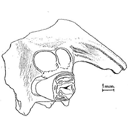
Additions to the elasmobranch fauna from the upper Cretaceous of New Jersey (middle Maastrichtian, Navesink Formation)Gerard R. Case and Henri Cappetta
Published online: 15/12/2004 |
|
|
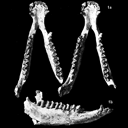
Les Paramyidae (Rodentia) de l'Eocène inférieur du bassin de Paris.Jacques MichauxPublished online: 15/07/1968Keywords: Ailuraviinae; Eocene; Paramyinae; Rodents https://doi.org/10.18563/pv.1.4.135-193 Abstract The exploitation of new early Eocene localities in the Paris Basin has resulted in the collecting of numerous mammalian remains, among which are about 300 isolated teeth representing the rodents. They belong, for the most part, to the paramyid group. Only the latest level of the early Eocene has yielded rodents belonging to the pseudosciurid group. The paramyids, the object of this study, are represented by at least 5 genera and 10 species; they are distributed among 4 clearly dilferentiated subfamilies : Paramyinae Simpson 1945, Pseudoparamyinae Michaux 1964, Ailuraviínae n. subf., Microparamyinae Wood1962. PV article infos Published in Vol. 01, Fasc. 4 (1968) |
|
|
Les Palaeotheridae (Perissodactyla) de la faune de Mammifères de Fons 1 (Eocène supérieur).Jean-Albert RemyPublished online: 15/06/1967Keywords: Anchilophus; Eocene; Pachynolophus; Palaeotheriidae; Perissodactyla https://doi.org/10.18563/pv.1.1.1-46 Abstract The locality of Fons 1, one of the fossiliferous outcrops in the late Eocene limestones of Fons-outre-Gardon (Gard), has yielded varied remains of mammals. The specimens were prepared by dilute acetic acid attack on the rock and by impregnation with an acrylic resin. PV article infos Published in Vol. 01, Fasc. 1 (1967) |
|

|
The eosimiid and amphipithecid primates (Anthropoidea) from the Oligocene of the Bugti hills (Balochistan, Pakistan): new insight into early higher primate evolution in South Asia.Laurent Marivaux
Published online: 15/10/2006 |
|
|
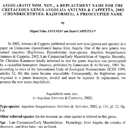
Angolabatis nom. nov.,a replacement name for the Cretaceous genus Angolaia Antunes & Cappetta, 2002 (Chondrichthyes: Rajiformes), a preoccupied name.Miguel T. Antunes
Published online: 15/10/2006 |
|

|
Rongeurs Caviomorphes de l'Oligocène de Bolivie. 2 Rongeurs du Bassin Deseadien de Salla-Luribat.René LavocatPublished online: 01/08/1976Keywords: cranium; Paleobiogeography; Rodentia https://doi.org/10.18563/pv.7.3.15-71 Abstract The fauna studied in the following work involves the dentitions and skulls more or less complete of 5 genera, among which only Cephalomys was previously known by its skull. One must notice that the Salla's species of this genus is a new one. Sallamys, rather small, shows a dentition rather similar to that of Platypittamys Wood from Patagonia. The upper molars, more primitive than those of this last genus, according to the smaller dimensions of the hypocone, retain a distinct metaloph. This metaloph tends to be reduced in a way which may give us a possibility to understand how it disappeared in Platypittamys. The upper P4 can be compared as well to that of Platypittamys as to that of Gaudeamus from the African Oligocene. The lower P4, more molarized than that of Platypittamys, is already moving towards the miocene type of structure. The infraorbital foramen is wide and the insertion of the masseter on the muzzle is spacious. Branisamys, genus of a great size, shows an auditory region partly preserved, peculiarly the promontorium with the fenestra rotunda, entirely of the Hystricognathi type. Upper molars are very clearly pentalophodont. A new reconstruction is proposed for the tooth called Villarroelomys by Hartenberger. This tooth is shown to be a lower D4, perhaps of Branisamys , certainly of a rather nearly allied form, and Hartenberger does agree with the essential part of this new conclusion. Of Incamys, two incomplete skulls are known, each one being admitted to be the type of a distinct species, the first one being I. bolivianus, I. pretiosus the second. The infraorbital foramen is of a great size and the impression of the masseter on the muzzle is spacious. The sphenopalatine foramen is widely developed and of a really very uncommon great size. Only Thryonomys from Africa shows a similar tendency to the enlargement of this foramen, but not so extreme. The main basicranial foramina can be observed. The upper teeth, hemi-hypsodont, show, either a vestigial metaloph, similar to that of recent Thryonomys from Africa, associated with a well developed mesoloph, either a well developed metaloph, while the mesoloph is reduced or absent. Cephalomys was previously known by anterior parts of the skull showing a wide infraorbital foramen and a spacious facial insertion of the masseter. Its lacrymal is of the phiomorph type and the spheno-palatine foramen is seemingly of great size, like in Incamys. The species is new. The varied peculiarities of the upper teeth of these genera can be easily understood if we refer to the plan of the teeth of Phiomys andrewsi from the Oligocene and Miocene of Africa. The structure of this genus, clearly more primitive, still typically brachyodont, shows and clearly explains the fundamental coherence of the varied realisations arised from such a structure. Luribayomys n.g. is known only by an anterior half of a skull without teeth. It is remarquable by the great development of the masseter's insertions on the muzzle and by the lacrymal region, well preserved, typically phiomorphid. The classification previously published by A.E. Wood and B. Patterson is granted in its essential parts, provisionally, but not as a definitive solution. Nevertheless the Dasyproctidae are integrated within the Cavioidea, following the conclusions of Bugge and of Vucetich, reached independently. The conclusion emphasizes the exceptional meaning of the fauna of Salla-Luribay. This shows that Platypittamys, while interesting, can no more be supposed certainly representative of the normal structure of the Oligocene Caviomorph, and not even of their ancestors. The anatomical peculiarities exhibited in these new samples, auditory region, lacrymal, spheno-palatine foramen, reinforce the primitive structural identity with the Phiomorpha. Similarly, the new lower D4 favour very close relationships, ever if the affinities of the D4 has been questioned or minimized by Wood and Patterson. It is certainly possible to admit that parallelism could explain limited similarities, like the presence in North America of Rodents with an hystricomorph type of infraorbital foramen and an hystricognath mandible. But if the parallelism could be a sufficient explanation of the identical association of multiple and complete structures observed in the Caviomorpha and Phiomorpha, all the Zoological systematic would have to be questioned. The last positions of A.E. Wood on the subject (1975) are revised and criticised, and the recent publications studying the problems of distance between Africa and South America in Eocene time, as a consequence of the drift, are quoted; the possibility of transportation by rafts is shown. A new hypothesis is proposed about the interrelationships of Pentalophodont Rodents, with interesting paleobiogeographic implications. PV article infos Published in Vol. 07, Fasc. 3 (1976) |
|

|
Les Issiodoromyinae (Rodentia, Theridomyidae) de l'Eocène supérieur à l'Oligocène supérieur en Europe occidentaleMonique Vianey-Liaud
Published online: 15/05/1976 |
|

|
Hexanchiforme nouveau (Neoselachii) du Crétacé inférieur du Sud de la FranceHenri Cappetta
Published online: 18/12/1990 |
|

|
Additions of the Geiseltal mammalian faunas, Middle Eocene: Didelphidae, Nyctitheriidae, Myrmecophagidae.Gerhard Storch and Hartmut HauboldPublished online: 04/12/1989Keywords: Edentata; Geiseltalian; German Democratic Republic; Lipotyphla; Marsupialia; MP 11-13 https://doi.org/10.18563/pv.19.3.95-114 Abstract New and hitherto unpublished mammals from the stratigraphical levels Unterkohle, Untere Mittelkohle and Obere Mittelkohle of the Geiseltal near Halle, GDR, are described (= biochronological levels MP 11-13, Geiseltalian sensu Franzen & Haubold 1986a, b). The marsupial taxa Amphiperatherium aff. maximum (MP 12), A. goethei (MP 12), and Peratherium aff. monspeliense (MP 12 and 13) are recorded for the first time. A lectotype for Amphiperatherium giselense is designated, and the alleged primate Microtarsioides voigzi is assigned to Marsupialia, incertae sedis. A new insectivore species, Saturninia ceciliensis n. sp., is described (MP 13). The anteater Eurotamandua joresi is recorded for the first time outside its type locality, Grube Messel, FRG (MP 11). The present humerus and ulna display the autapomorphic features of the myrmecophagids. PV article infos Published in Vol. 19, Fasc. 3 (1989) |
|

|
Contributions à l'étude du gisement Miocène supérieur de Montredon (Hérault). Les grands mammifères. 1 - Les LagomorphesNieves Lopez-MartinezPublished online: 15/11/1988Keywords: Lagomorpha; Montredon; Prolagus; Upper Miocene https://doi.org/10.18563/pv.18.ext.3-14 Abstract A sample of 231 isolated teeth of lagomorphs from the upper Miocene of Montredon (southern France), identified as the ochotonid Prolagus crusafonii DOPEZ, 1975, is studied, comparing it with other populations of the same species as well as with its closest species P. oeningensis (KÖNIG, 1825). PV article infos Published in Vol. 18, Ext (1988) |
|
