
Abstract book of the 18th Conference of the EAVP
Pterosaurs from Coahuila
Pliocene-Pleistocene large mammals from Le Riège and Saint-Palais
Les sélaciens du Miocène de la région de Montpellier
Muridae du Pliocène supérieur d'Espagne et du midi de la France.
Contribution à l'étude des genres Gliravus et Microparamys.
Eocene (57) , Quercy Phosphorites (38) , Systematics (32) , Rodents (29) , Mammalia (27) , Rodentia (25) , Miocene (24)

|
Origins of avian reproduction: answers and questionsfrom dinosaurs.David J. Varricchio
Published online: 15/12/2003 |
|

|
Les insectivores des phosphorites du QuercyJean-Yves CrochetPublished online: 15/11/1974Keywords: Insectivores; Quercy Phosphorites https://doi.org/10.18563/pv.6.1-2.109-159 Abstract Many types of insectivores have been described from specimens found in the Quercy phosphorites. These remains very often were not dated because they came from old collections. Recent excavations have permitted the situation of Amphidozotherium cayluxi FILHOL in the late Eocene. Two new genera are descrlbed based on material both from the old collections (Cryplotopos nov. g.) and from that recently recovered (Darbonetus nov. g., beginning of the middle Oligocene). Their systematic positions are revised and comparisons with American faunas are made. Amphidozotherium is not a talpid, but an erinaceoid belonging to an indeterminate family. Saturninia gracilis STHELIN is classified among the Nyctitheriinae, Myxomygale antiqua FILHOL among the Urotrichini Talpinae, and the genus Geotypus POMEL among the Scaptonichini Talpinae. A new study of the talpids from Auvergne has been rendered necessary. During the late Eocene and Oligocene precise morphology relationships existed between certain insectivores of Europe and North America. PV article infos Published in Vol. 06, Fasc. 1-2 (1974) |
|

|
Morphotypes dentaires actuels et fossiles des chiroptères vespertilionines. 2ème partie: implications systématique et phylogéniques.Henri MenuPublished online: 15/11/1987Keywords: Chiroptera; PHYLOGENY; Systematics; Vespertilionine https://doi.org/10.18563/pv.17.3.77-150 Abstract The first part of this study was devoted to a descriptive analysis of teeth morphologies among the vespertilionine bats. This leads now to a tentative synthesis, providing views on the systematics of the group. The results could be seen according to three distinct but closely related purposes : 1 - the sorting of the genera contents in order to conform the genera units to homogeneous taxa that could represent natural issues of evolutionary lineages ; 2 - the investigation of relationships between extant genera in order to infer the possibilities of common origin ; 3 - according to the preceeding items and to the observed evolutionary trends, a tentative phylogeny, modest and cautious. The contents of many genera are sorted : Leuconoe is removed from subgeneric to generic position, whereas Myotis becomes a subgenus of it ; the myotodont species are cleared away from the Pipistrellus genus ; Glischropus and Scotozous are synonymized within Pipistrellus ; Hypsugo is raised to the generic level ; some species previously ranged within Pipistrellus will form provisionally a collective group, Attalepharca nov. ; the Eptesicus genus is broken up, the excluded species being grouped within Nycterikaupius gen. nov. ; the Nycticeini tribe is defined again after exclusion of Otonycteris , Scotoecus, Scotophilus , and addition of Hesperoptenus ; the species la io and Pipistrellus tasmaniensis are removed to Eptesicus (n.s.) and Pipistrellus dormeri to Scotoecus. Groupings of genera are stated according to the main evolutionary trends of I1/. The relevance of these is often warranted by close morphologic similarities of other teeth. This leads to a recognition of the major evolutionary radiations which occurred in the group. The filiations schematized at the end of the work show the dental relationships observed between the extant genera, and could represent a phylogenic framework. Two major facts are to be underlined : 1- the early divergence of leuconoids ; 2 - the successives crossings to myotodonty from the nyctaloid flow. Fossil data from the literature are punctually and tentatively incorporated within phylogenic sketches. PV article infos Published in Vol. 17, Fasc. 3 (1987) |
|

|
Artiodactyla aus den Eozänen Braunkohlen des Geiseltales bei Halle (DDR)Jorg Erfurt and Hartmut HauboldPublished online: 04/12/1989Keywords: Artiodactyles; Eocene; Europe; Paleoecology; Stratigraphy; taxonomy https://doi.org/10.18563/pv.19.3.131-160 Abstract The present study of Artiodactyla from the Middle Eocene of the Geiseltal lignite beds concems systematics, biostratigraphy, and palaeoecology on the basis of 174 specimens: isolated remains to more complete skeletons. Instead of the formerly known five species of two families are now recognized 14 species of the Diacodexeidae, Dichobunidae, Cebochoeridae, and Haplobunodontidae. New species are Aumelasia maniai, Anthracobunodon neumarkensis, Masillabune franzeni. Four species of the Geiseltalfauna are definitely known from elswere, and five species are closely related to those from other European localities. Evidently the faunal situation of artiodactyls during the Middle Eocene of Europe was largely uniform. The distribution of artiodactyls within the sequence of the Geiseltal strata corroborates the biostratigraphical concept of the land mammal age Geiseltalian (Franzen & Haubold l986b) as well as the mammalian reference levels MP 11-13 (Franzen 1987). Reconstructions of the skulls and skeletons allow conclusions on the functional morphology and palaeoecology of the artiodactyls of the European Middle Eocene PV article infos Published in Vol. 19, Fasc. 3 (1989) |
|
|
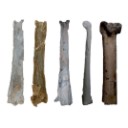
The geologically youngest remains of an ornithocheirid pterosaur from the late Cenomanian (Late Cretaceous) of northeastern Mexico with implications on the paleogeography and extinction of Late Cretaceous ornithocheiridsEberhard Frey
Published online: 21/07/2020 |
|

|
Cricetid rodents from Siwalik deposits near Chinji village. Part I: Megacricetodontinae, Myocricetodontinae and Dendromurinae.Everett H. Lindsay
Published online: 15/10/1988 |
|

|
Revision der Equoidea aus den Eozänen Braunkohlen des Geiseltales bel Halle (DDR).Jens L. Franzen and Hartmut HauboldPublished online: 15/04/1986Keywords: Eocene; Europe; Mammalia; Perissodactyla; Stratigraphy; taxonomy https://doi.org/10.18563/pv.16.1.1-34 Abstract The dentitions as well as one complete and several partial skeletons of Equoids from the Eocene lignite beds of the Geiseltal locality are revised. Instead of 13 species distinguished up to now 3 chronoclines with 5 species and 3 separate species are recognized (text. fig. 1). Propalaeotherium hassiacum HAUPT, 1925 is evolving into Propalaeotherium isselanum (CUVIER, 1824) between the levels of the « obere Unterkohle ›› and the « untere Mittelkohle ›› of the Geiseltal section. Propalaeotherium argentonicum GERVAIS, 1849 is shown to be present in the « untere Unterkohle ››, whereas Lophiotherium pygmaeum (DEPERET,1901) occurs in the « obere Mittelkohle ›› and in the « oberes Hauptmittel ››. Plagiolophus cartieri STEHLIN, 1904 appears during the transition from the « Mittelkohle ›› into the « Oberkohle ›› as the earliest true Palaeothere. Therefore the « Oberkohle ›› is already regarded as Upper Eocene. This is corroborated by the occurrence of a phyletic descendant of Propalaeatherium parvulum (Propalaeotherium n.sp.) in the middle and upper "Oberkohle " because this species appears otherwise for the first time at the mammal level of Lissieu. On the other hand Propachynolophus gaudryz (LEMOINE, 1878) described by Matthes (1977) from the « untere Unterkohle ›› turns out te be in fact a Phenacodont. Thus the decisive argument for classifying the « untere Unterkohle ›› as Lower Eocene has to be dropped. Biostratigraphically the « Unterkohle ›› and the «Basishauptrnittel ›› correspond with the lower Middle Eocene (mammal level of Messel), whereas the «unteres Hauptmittel ›› and the « untere Mittelkohle ›› are equivalent to the middle part of the middle Eocene (mammal level of lssel), and the « obere Mittelkohle ›› together with the « oberes Hauptmittel ›› coincide with the upper Middle Eocene (mammal level of Bouxwiller). PV article infos Published in Vol. 16, Fasc. 1 (1986) |
|

|
Experimental taphonomy inavian eggs and eggshells: effects on early diagenesis.Ana M. Bravo, D. A. Buscalioni
Published online: 15/12/2003 |
|

|
Les Gruiformes (Aves) des phosphorites du Quercy (France). 1. sous-ordre cariamae (Cariamidae et Phorusrhacidae), systématique et biostratigraphie.Cécile Mourer-Chauviré
Published online: 30/11/1983 |
|

|
Les Amphibiens et les reptiles du Pliocène supérieur de Balaruc II (Herault, France)Salvador Bailon
Published online: 15/09/1989 |
|

|
A survey of Cretaceous tribosphenic mammals from middle Asia (Uzbekistan, Kazakhstan and Tajikistan), of their geological setting, age and faunal environmentLev A. Nessov, Denise Sigogneau-Russell and Donald E. RussellPublished online: 20/05/1994Keywords: Cretaceous; Environment; Middle Asia; Sharks; Tribosphenic mammals https://doi.org/10.18563/pv.23.1-4.51-92 Abstract This paper is an English concentrate of various Russian publications by the senior author presenting the mammaIian taxa from the Cretaceous (Albian through Santonian) of the region termed Middle Asia by Soviet geographers. The diagnoses are the unmodified, literal translation of the original version, but are followed with short complementary remarks; most of the species are illuslrated anew with SEM photographs, others are by normal photography. The fossiliferous formations are cited and arguments for their dating are given. Finally, the main vertebrate groups accompanying mammaIs are listed and the environment and climate at the time of deposition are suggested. In conclusion, an hypothesis on the origin and high diversity of tribosphenic mammals on the Cretaceous coastal plains of southwest Asia is proposed. In appendix the taxon Khuduklestes bohlini novo gen. novo sp. is formally defined. PV article infos Published in Vol. 23, Fasc. 1-4 (1994) |
|

|
Henri Menu, 1925-2007Bernard SigéPublished online: 16/12/2008Keywords: bats; biography https://doi.org/10.18563/pv.36.1-4.1-5 Abstract Record of life and works of Henri Menu, French zoologist, contributor to the knowledge of living and fossil bats. PV article infos Published in Vol. 36, Fasc. 1-4 (2008) |
|
|
|
|

|
Pantolestidae nouveaux (Mammalia, Insectivora) de l'Eocène moyen de Bouxwiller (Alsace).Jean-Jacques Jaeger
Published online: 31/03/1970 |
|

|
Contributions à l'étude du gisement Miocène supérieur de Montredon (Hérault). Les grands mammifères. 5 - Les périssodactyles EquidaeVéra EisenmannPublished online: 15/11/1988Keywords: Equidae; Hipparion; Late Vallesian; Mammalia; Montredon; Perissodactyla https://doi.org/10.18563/pv.18.ext.65-96 Abstract Revision of the hipparion material from Montredon, including newly excavated and other unpublished specimens brings evidence of specific heterogeneity. PV article infos Published in Vol. 18, Ext (1988) |
|

|
Saturnin Garimond (1914-1987)Jean-Albert RemyPublished online: 15/11/1987Keywords: biography https://doi.org/10.18563/pv.17.3.151-154 Abstract Saturnin Garimond (1914-1987), naturaliste autodidacte né à Fons-outre-Gardon dans le Gard, a marqué la paléontologie et l'archéologie régionale par sa passion précoce pour les sciences naturelles. Quittant l'école à 10 ans, il s'instruit seul et explore inlassablement la garrigue, découvrant des sites préhistoriques dès 1930. Collaborant avec Camille Hugues, il fouille de nombreux gisements, dont la grotte de la Verrerie à Montmirat, révélant un outillage moustérien et des restes de néandertaliens. En 1961, il rejoint le Laboratoire de Paléontologie de Montpellier dirigé par Louis Thaler, contribuant à des fouilles majeures comme celle du gisement de Fons 4. En 1965, il permet la découverte du premier mammifère mésozoïque de France au gisement de Champ-Garimond. Membre de la Société Géologique de France, son érudition et sa collaboration ont enrichi de nombreuses recherches. Homme simple et affable, il a marqué tous ceux qui l'ont connu par son enthousiasme et ses connaissances encyclopédiques. PV article infos Published in Vol. 17, Fasc. 3 (1987) |
|

|
Fossil mammals and the age of the changxindian formation, Northeastern ChinaSpencer G. LucasPublished online: 16/12/1996Keywords: Changxindian Formation; China; Eocene; Fossil mammals Abstract Re-evaluation of the small collection of mammal fossils from the Changxindian Formation near Beijing, China indicates the following taxa are present: Eutheria, Hypsimilus beifingensis, cf. Miacis sp., Anthracotheriidae and Forstercooperia grandis. The presence of Forstercooperia grandis indicates an Irdinmanhan age and does not support previous assignment of a Sharamurunian age to the Changxindian Formation. PV article infos Published in Vol. 25, Fasc. 2-4 (1996) |
|

|
La région des phosphorites du QuercyA. CavailléPublished online: 15/11/1974Keywords: Quercy Phosphorites https://doi.org/10.18563/pv.6.1-2.5-19 Abstract L'exploitation des phosphates s'est produite surtout de 1890 à 1914 de Saint-Antonin à Cajarc, sur le Causse de Limogne, dont l'histoire géologique et morphologique peut expliquer les conditions de gisement du minerai, et aussi la découverte des nombreux, variés et beaux fossiles qu'on a extrait des poches en même temps que la phosphorite. Le Causse de Limogne est le nom donné par les géographes au plateau calcaire, faisant partie des Causses du Quercy, et compris entre la vallée du Lot au Nord et celle de "Aveyron au Sud". En fait, le nom de "causse" désigne localement un terroir, un paysage, à sous-sol de calcaire, à sol peu épais, qui s'oppose aux sols argileux des « terreforts » et aux sols légers et profonds des "boulbènes". Chaque communauté agricole distinguait ainsi son causse, par exemple le causse de Caylus, le causse de Limogne ou le causse de Cajarc. C'est par extension que l'appellation Causse de Limogne désigne tout un petit pays. La présence des poches à phosphate déborde un peu vers le Nord la vallée du Lot, et vers l'Est le Causse de Limogne proprement dit (Causse de Villeneuve). PV article infos Published in Vol. 06, Fasc. 1-2 (1974) |
|

|
Les rongeurs de l'Oligocène inférieur d'EscampsMonique Vianey-Liaud
Published online: 01/12/1974 |
|

|
Etude du crâne de Pachynolophus lavocati n. sp. (Perissodactyla, Palaeotheriidae) des Phosphorites du QuercyJean-Albert RemyPublished online: 15/02/1972Keywords: Perissodactyla; Quercy Phosphorites https://doi.org/10.18563/pv.5.2.45-78 Abstract The genus Pachynolophus, one of the poorest known of the Palaeotheriidae, includes the brachyodont forms with reduced and non-molariform premolars and with upper molars lacking a mesostyle. Quantitative characters (divers surface indications and elongation of the teeth), while demonstrating a close relationship to Hyracotherium, permit a better differentiation of the genus, confirm its specific splitting, and permit the distinction of three lineages. The skull from Memerlein is taken as the type of a new species, P. Iavocati, of which the dentition is extremely characterized by its lophiodonty, the strong reduction of the premolars and the reduction of the cingula. This characterization testifies to a late age which extends the existence of the genus quite near to the Eocene-Oligocene limit. Compared with the only two skulls known of related species (Hyracotheríum vulpiceps and Pachynolophus Iivinierensis), that from Memerlein is distinguished by progressive characters affecting diferent regions but most particularly the braincase; it is not possible, however, to isolate within this evolution the part which leads to a systematic differentiation. Modernization is translated by a considerable increase in size of the braincase, principally in the frontal region, a development of the facial region with anterior displacement of the dental series and a greater specialization of the masticatory apparatus. This evolution parallels the history of the Equidae of the North American early Tertiary, but certain particularities, the form of the alisphenoid, the presence of an anterior frontal foramen, and the structure of the paroccipital apophysis, testifies to the independance of the European forms. PV article infos Published in Vol. 05, Fasc. 2 (1972) |
|
