|
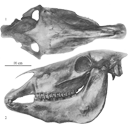
Old world hemiones and new world slender species (Mammalia, Equidae)
Published online: 16/12/2008
Keywords:
Amerhippus; biometry; Equus; Holocene; New World; Old World; Osteology; Pleistocene; Pliocene
https://doi.org/10.18563/pv.36.1-4.159-233
Abstract
Morphological and biometrical description of skulls, teeth, and limb bones of extant and fossil Old World herniones (including E. hydruntinus) and of New World 'stilt-Iegged' and other slender species from Blancan to Holocene. An Appendix presents ways in which the approximate size of some missing bones or dimensions may be deduced from available ones.
The discussed and/or illustrated fossils were found in Bolivia (Tarija), Canada (Yukon), China (Choukoutien, Gulongshan, Jiling, Loufangzi), Ecuador (Oil Fields), Ethiopia (Melka Kunturé), France (Lunel-Viel), Germany (Süssenborn), Greece (Agios Georgios, Petralona), Hungary (Dorog), Italy (Romanelli), Mexico (Cedazo, San Josecito), Mongolia (Sjara-osso-gol), Spain (Venta Micena), ex-Soviet Union (Akhalkalaki, Binagady, Chokurcha, Chukochya, Kabazi, Kolyma, Krestovka, Kurtak, Staroselie, Tologoj), USA (Alaska, Arkalon, Cedar Meadow, Channing, Conkling, Dry Mountains, Hay Springs, Leisey Shell Pit A, Lissie Formation, Natural Trap, Pool Branch, Powers Ranch, Rock Creek, San Diego, Santo Domingo, Seymour Formation, Shelter, Slaton, Trinity River). Numerous raw or statistically elaborated data are given in Tables.
There is no evidence for the existence of Old World hemiones in the New World nor of 'stilt-Iegged' equids in the Old World. The first 'stilt-Iegged' equid was found at Santo Domingo, New Mexico, and is believed to be Late Blancan. It was probably at the origin of E. calobatus (Arkalon, Rock Creek) and of the smaller E. semiplicatus (Channing, Rock Creek). Slender, but not 'stilt-Iegged', equids found at Natural Trap, Wyoming, ca. 12 ky ago belong to Amerhippus. AlI these species share with Oid World Sussemiones (and some hemiones) peculiar patterns on the lower cheek teeth.
The slender Equus sp. B of Leisey Pit A, Florida, ca. 1.2 Ma, as weIl as Amerhippus francisci and E. tau (probably a senior synonym of E. quinni) share conventional lower cheek teeth patterns. The skulls of A. francisci and E. tau, however, are quite different.
Paleontological data suggest a common origin of Amerhippus, Sussemiones, and 'stilt-Iegged' equids during the late Blancan. Old World hemiones seem to have differentiated later.
PV article infos
Published in Vol. 36, Fasc. 1-4 (2008)
|
PDF
|

|
Modification du statut générique de quelques espèces de sélaciens crétacés et tertiaires
Published online: 15/12/1980
Keywords:
Cretaceous; Selachians; Tertiary
https://doi.org/10.18563/pv.10.1.29-42
Abstract
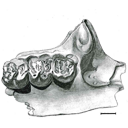
The re-examination of six fossil selachian species has involved the creation of six new genera: Squatiscyllium, Protolamna, Parotodus, Abdounia, Physogaleus, Hypolophodon and of one new species : Prozolamna sokolovi. The modification of the generic statute of these species allows to clarify their systematic position and to define their relationships at a familial level.
PV article infos
Published in Vol. 10, Fasc. 1 (1980)
|
PDF
|
|
Les rongeurs de Chéry-Chartreuve et Rocourt-Saint-Martin (est du bassin de Paris; Aisne, France). Leur place parmi les faunes de l'Eocène Moyen d'Europe
Published online: 15/12/2012
Keywords:
Biochronology; evolution; Middle Eocene; Paris basin; Rodents; Systematics
https://doi.org/10.18563/pv.37.4-5.167-271
Abstract
This paper is mainly devoted to the systematics of rodents from two middle Eocene (Bartonian) localities: Chéry-Chartreuve and Rocourt-Saint-Martin (Aisne, Eastern Paris Basin). These two localities are stratigraphically located slightly above the Auversian sands. The two faunas, which comprise 11 and 8 taxa, respectively, are very different in their composition. That of Rocourt-Saint-Martin shows strong similarities with that of the geographically very close locality of Grisolles, referred to the MP16 mammalian Reference level. The very distinct fauna of Chéry-Chartreuve includes a new species of Ailuravinae, Ailuravus nov.sp, and some teeth of the theridomyid Protadelomys, which represent archaic elements in the fauna. The most abundant species of the locality represents a new genus of primitive Theridomyidae. The presence of some teeth belonging to a new species of large Remyinae, Remys nov. sp., of Elfomys engesseri HOOKER & WEIDMANN, and a population of small dimensions referred to the genus Estellomys allow a correlation with Les Alleveys (Switzerland), with however some differences that would indicate an older age for Chéry-Chartreuve. Situated at the base of the "Marinesian" from the Bassin de Paris, this fauna is unquestionably different from those referred to the MP16 reference level and could represent an older level for which the macrofauna remains very poorly known. Conversely, the comparison of rodents from La Livinière II with those present in MP16 faunas, especially those of Robiac (Gard), shows a great similarity between both localities. This casts doubts on whether to keep this La Livinière II faunule to define the current MP15 reference level, while the biostratigraphical position of Pontils 26 (Spain), previously referred to this level, is reconsidered. Chery Chartreuse could be a good candidate for a new definition of the MP15 reference level.
PV article infos
Published in Vol. 37, Fasc. 4-5 (2012)
|
PDF
|
|
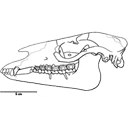
Révision systématique des Anchilophini (Palaeotheriidae, Perissodactyla, Mammalia).
Published online: 15/10/2012
Keywords:
Anchilophus; Eocene; new genus; new species; Palaeotheriidae; Paranchilophus; Perissodactyla; Systematics
https://doi.org/10.18563/pv.37.1-3.1-165
Abstract
The knowledge of the Anchilophini has been lately renewed by the discovery of a rather large amount of new material still largely unpublished. This new material offers the opportunity of a systematic revision of this tribe gathering those of European Eocene Equoidea which bear no mesostyle on upper check teeth and display a heavy trend to the molarization of premolars.
A cladistic analysis has made out two genera, Anchilophus (Paranchilophus included as a subgenus), characterized by a marked lophodonty and the transverse narrowness of the cheek teeth, a rather high hypsodonty, the frequent occurrence of "crochets" and "anticrochets" on the superior ones, and a rather weak molarization of the premolars, opposite to Metanchilophus n. gen. whose cheek teeth are more transversally elongated, less high, less lophodont, with cusps better distinct, enamel thicker and premolars more molarized on the whole.
Three species of Anchilophus are recognized, A. desmaresti, type species of the genus, A. (Paranchilophus) remyi and A. (Paranchilophus) jeanteli n. sp.
The genus Metanchilophus is more diversified with the species dumasi, radegondensis, gaudini (whose a new sub-species M. g. fontensis is defined), depereli, castrensis n. sp. and chaubeti n. sp.
The skull anatomy has been moreover described with several taxa; it brings to light (for all that one can generalize) that Anchilophini were light animals with a slender and elongated snout, a thin zygomatic arch, a rather developed encephalon with an advanced gyrencephaly.
The structure of the nasal opening together with the occurrence of epitympanic sinuses and the molarizing process of the premolars corroborate the attribution of this tribe to the family PalaeotheIiidae.
PV article infos
Published in Vol. 37, Fasc. 1-3 (2012)
|
PDF
|

|
Une faune du niveau d'Egerkinger (MP 14; Bartonien inférieur) dans les phosphorites du Quercy (Sud de la France)
Published online: 18/12/1990
Keywords:
Biochronology; Early Bartonian; Eocene; evolution; Mammals; New taxa; Quercy
https://doi.org/10.18563/pv.20.1.1-32
Abstract
The Laprade fauna is chronologically situated between those from Egerkingen and Lissieu and consequently, is close to the MP 14 reference-level of the European mammalian biochronological scale (Symposium of Mainz, 1987).
This new fauna is presently the oldest known in the Quercy phosphorites, formerly the Le Bretou fauna (MP 16) was considered as the oldest one. The Laprade fauna includes 21 species which belong in 7 mammalian orders (Marsupialia: Amphiperatherium bastbergense, Amphiperatherium goethei; Apatotheria: Heterohyus (Gervaisyus) pygmaeus nov. subgen., nov. sp.; Lipotyphla: Saturninia cf. mamertensis, Saturninia cf. intermedia; Chiroptera: Vespertiliavus lapradei nov. sp.; Rodentia: Protadelomys cf. lugdunensis, Elfomys nov. sp.; Primates: Nannopithex cf. filholi, cf. Pseudoloris or Pivetonia; Perissodactyla: ?Palaeotherium ?castrense, small-sized Palaeotherium sp., Plagiolophus sp., Anchilophus sp.; Artiodactyla: Dichobune cf. robertiana, Mouillacitherium cartieri, Tapirulus cf. depereti, Mixtotherium priscum, Pseudamphimeryx schlosseri, and Artiodactyla indet). Sixteen of these species are mentioned for the first time from the Quercy faunas.
The recognition of a new apatemyid, Heterohyus (Gervaisyus) pygmaeus nov. subgen., nov. sp., attests to an early origin of a lineage known in the Late Eocene. The emballonurid bat Vespertiliavus lapradei nov. sp. is presently the earliest record of this genus and family. This Auversian fauna leads to discuss the age of taxa showing archaic features. These taxa were defined on specimens collected in the Quercy during the last century and have never been found in the Quercy localities recently investigated. This fauna bears also evidence of a karstic filling episode older than those previously dated by fossils in the Quercy Jurassic.
PV article infos
Published in Vol. 20, Fasc. 1 (1990)
|
PDF
|

|
Strange Eocene rodents from Spain
Published online: 16/12/1996
Keywords:
Biogeography; Eocene; PHYLOGENY; Rodents; Spain; Zamoramys extraneus n. gen. n. sp.
https://doi.org/10.18563/pv.25.2-4.323-338
Abstract
A new European rodent from the middle Eocene of Spain, Zamoramys extraneus n. gen., n. sp., appears to be closely related to the middle Eocene chapattimyid rodents of Indo-Pakistan. This contradicts the generally accepted paleobiogeographic hypothesis of a Tethyian barrier between Europe and Asia isolating Europe during the middle Eocene. Because of this barrier, some authors have proposed that European and Asian rodents were not closely related, their similarity being the result of morphological convergence. Here monophyly has been tested, using the parsimony criterion, based on an analysis of dental characters (including discussing of homology and the validity of some characteristics). Our results indicate a phylogenetic relationship among the Asiatic Ctenodactyloidea, Zamoramys from Spain, and the European endemic Theridomyoidea. We also conclude from our analysis that theridomyoids and European ischyromyoids are probably not closely related phylogenetically.
PV article infos
Published in Vol. 25, Fasc. 2-4 (1996)
|
PDF
|

|
Batoids (Rajiformes, Torpediniformes, Myliobatiformes) from the Sülstorf Beds (Chattian, Late Oligocene) of Mecklenburg, northeastern Germany: a revision and description of three new species
Published online: 24/06/2015
Keywords:
Batoids; Chattian; Elasmobranchii; North Sea Basin; Oligocene
https://doi.org/10.18563/pv.39.2.e2
Abstract
Bulk-sampling of fossil-rich tempestites from the Chattian Sülstorf Beds of
Mecklenburg, north-eastern Germany, yielded a rich selachian fauna in which batoids
predominate by the abundance of teeth but are subordinate by the number of taxa. Thirteen
taxa are identified, among which rajiform batoids are the most diverse (six species). One
genus and three species are newly described: Raja thiedei sp. nov., Oligoraja pristina gen. et
sp. nov., and Torpedo chattica sp. nov. Two species are reallocated: Atlantoraja cecilae
(Steurbaut & Herman, 1978) new comb., and Dipturus casieri (Steurbaut & Herman, 1978)
new comb. Ontogenetic heterodonty is documented for the first time in the dental pattern of
Myliobatis sp. Stratigraphical ranges of batoid taxa in the period from Rupelian to Langhian
are presented and partly discussed in context with the palaeoclimatic evolution and
palaeogeographic situation of the North Sea Basin.
PV article infos
Published in Vol.39-2 (2015)
|
PDF
|

|
Study of the Turolian hipparions of the lower Axios valley (Macedonia, Greece). 4. Localities of Dytiko.
Published online: 15/12/1988
Keywords:
Equidae; Greece; Hipparion; Lower Axios Valley; Macedonia; Mammalia; Turolian
https://doi.org/10.18563/pv.18.4.187-239
Abstract
The hipparions from the Dytiko localities of the lower Axios valley (Macedonia, Greece) are studied. The material comes from three localities Dytiko-l, 2, 3 (DTK, DIT, DKO), which are situated near the village of Dytiko, about 60 km northwest to Thessaloniki. Three species have been determined, the medium-sized H. mediterraneum, the small-sized H. matthewi and the very small-sized H. periafricanum. The determined Hipparion species, their morphological characters and their comparison with the other Axios valley material indicate a Late Turolian age for the Dytiko localities.
PV article infos
Published in Vol. 18, Fasc. 4 (1988)
|
PDF
|

|
Les vertébres dévoniens de la Montagne Noire (Sud de la France) et leur apport à la phylogénie des pachyosteomorphes (Placodermes Arthrodires).
Published online: 15/05/1987
Keywords:
Devonian; Montagne Noire; New taxon; PHYLOGENY; Placoderms; Stratigraphy; Vertebrate
https://doi.org/10.18563/pv.17.1.1-26
Abstract
Several different taxa of jawed vertebrates are reported for the first time from the Devonian of south-eastern Montagne Noire, France. Besides some undeterminable fragments of placoderm fishes from the Pragian and Lower Emsian, the material from the Upper Devonian is mainly represented by Melanosteus occitanus gen. and sp. nov. (Frasnian) and Thoralodus cabrieri LEHMAN, 1952 ("Famennian"). The good state of preservation of Melanosteus allows a detailed anatomical study leading to a phylogenetic analysis of the selenosteid pachyosteomorphs.
PV article infos
Published in Vol. 17, Fasc. 1 (1987)
|
PDF
|

|
The Pleistocene vertebrate fauna of Robinson Cave, Overton County, Tennessee
Published online: 20/01/1969
Keywords:
Fauna; Mammalia; Pleistocene; Tennessee
https://doi.org/10.18563/pv.2.2.25-75
Abstract
A late Pleistocene deposit of 60 species of vertebrates and 12 of invertebrates is described from Robinson Cave, Overton County, Tennessee, U.S.A. Forty-eight species of mammals are represented by at least 2,483 individuals; 10 % are extinct, 10 % occur in the state only as boreal relicts in the Great Smoky Mountains; 23 % no longer occur as far south as Tennessee; 57 % occur at or near the site today. Nínety-one percent of the Recent mammal species can be found living today in the Minnesota-Wisconsin area, approximately 10 degrees farther north. Fluorine analysis suggests a long period of accumulation. The following 10 mammalian species are recorded from Tennessee for the first time. Sorex arcticus, Microsorex hoyi, Citellus tridecemlineatus, Clethrionomys gapperi, Microtus pennsylvanicus, Synaptomys cooperi, Synaptomys borealis, Zapus nudsonius, Napaeozapus insignis, Martes americana. Six additional species are present as boreal relicts in the Great Smoky Mountains of eastern Tennessee but not at the site today : Sorex cinereus, Sorex dispar, Sorex palustris, Parascalops breweri, Glaucomys sabrinus, Mustela nivalis. Six forms are extinct: Canis dirus, Ursus americanus amplidens, Sangamona furtiva, Dasypus bellus, Mammut americanus,Megalonyx jeffersoni. Twenty-six additional species of mammals, all of the snails, birds, reptiles, and amphibians recovered from the fauna still inhabit the area today: The fauna is indicative of a cold-temperate climatic episode associated with the Wisconsin glaciation, but may be chronologically mixed.
PV article infos
Published in Vol. 02, Fasc. 2 (1969)
|
PDF
|

|
La poche à phosphate de Ste-Néboule (Lot) et sa faune de vertebres du Ludien supérieur. 9- Primates et Artiodactyles
Published online: 25/09/1978
Keywords:
Eocene; Quercy Phosphorites
https://doi.org/10.18563/pv.8.2-4.269-290
Abstract
La faune d'artiodactyles de Ste-Néboule, qui comprend neuf espèces, présente de nombreux
points communs avec les faunes habituellement rattachées au Ludien supérieur, telles celles de La Débruge ou de Montmartre. A l'inverse de ces localités, on ne connaît pourtant, à Ste-Néboule, ni Oxacronae, ni Anoplotheriinae. Parmi les espèces du gisement se trouve une nouvelle espèce du genre Mouillacitherium (M. schlosseri n. sp.), cette forme devant être interprétée comme le dernier représentant du rameau. Nous faisons connaître par ailleurs la presque totalité de la denture du Dacrytherium saturninii, espèce qui était à ce jour très imparfaitement documentée. Ste-Néboule est, d'autre part, la seule localité où l'on peut signaler l'association probable de deux lignées du genre Amphimeryx. Les primates sont peu diversifiés à Ste-Néboule, puisque le groupe est limité au seul genre Adapis. Les genres Microchoerus et Pseudoloris, que l'on sait pourtant être représentés dans des gisements dâge voisin (Microchoerus ornatus à San Cugat de Gavadons et Mormont-Entreroches, Pseudoloris reguanti à San Cugat de Gavadons, Pseudoloris cf. reguanti à Neustadt ; cf. Louis et Sudre 1975) sont absents dans les faunes du Quercy de cette période.
PV article infos
Published in Vol. 08, Fasc. 2-4 (1978)
|
PDF
|

|
Hexanchiforme nouveau (Neoselachii) du Crétacé inférieur du Sud de la France
Published online: 18/12/1990
Keywords:
Hexanchiformes; New genera; Southern France; Systematics; Valanginian
https://doi.org/10.18563/pv.20.1.33-54
Abstract
The dentition of Welcommia bodeuri nov. gen. nov. sp. from the Valanginian of Southem France is described and reconstructed. Species and genera of Upper Jurassic and Lower Cretaceous Hexanchiformes are reviewed and discussed.
The genus Notidanoides MAISEY, 1986 must be restricted to the single Nusplingen Upper Jurassic specimen, whose attribution to the species muensteri AGASSIZ, 1843 remains doubtful.
The genus Paranotidanus WARD &THIES, 1987 that does not rest on any type-species nor on any precise dental characterization must be rejected.
The genus Eonotidanus PFEIL, 1983, based on a very poorly preserved and heterogeneous type-material must also be rejected.
Teeth from the Lower Cretaceous, with a peculiar morphology, previously assigned to Eonotidanus or to Notidanoides, are to be ranked in the new genus Pachyhexanchus.
PV article infos
Published in Vol. 20, Fasc. 1 (1990)
|
PDF
|

|
Morphotypes dentaires actuels et fossiles des chiroptères vespertilionines. 2ème partie: implications systématique et phylogéniques.
Published online: 15/11/1987
Keywords:
Chiroptera; PHYLOGENY; Systematics; Vespertilionine
https://doi.org/10.18563/pv.17.3.77-150
Abstract
The first part of this study was devoted to a descriptive analysis of teeth morphologies among the vespertilionine bats. This leads now to a tentative synthesis, providing views on the systematics of the group. The results could be seen according to three distinct but closely related purposes : 1 - the sorting of the genera contents in order to conform the genera units to homogeneous taxa that could represent natural issues of evolutionary lineages ; 2 - the investigation of relationships between extant genera in order to infer the possibilities of common origin ; 3 - according to the preceeding items and to the observed evolutionary trends, a tentative phylogeny, modest and cautious. The contents of many genera are sorted : Leuconoe is removed from subgeneric to generic position, whereas Myotis becomes a subgenus of it ; the myotodont species are cleared away from the Pipistrellus genus ; Glischropus and Scotozous are synonymized within Pipistrellus ; Hypsugo is raised to the generic level ; some species previously ranged within Pipistrellus will form provisionally a collective group, Attalepharca nov. ; the Eptesicus genus is broken up, the excluded species being grouped within Nycterikaupius gen. nov. ; the Nycticeini tribe is defined again after exclusion of Otonycteris , Scotoecus, Scotophilus , and addition of Hesperoptenus ; the species la io and Pipistrellus tasmaniensis are removed to Eptesicus (n.s.) and Pipistrellus dormeri to Scotoecus. Groupings of genera are stated according to the main evolutionary trends of I1/. The relevance of these is often warranted by close morphologic similarities of other teeth. This leads to a recognition of the major evolutionary radiations which occurred in the group. The filiations schematized at the end of the work show the dental relationships observed between the extant genera, and could represent a phylogenic framework. Two major facts are to be underlined : 1- the early divergence of leuconoids ; 2 - the successives crossings to myotodonty from the nyctaloid flow. Fossil data from the literature are punctually and tentatively incorporated within phylogenic sketches.
PV article infos
Published in Vol. 17, Fasc. 3 (1987)
|
PDF
|

|
Premier catalogue des specimens-types Paléontologiques déposés dans les collections de l'Université de Montpellier II (Sciences et Techniques du Languedoc)
Published online: 20/12/1994
Keywords:
Collections; Inventory; Type specimens; University Montpelllier II
https://doi.org/10.18563/pv.23.ext.3-113
Abstract
More than 400 paleontological type-specimens housed in the Montpellier University collections have been inventoried in this catalogue which includes charophytes, Paleozoic plants, brachiopodes, molluscs, arthropodes and vertebrates (selachians, amphibians, reptiles, birds and mammals). The vertebrates have been treated exhaustively in the catalogue and one can consider that it includes most of the type specimens deposited in the Montpelier II collections.
PV article infos
Published in Vol. 23, Ext (1994)
|
PDF
|

|
Schmelzmikrostruktur in den inzisiven alt-und neuweltlicher histricognather nagetiere
Published online: 15/12/1992
Keywords:
Africa; Caviomorpha; Ctenodactyloidea; Deseadan; Enamel microstructure; Hunter-Schreger bands; Hystricognathi; Incisors; Ischyromyoidea; multiserial; Paleobiogeography; pauciserial; Phiomorpha; Rodentia; South America
https://doi.org/10.18563/pv.21.ext.1-168
Abstract
Enamel microstructure in the incisors of Old- and New World hystricognath rodents:
The incisor enamel microstructure in more than 100 genera of fossil and Recent hystricognath and sciurognath rodents was studied. A multiserial schmelzmuster is present in the Hystricognathi, the Ctenodactylidae, advanced Chapattimyidae, and in Pedetes. A redefinition of pauciserial and multiserial HSB is given that makes the two enamel types unambiguously distinguishable which apparently represent well defined evolutionary levels. In the pauciserial Schmelzmuster the IPM is thicker than in the multiserial one. In pauciserial HSB the IPM always surrounds each prism, and the crystallites of the IPM run parallel to prism direction; transition zones between HSB are lacking; the inclination of the HSB is normally very low and the prism cross sections are not flattened but somewhat irregular. The number of prisms per HSB is no good distinctive character for pauciserial and multiserial HSB, since there exists a wide overlap. The pauciserial schmelzmuster is primitive, the multiseiial derived because: 1. the pauciseiial schmelzmuster appears earlier in the fossil record in the most primitive rodents (Paramyids s.l. and Ctenodactyloids); 2. the Eocene Ctenodactyloidea show pauciserial HSB but the Oligocene and younger ones are characterized by multiserial HSB; 3. in the outgroup comparison, the Eurymylidae (Mixodontia) show pauciserial HSB; 4. biomechanically, multiserial HSB strenghten the enamel better than pauciserial HSB, since their IPM runs nearly always in an angle of 45° or more to the prisms.
In multiseríal HSB three subtypes can be distinguished which are differentiated by the IPM orientation. Primitive is a (rarely strict) parallel or acute angular, anastomozing IPM, and derived is an interrow sheet-like ("plattenartige") IPM. This evolutionary polarity is indicated by enamel evolution in the Ctenodactylidae which show an acute angular IPM in the Oligocene and a rectangular interrow sheet-like IPM since the Miocene. Among the Caviomorpha a rectangular interrow sheet-like IPM is restricted to the Octodontoidea; therefore they must be considered derived in terms of their enamel structure. The first multiserial HSB in rodent incisors appear in phiomyids or chapatrimyids from the Upper Eocene of Algeria. The IPM is acute angular and anastomozing. The worldwide next younger multiserial HSB are found in Lower Oligocene phiomyids of Fayum, Egypt There already a rectangular interrow sheet like IPM is present (in Metaphiomys) besides the acute angular anastomozing IPM.
The first Caviomorpha from the Deseadan (Oligocene-Miocene) likewise show already acute angular anastomozing IPM (e.g. Scozamys) and rectangular interrow sheet-like IPM (Platypittamys). Therefore the first Caviomorpha cannot be positioned close to a transition from pauciserial to multiserial HSB. In none of the potential caviomorph ancestors from southern North America multiserial HSB or transitional stage between pauciserial and multiserial HSB could be found. The similarities between the enamel types of the Fayum rodents and the rodents from the Deseadan of South America make a derivation of the Caviomorpha from Paleogene North African phiomorph rodents or their direct ancestors most probable. This supports at the same time a descent of the platyrrhine Primates from North African anthropoids.
PV article infos
Published in Vol. 21, Ext (1992)
|
PDF
|

|
Contributions à l'étude du gisement Miocène supérieur de Montredon (Hérault). Les grands mammifères. 10 - Conclusions générales
Published online: 15/11/1988
Keywords:
Mammalia; Montredon; Upper Miocene
https://doi.org/10.18563/pv.18.ext.189-192
Abstract
Le présent volume traite des lagomorphes, carnivores, artiodactyles, périssodactyles et proboscidiens de la faune de Montredon (Hérault). Il clôt la monographie de ce célèbre gisement d'âge miocène supérieur du Languedoc, dont la première partie, relative aux rongeurs, insectivores et chiroptères, fut publiée en 1982.
[...]
PV article infos
Published in Vol. 18, Ext (1988)
|
PDF
|

|
Rythme et modalités de l'évolution chez les rongeurs à la fin de l'Oligocène-leurs relations avec les changements de l'environnement.
Published online: 15/12/2000
Keywords:
Environment; evolution; Oligocene; Rodents; Systematics
https://doi.org/10.18563/pv.29.2-4.83-360
Abstract
The analysis of oxygene isotope variations as well as paleobotanical data suggest that the Oligocene/Miocene boundary corresponds to a transitional period marked by floristical and climatic variations. During this period, the pyreneo-alpine tectonics has contribued to modify the geography and western Europe landscapes. Faunal changes (appearances, extinctions, migrations) are observed in different mammalian groups, notably in the rodents. A study of the evolutionary trends and patterns in paleogene rodents is involved for the period ranging from level MP 28 of the Late Oligocene to the Early Miocene, including the Oligo-Miocene boundary.
The Rodents fauna from the sites of Venelles (Bouches-du-Rhône District, France) and Thezels (Lot, France), previously mentionned in litterature, have been studied. The first description of the Eomyidae of La Milloque (MP 29) has been completed. These faunas are compared to those from various localities dating from the considered period. In La Milloque, a new representative of the Eomys species is described next to a form close to Rhodanomys hugueneyae ENGESSER, 1987. It is the Eomys milloquensis nov. sp., the likely descendant of Eomys quercyi COMTE & VIANEY-LIAUD, 1987. Two new species are also described in Thezels: Eucricetodon thezelensis nov. sp., resulting from a likely and local evolution of Eucricetodon praecursor (SCHAUB, 1925) from La Milloque, which, in the same geographic area, could be at the origin of Eucricetodon hesperius ENGESSER, 1985 from Paulhiac. Plesiosminthus admyarion nov. sp., quite distinct from Plesiosminthus schaubi VIRET, 1926, which announces Plesiosminthus myarion SCHAUB 1930. Venelles 'Plesiosminthus schaubi population is considered as a sub-species, named Plesiosminthus schaubi meridionalis nov. subsp. New phylogenetic patterns are proposed. Among the Eomyidae, a quantification of various features of the M1-2/ crown (hypsodonty, degree of abrasion, occlusal angle, state of development of the I and V anticlines), and a comparison with the occlusal diagram of the other teeth among various other populations allows a more efficient separation of Eomys and Rhodanomys genera. In Western Europe, and within this period, it finally does not seem possible to gradually connect the genus Eomys to the genus Rhodanomys. The evolution of the Eomys quercyi - milloquensis lineage seems to underline a similar evolution to that which may have led from the Eomys to the Rhodanomys form. The latter which appears totally accomplished at level MP 29 of the Oligocene is considered as an immigrant. If we compare the most representative species of the Venelles, Thezels, and Coderet sites, (i.e. Rhodanomys, Eucricetodon, Adelomyarion, Peridyromys, Plesíosminthus), it becomes impossible to confirm their biochronological separation. The noticeable differences between the populations may be interpreted as geographical variations. An explanation to these variations, and to fauna's evolution during the Late Oligocene and Early Miocene can be found in the environmental modifications, supported by isotopic, paleobotanical and sedimentologic analysis. A tentative reconstruction of the environments is attempted by the cenogram method. The analysis of the fluctuations of fauna's diversity shows variations which may be correlated to a drop in temperature at MP 29, during the Late Oligocene, followed by an increase in temperature along with an aridity phenomenom, during the basal Miocene (MN O).The confrontation of various methods give the opportunity of reconstituting and comparing the evolution of the environment of three sequences of sites chosen from different regions. Ecological affinities of various rodents' species are being examined. It is possible to consider that the integration of all the conclusions resulting from this study should lead to an explanation to the evolution of rodents for the period around the Oligocene-Miocene boundary. The site of Coderet- level 3- would be posterior to the latter, at the beginnig of the Miocene, and would mark the level MN 0 of the Aquitanian.
PV article infos
Published in Vol. 29, Fasc. 2-4 (2000)
|
PDF
|

|
Le genre Mesembriacerus (Bovidae, Artiodactyla, Mammalia) : un Oviboviné primitif du Vallésien (Miocène supérieur) de Macédoine (Grèce)
Published online: 15/12/1984
Keywords:
Bovidae; Cladistics; Late Miocene; Ovibovinae; Vallesian
https://doi.org/10.18563/pv.14.4.201-223
Abstract
The bovid Mesembriacerus melentisi, the numerous skulls, teeth and limb bones of which are described from the locality Ravin de la Pluie (Macedonia, Greece), bears some features which allow us to put it in the tribe ovibovini (Ovibovinae) with several other Miocene genera and the Recent one Ovibos. A cladogram gives the phyletic relationships within this tribe. It shows that Mesembriacerus which is one of the oldest genera, is also the most primitive. The limb bones are as elongated as those of Recent cursorial bovids and they show, as does the bulk of the fauna, an open environment for the locality.
PV article infos
Published in Vol. 14, Fasc. 4 (1984)
|
PDF
|
|
L’assemblage mammalien de l’Eocène continental du Complexe de Gour Lazib (Algérie) : structure écologique et implications paléoenvironnementales
Published online: 01/01/1970
Keywords:
Afrique du Nord; Cénogramme; Paléogène; Vertébrés
https://doi.org/10.18563/pv.49.2.e2
Abstract
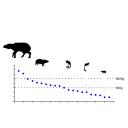
Des prospections géologiques et paléontologiques sur les affleurements continentaux paléogènes du Complexe de Gour Lazib (Hammada du Dra, Algérie) nous ont permis de mettre en évidence plusieurs sites à vertébrés, sur une superficie de plus de cinq cents kilomètres carrés. La faune est constituée de nombreux vertébrés fossiles associant mammifères placentaires, poissons actinoptérygiens et protoptères, squamates, amphibiens, chéloniens, crocodiles et oiseaux. La flore de charophytes est également diversifiée. Les données bio-magnétostratigraphiques indiquent un âge compris entre l’Yprésien terminal et le Lutétien basal pour cet assemblage unique en Afrique. Les nombreux restes de mammifères récoltés ont une préservation exceptionnelle pour le Paléogène ancien arabo-africain et permettent une reconstitution paléoenvironnementale réalisée via une méthode couplant cénogramme et distribution pondérale des taxons arboricoles. Le profil du cénogramme, caractérisé par l’abondance des espèces de petite taille (insectivores, primates et rongeurs), la présence d’espèces de taille intermédiaire (hyracoïdes) et la rareté des grandes espèces (uniquement représentées par les hyracoïdes ; absence notable des proboscidiens et embrithopodes), met en évidence un milieu forestier assez fermé sous climat tropical. Par ailleurs, les données lithologiques et sédimentologiques indiquent un milieu fluviatile méandriforme où ont proliféré les charophytes. Plus hypothétique reste l’existence d’une saisonnalité dans les Gour Lazib, avec de possibles périodes temporaires modérément arides.
PV article infos
Article state: in_press
|
PDF
S.I. Data
|
|
A new Desmodillus (Gerbillinae, Rodentia) species from the early Pliocene site of Langebaanweg (South-western Cape, South Africa)
Published online: 20/01/2017
Keywords:
Lower Pliocene; Muridae; Rodentia; RSA
https://doi.org/10.18563/pv.41.1.e1
Abstract
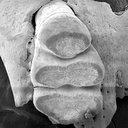
Situated in the Cape region of the Republic of South Africa (RSA), the paleontological site of Langebaanweg is dated to 5.1 Myr and is famous for having yielded an abundant vertebrate assemblage, including numerous rodent species from the Mio-Pliocene transition. Based on molar morphology and skull anatomy, the single Gerbillinae taxon identified at Langebaanweg and described in this paper is allocated to Desmodillus, which is a modern monotypic South African endemic genus. It is significant in being the oldest representative of the genus in Africa. We describe here a new species of this genus which is larger than the modern D. auricularis, but nevertheless retains some of its main characteristics, namely the shape of the maxilla and mandible, the presence of poorly fused alternating cusps, and no longitudinal crest. This taxon differs from modern South African Gerbilliscus representatives in some mandibular and maxillary characters, in the m1 prelobe cusp, and in having less fused cusps. Two fossil Gerbillinae discovered in the Upper Miocene of Africa and Asia, Abudhabia and Protatera, have been compared with the new species. We discuss their relationships with modern and Plio-pleistocene Gerbillinae and conclude that Abudhabia could be the sister taxon of Desmodillus and that around 6-5 Myr a vicariance event allowed Gerbillinae to diversify into modern Desmodillus in South Africa, and Gerbilliscus in East Africa. The murine/gerbilline ratio, which is a good indicator of rainfall, supports other proxies which suggest that at 5.1 Myr the climate in the Langebaanweg region was more humid than today.
PV article infos
Published in Vol 41-1 (2018)
|
PDF
S.I. Data
|