Current issue


2025-12
48-2
<< prev. next >>

Print ISSN: 0031-0247
Online ISSN:
2274-0333
Frequency: biannual

Article Management

You must log in to submit or manage articles.

You do not have an account yet ? Sign up.

Most downloaded articles (all time)


Page 17 of 19, showing 20 record(s) out of 365 total

Rongeurs Miocènes dans le valles-Penedes 1 : Les rongeurs de Can Ponsic 1
Jean-Louis Hartenberger and Miquel Crusafont i Pairó
Published online: 20/04/1979

Keywords: Can Ponsic 1; Miocene; Rodents; Valles-Penedes

https://doi.org/10.18563/pv.9.1.1-15

  Abstract

    The rodents from the spanish locality of Can Ponsic 1 bring new data about some rodents species of the beginning of the Upper Miocene in South-West Europe. The criticims made by Mein and Freudenthal about the validity of the species Hispanomys thaleri from Can Llobateres are not justiíied. The study of the anatomy of the skull of Rotundomys from Can Ponsic 1 gives accurate information about the affinity of this genus with Cricetulus, and shows that the hypothesis, according to which Rotundomys is an ancestral form of the Arvicolids, is unlikely. The systematics of Heteroxerus and the phylogeny of the mio-pliocene Muscardinus species are also discussed. The Can Ponsic 1 locality is a little older than Can Llobateres.


  PV article infos

Published in Vol. 09, Fasc. 1 (1979)

PDF
First record of the genus Megaderma Geoffroy (Microchiroptera: Megadermatidae) from Australia.
Suzanne J. Hand Logo
Published online: 14/06/1995

Keywords: Australia; Chiroptera; Megaderma; Megadermatidae; Pliocene; Rackham's Roost Site; Riversleigh

  Abstract

    A new Tertiary megadermatid is described from Rackham's Roost Site, a Pliocene limestone cave deposit on Riversleigh Station, northwestern Queensland, Australia. It appears to represent the first Australian record of Megaderma GEOFFROY, 1810, a genus otherwise known from Tertiary African and European taxa and the living Asian species M. spasma (LINNAEUS, 1758) and M. (Lyroderma) lyra PETERS, 1872. Megademza richardsi n. sp. is one of the smallest megademiatids known. It exhibits a mixture of plesiomorphic and autapomorphic features, the latter appearing to exclude it from being ancestral to any living megadermatid. The new species is one of eight megadermatids identified from the Australian fossil record, most of which are referable to Macroderma MILLER, 1906. 


  PV article infos

Published in Vol. 24, Fasc. 1-2 (1995)

PDF
On the genus Dikkomys (Geomyoidea, Mammalia)
Morton Green and Philip R. Bjork
Published online: 01/10/1980

Keywords: Dikkomys; Geomyoidae; North America

https://doi.org/10.18563/pv.9.ext.343-353

  Abstract

    The geomyoid genus Dikkomys is well represented in a sample from the Black Bear Quarry Il local fauna of Early Hemingfordian age in Bennett County, South Dakota. Isolated unworn P/4's of Dikkomys matthewi WOOD have a prominent median cristid (sagicristid) with a connection to the metaconid and the hypolophid. With wear, P/4 does not become as molariform as P/4 because of this cristid.
    A large sample of the Whitneyan beteromyid Proheteromys nebraskensis WOOD contains variants of the P/4 with on incipient sagicristid in approximately 18 percent of the population. The upper dentition and lower molars of Proheteromys nebraskensis are sufficiently generalized to indicate probable ancestry to Dikkomys


  PV article infos

Published in Vol. 9, Ext (1980)

PDF
Les rongeurs du Miocène moyen et supérieur du Maghreb
Jean-Jacques Jaeger Logo
Published online: 15/05/1977

Keywords: Neogene; North Africa; Rodentia

https://doi.org/10.18563/pv.8..1.1-166

  Abstract

         The Faunas of Rodents from seven north-african fossiliferous beds distributed from the Middle up to the Uppest Miocene are studied. One genus, seventeen species, one subspecies described are new.
           A detailed description is given of the evolution of the numerous specific lines, systematic groups and communities. The evidence of the strong endemism of the North African faunas of that time compared with those of Europe as well as of Tropical Africa is clearly shown. Special relationships with Asia clearly also appear, mostly in the Middle Miocene and the beginning of the Upper Miocene.
           Using the specific lines with a biostratigraphic purpose gives the opportunity to establish a biochronological scale for the continental formations of the Maghreb. This scale is calibrated by a few absolute datations. These datations, as well as the stratigraphical study of several fossiliferous localities have given the possibility to establish precise correlations with the corresponding scales of Europe and of Tropical Africa, as well as with the marine formations of the Neogene of occidental Mediterranean sea.
           The paleoclimatic data connected with this period in North Africa are explained and the contribution of the micromammals is discussed. 


  PV article infos

Published in Vol. 08, Fasc. 1 (1977)

PDF
Contribution à la classification des Pistes de Vertébrés du Trias : les types du Stormberg d'Afrique du Sud (2 ème Partie: le Stormberg supérieur - 1. Le biome de la zone B/1 ou niveau de Moyeni: ses biocénoses).
Paul Ellenberger
Published online: 01/12/1974

Keywords: biocenosis; Footprints; South Africa; Stormberg; Trias

https://doi.org/10.18563/pv.6.ext

  Abstract

    Les Pistes de Vertébrés du Stormberg Supérieur ("Trias terminal à Rhétien"), ou Quthingien

    Si les zones du Stormberg inférieur se sont révélées contenir de nombreuses traces, surtout dans les faciès dits "Molteno moyen et supérieur", représentant apparemment la base du Keuper, il est frappant de voir pratiquement l'ensemble de cette grosse faune "Molteno" disparaître avec la fin de cette période, que nous avons appelée le "Maphutsengien".

    Dès les premières zones du Stormberg supérieur, que nous nommons le"Quthingien" la zoocénose et la phytocénose, en même temps que les données d'ensemble manifestées par l'environnement, sont modifiées. Nous ne verrons plus guère de dépôts marécageux à flore riche et variée, parfois même luxuriante. Les fougères elles-mêmes ont disparu. Elles sont remplacées par de maigres plantes, aux feuilles très souvent filiformes qui paraissent témoigner d'un climat continental. Le sol est devenu de plus en plus rouge, avec des variations latérales beaucoup plus accusées. Les fleuves amenant des galets des monts du "Grand Sud" ont tari. La faune va en subir les conséquences. Certaines des espèces se révèleront sautillantes ou coureuses, pour un grand nombre plus légères et pour la quasi-totalité d'apparence carnivore ou entomophages, les phytophages devant se contenter d'un régime ingrat,difficile ou à tout le moins irrégulier,les dépôts le montrent.

    C'est dans ces conditions que s'inaugure notre Etage nouveau,quelque peu discordant sur les zones A/5, A/6 ou A/7 du Stormberg inférieur (Maphutsengien). Le Stormberg supérieur (ou Quthingien) commence avec le paléopaysage remarquable dit de Moyeni, que nous allons maintenant étudier, typologiquement, avec ses homologues du même âge. Quelques 38 types d'animaux tous nouveaux vont défiler à nos yeux lors de la zone de base de cet Etage, ou zone B/1.

    L'on nous avait proposé d'intituler ce Ile Tome de la série : "La grande Dalle de Moyeni et ses homologues. Paléo-spectacles, scènes et paysages animaux au Lesotho à l'approche du Trias finissant". Nous avons préféré garder le sous-titre plus haut, peut-être plus prosaïque.

    Un llle Tome est en préparation : "Les développements ultérieurs et terminaux de la faune du Gondwana".


  PV article infos

Published in Vol. 6, Ext (1974)

PDF
Pterosaurs (Pterosauria) from the Cerro del Pueblo Formation (Late Campanian) of Coahuila, Mexico
Héctor E. Rivera-Sylva Logo, David Hone, Martha Aguillón-Martínez Logo, José R. Guzmán-Gutiérrez Logo, David Morales-Flores, Iván Sánchez-Uribe Logo, José Flores-Ventura and Rafael Vivas-González
Published online: 21/11/2025

Keywords: Azhdarchoidea; Coahuila; Mexico; Pterodactyloidea; Pterosauria

https://doi.org/10.18563/pv.48.2.e1

  Abstract

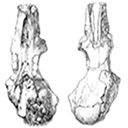
    The Late Campanian Cerro del Pueblo Formation, located in southeastern Coahuila, Mexico, has produced a diverse array of vertebrate fossils. However, pterosaur remains from this unit are notably scarce. In this study, we describe new pterosaur material from the formation. The specimens include a fragmentary vertebra identified as belonging to an indeterminate, but derived pterodactyloid, along with the distal condyle of a left metacarpal, referable to an azhdarchoid pterosaur, and a left manus print. While these specimens provide additional evidence of pterosaur presence in the region during the Late Cretaceous, their fragmentary nature limits precise taxonomic and ichnotaxonomic identification. Nevertheless, they highlight the potential for future discoveries that could refine our understanding of the diversity and distribution of pterosaurs in Mexico.


  PV article infos

Published in 48-2 (2025)

PDF
Description des restes d'Elasmobranches (Pisces) du Dévonien moyen de Bolivie
Philippe Janvier Logo
Published online: 01/02/1977

Keywords: South America

https://doi.org/10.18563/pv.7.4.126-132

  Abstract

    Some fragmentary remains of spines and endoskeletal elements, referred here to as ctenacanthid like elasmobranchs, are recorded in the Middle Devonian of Bolivia. These specimens, and some others from the Eodevonian of Brasil represent the only  Devonian fish remains hitherto known from South America and indicate that further discoveries may be made in their original localities respectively.


  PV article infos

Published in Vol. 07, Fasc. 4 (1977)

PDF
Nouvelles faunes de rongeurs de la fin Miocène inférieur en Provence. Implications géologiques et Paléogéographiques.
Dominique Lalaï
Published online: 01/09/1986

Keywords: Biogeographic province; Biozonation; Correlation; Miocene; Palaeogeography; Rodentia

  Abstract

    Rodents from the new localities of Châteauredon (Alpes-de-Haute-Provence) and La Denise (Bouches-du-Rhône) show more similarities with the rodents known from the Czecho-Slovak locality of Franzenbad than with the species found in contemporaneous Lower Miocene faunas located westward of the present Rhône Valley. This is another data wich support the existance of several biogeographical provinces in Southern France during Lower Miocene. The correlations which have been settled down allow new datations of several formations in Provence and give new information on the Aquitanian and Burdigalian paleogeographies of this region. More precise stratigraphical allocations are given to some other localities of Central Europe. 


  PV article infos

Published in Vol. 16, Fasc. 2 (1986)

PDF
Contributions à l'étude des micromammifères du gisement Miocène supérieur de Montredon (Hérault). 1- Le gisement
Jean-Pierre Aguilar and Jean-Yves Crochet
Published online: 30/06/1982

Keywords: Hérault; Late Miocene; Micromammals; Montredon

https://doi.org/10.18563/pv.12.3.75-79

  Abstract

    La localité fossilifère du Puech de Montredon, désignée plus communément sous le nom de Montredon, est située sur la commune de Montouliers (Hérault) à quelques 300 mètres de la limite avec le département de l'Aude. Elle a été découverte en 1845 par Narbonne, Directeur des Mines de La Caunette, et de très nombreux restes de vertébrés continentaux y ont été extraits. La plus ancienne mention de ce gisement dans la littérature semble être celle de Lartet (1859) qui signale que "M. Jourdan, de Lyon, a constaté à Montredon, près de Bize (Aude), l'association des restes de Dinotherium avec l'Hipparion". 


  PV article infos

Published in Vol. 12, Fasc. 3 (1982)

PDF
Contributions à l'étude du gisement Miocène supérieur de Montredon (Hérault). Les grands mammifères. 1 - Les Lagomorphes
Nieves Lopez-Martinez
Published online: 15/11/1988

Keywords: Lagomorpha; Montredon; Prolagus; Upper Miocene

  Abstract

    A sample of 231 isolated teeth of lagomorphs from the upper Miocene of Montredon (southern France), identified as the ochotonid Prolagus crusafonii DOPEZ, 1975, is studied, comparing it with other populations of the same species as well as with its closest species P. oeningensis (KÖNIG, 1825).
    The maintenance dining 5 m.y. of a high morphological variability in a group of non-selected features is interpreted as an evolutionary response. This may be related with the heterogeneity and probably too with the regression of the environment. 


  PV article infos

Published in Vol. 18, Ext (1988)

PDF
La poche à phosphate de Ste-Néboule (Lot) et sa faune de vertebres du Ludien supérieur. 10 - Paléothérides (Perissodactyles).
Jean-Albert Remy
Published online: 25/09/1978

Keywords: Eocene; Quercy Phosphorites

https://doi.org/10.18563/pv.8.2-4.291-293

  Abstract

    La poche à phosphorite de Sainte-Néboule (Lot) a livré au cours des récentes campagnes de fouilles effectuées dans le cadre de la RCP 311 une douzaine de dents ou fragments de dents de paléothéridés à rapporter à 3 taxons. 


  PV article infos

Published in Vol. 08, Fasc. 2-4 (1978)

PDF
La variabilité morphologique dentaire du Landenodon (Condylarthra) de Dormaal, (Eocène,Belgique)
Marc Godinot Logo
Published online: 01/10/1980

Keywords: Condylarths; Dormaal; Early Eocene; Landenodon

https://doi.org/10.18563/pv.9.ext.167-196

  Abstract

    The study of dental variations in Landenodon from Dormaal (early Eocene, Belgium) shows that only one
    species is present in this locality : L. woutersi QUINET, 1968 (Condylarthra, Arctocyonidae, Arctocyoninae). A high morphological variability is described, especially concerning the metaconid of P/4, the paraconid of M/2, and some characters of M1/ which have been found to be independant of each other. This variability is discussed. 


  PV article infos

Published in Vol. 9, Ext (1980)

PDF
Les Ischyrictis de la transition Vindobonien-Vallésien
Miquel Crusafont i Pairó
Published online: 15/09/1972

Keywords: Ischyrictis; Mustelidae

https://doi.org/10.18563/pv.5.5.253-260

  Abstract

    Le groupe des Mustélides « Ischyrictoïdes » développe des tendances évolutives qu’engendrent des formes de Carnassiers prédateurs robustes et de grande taille. C’est une évolution comparable à celle que l’on trouve chez Plesiogulo, qui, lui, a une origine énigmatique (Petter, 1963). Chez les Mustélides on peut signaler deux lignées assez nettes : celle du sous-genre nominal des Laphyctis, plus conservatrice, plus mustéliforme, renfermant les espèces Ischyrictis (Laphyctis) mustelinus VIRET et L. zibethoides BLAINVILLE ; celle de type félinoïde caractérisée par L. Ginsburg (1961) avec la forme type Ischyrictis (Hoplicitis) florancei du Vindobonien inférieur de Pontlevoy-Thenay et I. helbingi VIRET, 1951 du Vindobonien supérieur de la Grive Saint-Alban. De plus rappelons que I. vorax DEHM et I. comitans DEHM du Burdigalien de Wintershof-West sont sans rapport avec les espèces du Miocène supérieur (Ginsburg, o.c.).

    Récemment G. Petter (o.c.) a montré la difficulté qu’il y avait à envisager que l’Ischyrictis de Can Llobateres qu’elle décrivait puisse être le descendant de Ischyrictis helbingi de La Grive : la forme plus récente est évidemment de plus grande taille, mais le développement très marqué et la position avancée du protocône paraissent constituer un obstacle à une telle filiation.

    Donc on signalait jusqu’ici deux lignées de Mustélides « ischyrictoïdes » toutes deux de grande taille : d’une part I. zibethoides de Sansan, d’autre part I. helbingi de la Grive. Or à notre point de vue nous considérons actuellement qu’il existe très probablement trois phyla d’Ischyrictis. Le premier serait représenté par les formes burdigaliennes déjà nommées I. vorax et I. comitans ; il se caractériserait par la perte précoce de la P₁ inférieure et la forme spéciale de la canine inférieure. Ce premier ensemble pourrait être rassemblé dans le sous-genre Laphyctis. Le reste des ischyrictoïdes de type conservateur, pour ce qui est de la région des prémolaires et de la forme de la canine, pourrait être subdivisé en deux sous-genres : le sous-genre Ischyrictis désignant les formes les plus mustéliformes avec I. mustelinus et I. zibethoides d’une part, et le sous-genre Hoplicitis pour les formes félinoïdes avec I. florancei et I. helbingi


  PV article infos

Published in Vol. 05, Fasc. 5 (1972)

PDF
Nouvelle interprétation de l'évolution du genre Megacricetodon au cours du Miocène
Jean-Pierre Aguilar
Published online: 01/10/1980

Keywords: Megacricetodon; Micromammals; Miocene

https://doi.org/10.18563/pv.9.ext.355-364

  Abstract

    La découverte de nouveaux gisements à micromammifères dans le Miocène du Sud de la France et d'Espagne montre que, s'il n'est plus possible d'accepter dans son intégralité le schéma phylétique de Fahlbusch du genre Megacricetodon, il existe toutefois des segments de lignées à l'intérieur de provinces géographiques différentes (Péninsule Ibérique, France, Europe Centrale), avec lesquels on peut établir une biochronologie locale, segments qu'il est aussi possible de placer les uns par rapport aux autres, en utilisant les corrélations que l'on peut reconnaître entre certains niveaux repères des mammalogistes et l'échelle stratigraphique marine.
    En utilisant ces données nouvelles, et d'après l'étude de la première molaire inférieure, nous proposons le
    schéma évolutif suivant, pour les espèces de grande taille :

    1 - au début du Burdigalien supérieur. une espèce commune, M. collongensis, issue de la forme ancestrale M. primitivus, est présente, de la Péninsule Ibérique à l'Europe Centrale. Son évolution est mal connue en Espagne, par contre cette lignée s'éteindrait en France au Burdigalien terminal avec le stade M. gersii nov. sp. de Sansan et de Luc-sur-Orbieu.
    2 - au cours de la régression post-burdigalienne. reconnue en Languedoc et dans la Péninsule Ibérique apparaîtrait une espèce immigrante, M. crusafonti qui, dans cette dernière province, évolue pour donner M. ibericus de Nombrevilla. L'espèce M. gregarius de La Grive M et de La Grenatière dériverait de cette forme immigrants, en ayant une évolution différente.
    3 - en Suisse, Bavière et Europe centrale, la lignée M. primitivus - M. collongensis va s'individualiser, dès le Burdigalien supérieur ou terminal, et donner naissance à la lignée M. bavaricus qui s'éteindra avec le stade M. germanicus nov. sp. du gisement anté - Hipparion de Anwil. Cette dernière espèce a été trouvée pour la première fois en France, dans le gisement de Collet Redon. 


  PV article infos

Published in Vol. 9, Ext (1980)

PDF
Koobi Fora Research Project, volume 3. The fossil ungulates: geology, fossil artiodactyls, and palaeoenvironments, édité par John Michael HARRIS, 1991. Clarendon Press, Oxford, xvi + 384 p. ISBN 0-19-857399-5.
Jean Sudre
Published online: 11/02/1993

Keywords: Artiodactyls; palaeovenvironments; Ungulates

  Abstract

    Avec ce volume se clôture l'étude géologique et paléontologique des sites à hominidés de Koobi Fora. Il fait suite aux deux précédents ouvrages, parus respectivement en 1978 et 1983, consacrés également à l'étude des faunes recueillies sur ces gisements dans le cadre du Koobi Fora Research Project. 


  PV article infos

Published in Vol. 22, Fasc. 2-3 (1993)

PDF
Premier signalement du Monachinae (Phocidae, Mammalia) dans le Sahélien (Miocène supérieur) d'Oran (Algérie)
Christian de Muizon Logo
Published online: 15/10/1981

Keywords: Algeria; Late Miocene; Phocidae

https://doi.org/10.18563/pv.11.5.181-194

  Abstract

    Messiphoca mauretanica nov. gen., nov. sp. représente le premier Phocidae fossile recensé en Afrique du Nord. Provenant du gisement sahélien (Miocène supérieur) de Raz-el-Aïn (Algérie), il est connu par quelques os du membre antérieur (humérus, radius, ulna), quelques vertèbres dorsales et un crâne très fragmentaire. La description de cette forme nouvelle amène à considérer Messiphoca mauretanica comme un Monachinae archaïque proche de l'origine du groupe Pliophoca - Monachus. L'incidence de cette interprétation d'un Phocidae «pré-Messinien ›› sur la crise de salinité du Messinien est aussi envisagée. 


  PV article infos

Published in Vol. 11, Fasc. 5 (1981)

PDF
The microfauna of the Djebel Qafze Cave
G. Haas
Published online: 15/09/1972

Keywords: Micromammals; Rodents

https://doi.org/10.18563/pv.5.5.261-270

  Abstract

    This study examines the microfauna from Djebel Qafze Cave, focusing on mammalian remains, with Microtus guentheri as the dominant species and a notable absence of Cricetinae (hamsters). The richest layers (XVIa, XVII, XVIII) suggest accumulation by raptors, particularly owls, given the high presence of nocturnal species like voles and shrews. Two significant species, Arvicanthis cf. ectos and the newly described Rattus (? Mastomys) nazarensis, are highlighted. Reptiles (gekkos, Ophisaurus) and birds are also present, while hedgehogs and lagomorphs are absent. The findings underscore the role of avian predators in fossil deposition and refine the chronology of regional Pleistocene fauna. 


  PV article infos

Published in Vol. 05, Fasc. 5 (1972)

PDF
Premières données sur les rongeurs de la formation de Ch'orora (Ethiopie) d'âge Miocène supérieur. I: Thryonomyidés
Jean-Jacques Jaeger Logo, Jacques Michaux and Maurice Sabatier
Published online: 01/10/1980

Keywords: Ethiopia; Paraulacodus; Rodents; Upper Miocene

https://doi.org/10.18563/pv.9.ext.365-374

  Abstract

    The genus Paraulacodus has been collected in the Ch'orora formation of Upper Miocene age, in Ethiopia. The new species, P. johanesi n. sp.. is more evolved than the previously described indian species P. indicus HINTON of the Siwalik Hills area. The morphological gap between P. johanesi and the present Thryonomys is still important. 


  PV article infos

Published in Vol. 9, Ext (1980)

PDF
Rates of evolution in divergent species lineages as a test of character displacement in the fossil record : tooth size in Paleocene Plesiadapis (Mammalia, Proprimates)
Phillip D. Gingerich Logo
Published online: 16/12/1996

Keywords: character displacement; character divergence; fractal time series; Plesiadapis; Rates of evolution

  Abstract

    Two species lineages of North American late Paleocene Plesiadapis exhibit a pattern of size divergence from a common ancestral lineage. Time series of fossils in each of these lineages are analyzed to test the idea that size divergence represents competitive character displacement. The critical factor in a test of character divergence is showing that divergent lineages evolved directionally rather than randomly (multifactorially). Analysis of evolutionary rates and their temporal scaling in Plesiadapis shows that both divergent species lineages have the scaling slope expected for lineages evolving randomly rather than directionally, and size divergence in Plesíadapis does not represent character displacement. Rates of evolution commonly observed on a per-generation time scale are high enough to produce character displacement within a few generations. Thus character displacement is not likely to be visible on scales of time that can be studied in the fossil record. 


  PV article infos

Published in Vol. 25, Fasc. 2-4 (1996)

PDF
Rongeurs (Mammalia, Rodentia) du Miocène de Beni-Mellal
Jean-Jacques Jaeger Logo
Published online: 15/02/1977

Keywords: Morocco; Neogene

https://doi.org/10.18563/pv.7.4.91-125

  Abstract

    The rodent fauna of Beni-Mellal is characterized by the abundance of ctenodactylids and cricetids. The latter are represented by four distinct species, among which a new form. Dakkamys zaiani nov. gen., nov. sp. is described. A detailed morphological analysis shows that, contrary to that which had been established before, « Cricetodon ›› atlasi Lavocat, 1961, is not closely related to any European form known; this species is attributed, in consequence, to the new genus Mellalomys. A simple biometric analysis has shown that the genus Myocricetodon Lavocat, 1952, is represented in this locality by two distinct species. The systematic homogeneity of the Beni-Mellal cricetids is also demonstrated: they can, as a matter of fact, all be referred to the subfamily Myocricetodontinae. The definition of this subfamily is completed. The sciurids and glirids are also reviewed in the light of new systematic and biogeographic information established ln Europe. A new species of Atlantoxevus from the early Pleistocene of Morocco, A. huvelini nov. sp., is described. It is probably the descendant of A. tadlae from Beni-Mellal. Biogeographic analysis leads one to consider this fauna as the result of geographic isolation in the Maghreb since the late Oligocene or the early Miocene. In particular no direct European influence can be discerned. Stratigraphic considerations resulting from the discovery of new localities in North Africa lead to the confirmation of the ante-Vallesian age of this fauna and to its parallelism with the faunas of La Grive in Western Europe and Fort Ternan in East Africa. The peculiar geologic nature of this locality is discussed.


  PV article infos

Published in Vol. 07, Fasc. 4 (1977)

PDF

Page 17 of 19, showing 20 record(s) out of 365 total