Print ISSN: 0031-0247
Online ISSN: 2274-0333
Frequency: biannual
Notidanodon tooth (Neoselachii: Hexanchiformes) in the Late Jurassic of New Zealand
Additions to the elasmobranch fauna from the upper Cretaceous of New Jersey (middle Maastrichtian, Navesink Formation)
stratigraphy and biochronology of Oligo-Miocene of Kazakhstan
Fossil snakes, Palaeocene, Itaborai, Brazil, Part I
Abstract book of the 18th Conference of the EAVP
Eocene (57) , Quercy Phosphorites (38) , Systematics (32) , Rodents (29) , Mammalia (27)

|
A.J.Sutcliffe. On the track of Ice Age mammalsJacques MichauxKeywords: Book reviewAbstract On the Track of Ice Age Mammals justifie pleinement son titre car l'auteur, Anthony J. Sutcliffe, apporte au lecteur faits et interprétations qui l'amèneront à s'intéresser encore plus au passé récent et à l'avenir de son environnement et à la question de l'impact de l'homme sur la nature. Après les chapitres qui présentent les temps glaciaires et les divers témoignages qui nous en sont parvenus, les cinquième et sixième apportent les informations nécessaires à la compréhension des résultats que nous donnent les chercheurs: principes, moyens d'étude et limites des méthodes, difficultés de l'intégration des données dans un cadre stratigraphique, variabilité des signaux climatiques, variabilité de leur intensité selon l'endroit par rapport au centre de la glaciation, complications liées à la qualité inégale de l'enregistrement géologique, en mer et sur le continent. Article infos Published in Vol. 15, Fasc. 4 (1985) |
|
|

|
La poche à phosphate de Ste-Néboule (Lot) et sa faune de vertebres du Ludien supérieur. 9- Primates et ArtiodactylesJean SudreKeywords: Eocene; Quercy PhosphoritesAbstract La faune d'artiodactyles de Ste-Néboule, qui comprend neuf espèces, présente de nombreux Article infos Published in Vol. 08, Fasc. 2-4 (1978) |
|
|

|
Eléments nouveaux sur l'évolution des genres Eucricetodon et Pseudocricetodon (Eucricetodontinae, Rodentia,Mammalia, de l'Oligocène d'Europe Occidentale.Bernard ComteKeywords: evolution; Occidental Europe; Oligocene; Rodentia; SystematicsAbstract The review of material recently collected in the new localities from the “Phosphorites du Quercy", and different localities from the South of France, bring new informations on the genus Eucricetodon THALER. 1966, and Pseudocricetodon THALER, I969 (Middle and Upper Oligocene. Western Europe). Thanks to Eucricetodon huerzeleri VIANEY-LIAUD, 1972, which were unsufficiently known until now, is proposed. During the middle Oligocene Eucricetodon atavus MISONNE, 1957 seems to give rise to two lineages. One of them led to Eucricetodon huberi,which however exhibits a larger size and a development of progressive characters on the teeth. The other would be Eucricetodon huerzeleri well differentiated at the “Mas de Pauffié" standard level (beginning of the upper Oligocene). The ornementation of lower incisors is described, when possible. Though the fossils are not abundant, it seems that the ancestral lineage, Eucriretodon atavus, remains in the upper Oligocene (Boningen standard level). evolving into Eucricetodon praecursor SCHAUB, 1925 (Rickenbach standard level). The characters of Eucricetodon dubius (SCHAUB. 1925), represented by a numerous population in Pech Desse and Pech du Fraysse (Quercy). confirm that this species and Eucricetodon praecursor belong to two different lineages. As Eucricetodon dubius shows more primitive features, this species could not originale from Eucricetodon atavus -Eucricetodon huberi. The appearance of this species at the level of Mas de Pauffié could be the result of an immigration. A new definition of Pseudocricetodon incertus (SCHLOSSER. 1884) is given. This species has been found in several localities, where it had not been identified until now. lts comparison with Pseudocricetodon moguntiacus (BAHLO. l975), found at several localities from the standard level of Antoingt (end of middle Oligocene). shows a parallel evolution to that of Pseudocetodon incertus, which is of larger size and with a less complicated pattern of teeth. Article infos Published in Vol. 15, Fasc. 1 (1985) |
|
|

|
Les Affinités de Nyctereutes megamastoides (Pomel), canidé du gisement Villafranchien de Saint-Vallier (Drôme, France).R. MartinKeywords: Canidae; Nyctereutes; Villafranchiandoi: 10.18563/pv.4.2.39-58 Abstract Nyctereutes megamastoides (Pomel) from the Villafranchian of the Auvergne and from Saint-Vallier presents cranial and dental characters sufficiently close to those of the late Pliocene canid from Perpignan (Roussillon), described by Depéret under the specific name of Canis donnezani belonging to the same genus Nyctereutes. The extinction of the European "Nyctereutes" group seems due to the too great alimentary specialization of this canid, whereas the Asiatic lineage represented in the Villafranchian by Nyctereutes sinensis Schlosser and at present by Nyctereutes procyonider Gray was able to maintain itself probably by means of a profound change in its alimentary regime. Article infos Published in Vol. 04, Fasc. 2 (1971) |
|
|

|
Contributions à l'étude des micromammifères du gisement Miocène supérieur de Montredon (Hérault). 4 - Les chiroptèresBernard SigéKeywords: Chiroptera; Hérault; Late Miocene; Micromammals; MontredonAbstract The Montredon local fauna yielded very rare bats, represented by damaged isolated teeth. Only a few documents are available for this period of the European Neogene. ln this poor state of knowledge, the material represents three undetermined species, a supposed molossid and two vespertilionids. Article infos Published in Vol. 12, Fasc. 3 (1982) |
|
|

|
Origins of avian reproduction: answers and questionsfrom dinosaurs.David J. Varricchio and Frankie D. JacksonKeywords: Avian reproduction; clutch; dinosaurs; egg size; nests; oviducts; parental careAbstract The reproductive biology of living birds differs dramatically from that of other extant vertebrates. Distinctive features common to most birds include a single ovary and oviduct, production of one egg at daily or greater intervals, incubation by brooding and extensive parental care. The prevalence of male parental care is most exceptional among living amniotes. A variety of hypotheses exist to explain the origin of avian reproduction. Central to these models are proposed transitions from a condition of no care to maternal, paternal or biparental care systems. These evolutionary models incorporate a number of features potentially preservable or inferable from the fossil record (integument, skeletal adaptations for flight, egg and clutch size, nest form, hatchling developmental stage, the number and function of oviducts, and the mode of egg incubation). Increasing availability of data on dinosaur reproduction provides a means of assessing these hypotheses with fossil evidence. We compare dinosaur data to a selection of models that emphasize maternal, paternal or biparental care. Despite some congruence with dinosaur features, no single model on the evolution of avian reproduction conforms fully to the fossil record, and the ancestral parental care system of birds remains ambiguous. Further investigation into dinosaur parental care, nest structures, clutch geometry, egg-pairing, eggshell porosity, and embryo identification may eventually resolve these issues. Article infos Published in Vol. 32, Fasc. 2-4 (2003) |
|
|

|
D'important restes de Diplobune minor FILHOL à Itardies (Quercy)Jean SudreKeywords: Diplobune; Quercy PhosphoritesAbstract Abstract not available Article infos Published in Vol. 06, Fasc. 1-2 (1974) |
|
|

|
Rates of evolution in divergent species lineages as a test of character displacement in the fossil record : tooth size in Paleocene Plesiadapis (Mammalia, Proprimates)Phillip D. GingerichKeywords: character displacement; character divergence; fractal time series; Plesiadapis; Rates of evolutionAbstract Two species lineages of North American late Paleocene Plesiadapis exhibit a pattern of size divergence from a common ancestral lineage. Time series of fossils in each of these lineages are analyzed to test the idea that size divergence represents competitive character displacement. The critical factor in a test of character divergence is showing that divergent lineages evolved directionally rather than randomly (multifactorially). Analysis of evolutionary rates and their temporal scaling in Plesiadapis shows that both divergent species lineages have the scaling slope expected for lineages evolving randomly rather than directionally, and size divergence in Plesíadapis does not represent character displacement. Rates of evolution commonly observed on a per-generation time scale are high enough to produce character displacement within a few generations. Thus character displacement is not likely to be visible on scales of time that can be studied in the fossil record. Article infos Published in Vol. 25, Fasc. 2-4 (1996) |
|
|

|
Evolution des Aplodontidae Oligocènes EuropéensNorbert Schmidt-Kittler and Monique Vianey-LiaudKeywords: Aplodontidae; Europe; OligoceneAbstract Until now Aplodontidae of the European Oligocene have been documented by four species only. The phylogenetic relations remained obscure. as the distribution of only one species has been known in some detail. New material made it possible to define the stratigraphic range of two of the already existing species (Plesispermophilus angustidens, Sciurodon cadurcense) and to follow their development during the Oligocene beginning with the event of the « Grande Coupure ››. Sciurodon remained nearly without change until the end of the Middle Oligocene. Plesispermophilus angustidens split into two distinct phyletic lines, one of which (P. macrodon n. sp.) reaching considerable size, is represented till the beginning of the Upper Oligocene (Pech de Fraysse, Gaimersheim). The other line leads to Plesispermophilus ernii (basal Upper Oligocene of Burgmagerbein 1. terminal Upper Oligocene of Coderet). Besides the already known forms a new small-sized species (P. atavus n. sp.) is described, which by its primitive features closely resembles the genus Plesispermophilus. Two other small-sized species already known from the Upper Oligocene (? P. argoviensis) and Lower Miocene (? P. descedens) seem to be closely related to the new species. It cannot be decided whether they are descendents of this line or have developed independently, because of their poor fossil record. Article infos Published in Vol. 09, Fasc. 2 (1979) |
|
|

|
Les Gruiformes (Aves) des phosphorites du Quercy (France). 1. sous-ordre cariamae (Cariamidae et Phorusrhacidae), systématique et biostratigraphie.Cécile Mourer-ChauviréKeywords: Aves; Biostratigraphy; Birds; Cariamae; gruiformes; Quercy Phosphorites; SystematicsAbstract The revision of the old collections of fossil birds from the “Phosphorites du Quercy” and the study of new material give the following results (Gruiformes, Cariamae) : The humeri and most of the carpometacarpi described under the name Filholornis belong in Elaphrocnemus. The ulnae ascribed to Fïlholornis belong in Idiornis. Most of the post-cranial elements of the genera Elaphrocnemus and Idiornis are described and show great similarities with recent Cariamidae and Opisthocomidae, and fossil Bathornithinae. A new genus and a new species, Oblitavis insolitus, are created in the sub-family Idiornithinae; two new species are described in the genera Elaphrocnemus (E. brodkorbz) and Idiornis (I. itardiensis), and the species Elaphrocnemus gracilis is transferred to the genus Idiornis. The genus Propelargus Lydekker is transferred from the family Ciconiidae to Cariamidae. A new generic name, Occitaniavis, is created for the species Geranopsis elatus, which belong in Cariamidae, while the type-species of the genus, Geranopsis hastingsiae, is a member of the Gruidae. The affinities between the Quercy avifauna and the Neotropical one is emphasized by the occurrence of Phorusrhacidae, previously known only from the Cenozoic of South America and the Late Pliocene or Early Pleistocene of North America. Thanks to the material collected during the new excavations, the stratigraphical position of most of the species is stated precisely, and evolutionary lineages are outlined. This study shows that the suborder Cariamae, presently restricted to two South American genera, was already extremely diversified during the Eocene, and widespread in Europe and North America. Article infos Published in Vol. 13, Fasc. 4 (1983) |
|
|
|
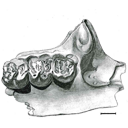
Les rongeurs de Chéry-Chartreuve et Rocourt-Saint-Martin (est du bassin de Paris; Aisne, France). Leur place parmi les faunes de l'Eocène Moyen d'EuropeBernard Comte, Maurice Sabatier and Monique Vianey-LiaudKeywords: Biochronology; evolution; Middle Eocene; Paris basin; Rodents; Systematicsdoi: 10.18563/pv.37.4-5.167-271 Abstract This paper is mainly devoted to the systematics of rodents from two middle Eocene (Bartonian) localities: Chéry-Chartreuve and Rocourt-Saint-Martin (Aisne, Eastern Paris Basin). These two localities are stratigraphically located slightly above the Auversian sands. The two faunas, which comprise 11 and 8 taxa, respectively, are very different in their composition. That of Rocourt-Saint-Martin shows strong similarities with that of the geographically very close locality of Grisolles, referred to the MP16 mammalian Reference level. The very distinct fauna of Chéry-Chartreuve includes a new species of Ailuravinae, Ailuravus nov.sp, and some teeth of the theridomyid Protadelomys, which represent archaic elements in the fauna. The most abundant species of the locality represents a new genus of primitive Theridomyidae. The presence of some teeth belonging to a new species of large Remyinae, Remys nov. sp., of Elfomys engesseri HOOKER & WEIDMANN, and a population of small dimensions referred to the genus Estellomys allow a correlation with Les Alleveys (Switzerland), with however some differences that would indicate an older age for Chéry-Chartreuve. Situated at the base of the "Marinesian" from the Bassin de Paris, this fauna is unquestionably different from those referred to the MP16 reference level and could represent an older level for which the macrofauna remains very poorly known. Conversely, the comparison of rodents from La Livinière II with those present in MP16 faunas, especially those of Robiac (Gard), shows a great similarity between both localities. This casts doubts on whether to keep this La Livinière II faunule to define the current MP15 reference level, while the biostratigraphical position of Pontils 26 (Spain), previously referred to this level, is reconsidered. Chery Chartreuse could be a good candidate for a new definition of the MP15 reference level. Article infos Published in Vol. 37, Fasc. 4-5 (2012) |
|
|

|
Neue Beobachtungen zum Schädel-und Gebiss-Bau der Paulchoffatiidae (Multituberculata,Ober-Jura).Gerhard HahnKeywords: Dentition; Paulchoffatiidae; Portugal; Skull structure; Upper JurassicAbstract The ventral face of the Paulchoffatiinae skull (Multituberculata, Lower Kimmeridgian, Portugal) is new reconstructed. Some details hitherto unknown are added, as the presence of jugals, the structure of the palatine and the extension of the pterygoids. The situation of the m2/ is discussed. Kielanodon hopsoni n. g., n. sp. is erected, known by its upper p3-5/. From Guimarotodon leiriensis the mandible with its dentition is made known. New informations concerning the milk-dentition and the replacement of teeth are also added. Article infos Published in Vol. 17, Fasc. 4 (1987) |
|
|
|
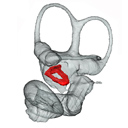
Fallen in a dead ear: intralabyrinthine preservation of stapes in fossil artiodactylsMaeva J. Orliac and Guillaume BilletKeywords: allometry; bony labyrinth; inner ear; middle ear ossiclesdoi: 10.18563/pv.40.1.e3 Abstract The stapes is the last of the middle ear ossicle chain and the smallest bone of the mammalian skeleton. Because it rests on the membrane of the fenestra vestibuli during life, the stapes may often fall within the bony labyrinth cavity when soft structures decay after death. In this work, we highlight the unexpected role that the bony labyrinth plays in the preservation of the stapes. Systematic investigation of the bony labyrinth of 50 petrosal bones of extinct and extant artiodactyls led to the discovery of eight cases of “intralabyrinthine” stapes. Three dimensional reconstructions of these stapes allow documenting stapes morphology of four extinct artiodactyl taxa: Microstonyx erymanthius (Suidae), Elomeryx borbonicus (Hippopotamoidea), ?Helohyus plicodon (Helohyidae), and an undetermined Cainotheriidae; and four extant ones Choeropsis and Hippopotamus (Hippopotamidae), and Tayassu and Phacochoerus (Suoidea). ?Helohyus plicodon from the Middle Eocene documents the oldest stapes known for the order Artiodactyla. Morphological study and metric analyses of our sample of artiodactylan stapes show that stapes are likely to carry relevant phylogenetic characters/signal within artiodactyls, and a potential Euungulata signature. Article infos Published in Vol.40-1 (2016) |
|
S.I. Data |

|
La poche à phosphate de Ste-Neboule (Lot) et sa faune de vertébres du Ludien Supérieur. 1 La poche et son remplissageBernard GèzeKeywords: Eocene; Quercy PhosphoritesAbstract La poche de Ste-Néboule, commune de Béduer (Lot), 15 km environ à l'WSW de Figeac, fait partie du groupe le plus septentrional des gouffres creusés par les ruissellements du Paléogène dans les calcaires jurassiques de la bordure sud-ouest du Massif Central et qui furent comblés à la même époque par des argiles sidérolithiques accompagnées de phosphate de chaux concrétionné ainsi que des restes de la célèbre faune dite «des phosphorites du Quercy» . Article infos Published in Vol. 08, Fasc. 2-4 (1978) |
|
|

|
Decouverte d'un nouveau Diacodexis (Artiocactyla, Mammalia) dans l'Eocène inférieur de Silveirinha, Portugal.Carmen Estravis and Donald E. RussellKeywords: Artiodactyla; Eocene; Migration; Portugal; SilveirinhaAbstract A new artiodactyl, Diacodexis antunesi n.sp., is described from the early Eocene of Silveirinha, Portugal. Comparisons are made with Diacodexis gazini GODINOT, 1978, D. varleti SUDRE et al., 1983, D. cf. varleti from Paris Basin sites, D. sp. from Dormaal and from localities in Spain and England, D. secans from North America and D. pakistanensis from Asia; affinities and evolutive tendencies are discussed. The presence of Diacodexis in the locality of Silveirinha confirms the very early Eocene age of the latter. As Diacodexis antunesi appears ta be more primitive than D. gazini from Rians (early Eocene of France), it lends corroboration to the interpretation (essentially based previously on condylarths) of the Silveirinha assemblage as the oldest Eocene fauna known in Europe and supports the hypothesis that early artiodactyls migrated from Europe to North America. Article infos Published in Vol. 19, Fasc. 1 (1989) |
|
|

|
Le genre Microstonyx en Espagne et ses relations avec les autres espèces du même genre hors d'EspagneJuana M. Golpe-PosseKeywords: Microstonyx; Spain; SuidaeAbstract The genus Microstonyx was found only in the north eastern part of Spain : M. antiquus, referable to the Article infos Published in Vol. 9, Ext (1980) |
|
|

|
Pseudorhyncocyon cayluxi Filhol, 1892 insectivore géant des phosphorites du QuercyBernard SigéKeywords: Insectivores; Leptictidae; Quercy PhosphoritesAbstract Une hémimandibule et une molaire supérieure recueillies dans le gisement oligocène inférieur d'Escamps (phosphorites du Quercy) fournissent de nouvelles informations sur le genre Pseudorhyncocyon FllHOL, grand insectivore longirostre du Paléogène d'Europe, fossile très mal connu jusqu'ici. Des comparaisons avec les macroscélididés africains, géolabididés nord-américains, et leptictidés euraméricains permettent de rattacher cet amimal aux leptictidés, et de le rapprocher du genre Lepticidium TOBIEN, au sein de la sous-famille européenne nouvelle des pseudorhyncocyoninés. Article infos Published in Vol. 06, Fasc. 1-2 (1974) |
|
|

|
Contributions à l'étude du gisement Miocène supérieur de Montredon (Hérault). Les grands mammifères. 7 - Les proboscidiens DeinotheriidaeHeinz TobienKeywords: allometry; Astaracian; Deinotherium; Montredon; Systematics; taphonomy; VallesianAbstract Some complete tooth rows and about one hundred isolated teeth enabled the identification of the deinothere of the Vallesian site Montredon (Hérault) as Deinotherium giganteum KAUP 1829, mainly by comparisons with the likewise Vallesian sample of the type locality Eppelsheim (Rheinhessen, F.R.G.). Article infos Published in Vol. 18, Ext (1988) |
|
|

|
Contributions à l'étude du gisement Miocène supérieur de Montredon (Hérault). Les grands mammifères. 6 - Les périssodactyles RhinocerotidaeClaude GuérinKeywords: Aceratherium; anatomy; Biostratigraphy; Dicerorhinus; Miocene; Montredon; Paleoecology; Upper VallesianAbstract The Montredon site has yielded about hundred rhinoceros remains: Article infos Published in Vol. 18, Ext (1988) |
|
|

|
Middle Eocene rodents from the Subathu group, Northwest Himalya.Kishor Kumar, Rahul Srivastava and Ashok SahniKeywords: Chapattimyidae; Eocene; evolution; India; Rodentia; Subathu group; SystematicsAbstract Extensive collecting in previously known and new Middle Eocene rodent localities in the Subathu Group of the Rajauri and Reasi districts, Jammu and Kashmir (northwest Himalaya, India) has yielded over 500 isolated cheek teeth, numerous incisors and cheek tooth fragments, and two mandibular fragments with M/1-M/3. An analysis of this additional material and a restudy of that reported earlier from the Metka (Rajauri) area has revealed the presence of diverse Middle Eocene ctenodactyloid rodents in India. The assemblage comprises six genera and twelve species, viz.., Bírbalomys woodi, B. ibrahimshahi, B. sondaari, Basalomys vandermeuleni, B. ijlsti, B. lavocati, Chapattimys wilsoni, C. debruijni, Gumbatomys asifi, cf. Advenimus bohlini, cf. Petrokoslovia sp. indet. 1 and cf. Petrokoslovia sp. indet. 2. Most species of this assemblage are endemic to the Indian subcontinent and are referred to the Family Chapattimyidae. However, at least three taxa, viz.., cf. Advenimus bohlini, cf. Petrokoslovia sp.indet. 1 and cf. Pezrokoslovia sp. indet. 2 show close affinities with their Central and Eastern Asiatic contemporaries and are attributed to the Family Yuomyidae. The dentitions of most of the Middle Eocene rodents from India are described here in better detail thus providing more precise characterization than was available earlier. The taxonomie status of Basalomys, formerly a subgenus of Birbalomys has been raised to that of a genus. Basalomys vandermeuleni is here designated as the type species of Basalomys in place of B. ijlsti. The rodent assemblage from the Subathu Group is specifically similar to that from the coeval Kuldana Formation of Pakistan. The absence of Birbalomys ibrahimshahi and cf. Advenimus bohlini in Pakistan is related to sampling bias. The identifications of the Early Eocene rodents from Barbara Banda, Pakistan have been reexamined and the familial assignments of some of the Early and Middle Eocene rodents from Central and Eastern Asia have been discussed and reviewed in the light of recent discovery of early rodents in Mongolia. Article infos Published in Vol. 26, Fasc. 1-4 (1997) |
|