
Abstract book of the 18th Conference of the EAVP
Pterosaurs from Coahuila
New elephant cranium from early Pliocene Ileret, Kenya
Les sélaciens du Miocène de la région de Montpellier
Muridae du Pliocène supérieur d'Espagne et du midi de la France.
Contribution à l'étude des genres Gliravus et Microparamys.
Eocene (57) , Quercy Phosphorites (38) , Systematics (32) , Rodents (29) , Mammalia (27) , Rodentia (25) , Miocene (25)
Page 13 of 19, showing 20 record(s) out of 366 total

|
La poche à phosphate de Ste-Néboule (Lot) et sa faune de vertebres du Ludien supérieur. 8- Insectivores et Chiroptères.Bernard SigéPublished online: 25/09/1978Keywords: Eocene; Quercy Phosphorites https://doi.org/10.18563/pv.8.2-4.243-268 Abstract The small insectivorous placental mammals from Ste-Néboule are poorly varied. Two orders of insectivores are documented : the Proteutheria by Pseudorhyncocyon cayluxi (leptictids), the Lipotyphla by Saturninia gracilis and S. beata (nyctitheriids). The bats are only rhinolophoids and mostly hipposiderids. Sufficient populations allow us to restrict the original definitions of three previous species (Hipposideros schlosseri, Palaeophyllophora quercyi, P. oltina). From now, these species can be regarded as monophyletíc. PV article infos Published in Vol. 08, Fasc. 2-4 (1978) |
|

|
Les mammifères Montiens de Hainin (Paléocène moyen de Belgique) Part1: Multituberculés.Monique Vianey-Liaud
Published online: 01/11/1979 |
|

|
Contribution à l'étude des Cricétidés oligocènes d'Europe occidentaleMonique Vianey-Liaud
Published online: 20/01/1972 |
|
|
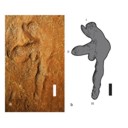
Pterosaurs (Pterosauria) from the Cerro del Pueblo Formation (Late Campanian) of Coahuila, MexicoHéctor E. Rivera-Sylva
Published online: 21/11/2025 |
|
|
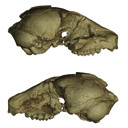
The digital endocast of Necrolemur antiquusArianna Harrington
Published online: 24/07/2020 |
|

|
Les Bovidae (Artiodactyla, Mammalia) du Miocène moyen de la formation Hofuf (Province du Hasa, Arabie Saoudite).Herbert ThomasPublished online: 30/12/1983Keywords: Biostratigraphy; Bovidae; Middle Miocene; Palaeogeography; Saudi Arabia https://doi.org/10.18563/pv.13.5.157-206 Abstract The study of the bovids from Al Jadidah (Hofuf Formation, Saudi Arabia) confirms that the fauna comes from a pre-Hipparion level. The Al Jadidah age is close to that of Fort Ternan (14 m.y.) and Beni Mellal, but cannot be older than that of Fort Ternan. The age of the Hofuf Formation is close to but slightly older than the oldest deposits of the Ngorora Formation (Kenya). 7 to 9 species have been recorded, of which 2 to 4 remain indeterminate. If the great specific diversity of te bovids from this locality gives evidence of immigrations from anterior Asia (Turkey) (e.g. Pachytragus Iigabuei sp. nov.), the bovid assemblage of Al Jadidah results in fact from a double influence: from the anterior Asia and mainly from Africa (e.g. the Caprotragoides lineage and the Neotragini? Homoiodorcas). The Al Jadidah bovids reflect, on the whole, the predominant character of open to very open environment, which supports the conclusions drawn from our two preliminary studies. PV article infos Published in Vol. 13, Fasc. 5 (1983) |
|
|
Contributions à l'étude de l'anatomie crânienne des rongeurs. 1- Principaux types de cricétodontinésJean-Louis HartenbergerPublished online: 25/09/1967Keywords: Cricetodon; Cricetodontinae; Miocene https://doi.org/10.18563/pv.1.2.47-64 Abstract Description, for the first time, of the skull of Ruscinomys Depéret on the basis of a nearly complete specimen, and description of a new facial part of a Megacricetodon Fahlbusch skull (material from upper Miocene, Spain). New description of the skull (facial part) of " Cricetodon" incertum Schlosser on the basis of the specimen from the Oligocene of Quercy phosphorites already published by S. Schaub. PV article infos Published in Vol. 01, Fasc. 2 (1967) |
|

|
La Poche à phosphate de Ste-Neboule (Lot) et sa faune de vertébres du Ludien Supérieur. 3- ChéloniensFrance de Broin
Published online: 25/09/1978 |
|

|
Un Haplobunodontidae nouveau Hallebune krumbegeli nov.gen. nov.sp. (Artiodactyla, Mammalia) dans l'Eocène moyen du Geiseltal près Halle (Sachsen-Anhalt, Allemagne)Jorg Erfurt and Jean SudrePublished online: 14/06/1995Keywords: Artiodactyla; Geiseltal; Germany; Mammal; Middle Eocene; new gen.; new sp. https://doi.org/10.18563/pv.24.1-2.85-99 Abstract A new genus and species of haplobunodontid artiodactyl, Hallebune krumbiegeli nov. gen. nov. sp., is described from the middle Eocene Geiseltal Fauna (Saxon-Anhalt, Germany). Its stratigraphic range is restricted to the MP 13 ("obere Mittelkohle") of the Geiseltalian. The material consists of seven fragments, representing both upper and lower jaws. It is indicated, that H. krumbiegeli was a small bunodont herbivore. The size and primitive character of the teeth suggest that the genus possibly is directly derived from Diacodexeidae.The new material forms the basis for reinterpreting the haplobunodontid phylogeny. PV article infos Published in Vol. 24, Fasc. 1-2 (1995) |
|

|
La poche à phosphate de Ste-Neboule (Lot) et sa faune de vertébres du Ludien Supérieur. 1 La poche et son remplissageBernard GèzePublished online: 15/09/1978Keywords: Eocene; Quercy Phosphorites https://doi.org/10.18563/pv.8.2-4.171-173 Abstract La poche de Ste-Néboule, commune de Béduer (Lot), 15 km environ à l'WSW de Figeac, fait partie du groupe le plus septentrional des gouffres creusés par les ruissellements du Paléogène dans les calcaires jurassiques de la bordure sud-ouest du Massif Central et qui furent comblés à la même époque par des argiles sidérolithiques accompagnées de phosphate de chaux concrétionné ainsi que des restes de la célèbre faune dite «des phosphorites du Quercy» . PV article infos Published in Vol. 08, Fasc. 2-4 (1978) |
|

|
La poche à phosphate de Ste-Néboule (Lot) et sa faune de vertébres du Ludien Supérieur. Résumé.Bernard Gèze, Jean-Claude Rage
Published online: 15/09/1978 |
|

|
Rongeurs caviomorphes de l'Oligocène de Bolivie. 1 Introduction au deseadien de BolivieRobert HoffstetterPublished online: 01/08/1976Keywords: Rodentia; South America https://doi.org/10.18563/pv.7.3.1-16 Abstract The Tertiary of the Salla-Luribay basin consists of red beds affected by the second period of the andine compression, of Miocene ending age. The Tertiary layers are exposed at an approximate elevation of 3.500 to 4.000 meters. Two stratigraphic units can be distinguished in them: the Luribay conglomerates, in which vertical clifts result from erosion, and the Salla layers consisting mostly of consolidated clays. These clays are very fossiliferous and have furnished a rich vertebrate fauna which gave to R. Hoffstetter the possibility to establish the Oligocene age of these beds. Sediments of same age has been reported to be present in several other places of Bolivia, particularly near Lacayani, where have been collected highly hypsodont Rodents, different from those found in Salla-Luribay basin. PV article infos Published in Vol. 07, Fasc. 3 (1976) |
|

|
Neue Beobachtungen zum Schädel-und Gebiss-Bau der Paulchoffatiidae (Multituberculata,Ober-Jura).Gerhard HahnPublished online: 15/12/1987Keywords: Dentition; Paulchoffatiidae; Portugal; Skull structure; Upper Jurassic https://doi.org/10.18563/pv.17.4.155-196 Abstract The ventral face of the Paulchoffatiinae skull (Multituberculata, Lower Kimmeridgian, Portugal) is new reconstructed. Some details hitherto unknown are added, as the presence of jugals, the structure of the palatine and the extension of the pterygoids. The situation of the m2/ is discussed. Kielanodon hopsoni n. g., n. sp. is erected, known by its upper p3-5/. From Guimarotodon leiriensis the mandible with its dentition is made known. New informations concerning the milk-dentition and the replacement of teeth are also added. PV article infos Published in Vol. 17, Fasc. 4 (1987) |
|

|
Sur le remplissage des "poches à phosphorite" d'Aubrelong (commune de Bach, Lot)Bernard GèzePublished online: 15/11/1974Keywords: Aubrelong; Quercy Phosphorites https://doi.org/10.18563/pv.6.1-2.21-25 Abstract L’article analyse les poches à phosphorite d’Aubrelong (Quercy), comparant les fouilles de 1937 (Éocène supérieur) et celles des années 1967-1970 (Oligocène inférieur), révélant une stratification contrastée : argiles brunes pauvres en fossiles en surface, et argiles rouges riches en phosphates et faune en profondeur. Les analyses géochimiques confirment une origine latéritique sous climat tropical humide, avec des remplissages tantôt stratifiés, tantôt chaotiques, remettant en cause l’hypothèse d’une progression chronologique uniforme des dépôts PV article infos Published in Vol. 06, Fasc. 1-2 (1974) |
|

|
Préface au mémoire jubilaire en hommage à René LavocatJacques MichauxPublished online: 01/10/1980Keywords: Editorial https://doi.org/10.18563/pv.9.ext.1-13 Abstract Monsieur René Lavocat, Directeur du Laboratoire de Paléontologie des Vertébrés de la troisième section de l'Ecole Pratique des Hautes Etudes, quittait le service actif en l'année 1979. View editorial Published in Vol. 9, Ext (1980) |
|

|
Cricetid and arvicolid rodents of the California wash local fauna, late Blancan of the san Pedro Valley, Arizona.Cristiana MezzabottaPublished online: 15/12/1997Keywords: Arvicolidae; Blancan; Cenozoic; Cricetidae; Mammals https://doi.org/10.18563/pv.26.1-4.189-218 Abstract An assemblage of micromammals is reported from California Wash, a fossil bearing continental deposit in the San Pedro Valley, Arizona, late Blancan in age. Cricetid and Arvicolid rodents are richly represented, including four and two species, respectively. This study mainly focuses on Sígmodon, the most abundant form. The sample of Sigmodon is compared to samples of the same genus from other localities of the San Pedro Valley of comparable age, and some inferences on the taxonomy of the genus are attempted. The specimens are referred to Sigmodon minor and Sigmodon cf. S. curtisi. Other cricetids (Onychomys pedroensis and Baiomys brachygnathus) and arvicolids (Mictomys vetus and Ondatra ídahoensis) are also recognized and described. PV article infos Published in Vol. 26, Fasc. 1-4 (1997) |
|
|
Latest Early-early Middle Eocene deposits of Algeria (Glib Zegdou, HGL50), yield the richest and most diverse fauna of amphibians and squamate reptiles from the Palaeogene of AfricaJean-Claude Rage
Published online: 08/02/2021 |
|

|
L'occlusion dentaire chez Peradectes, Amphiperatherium et Peratherium, Marsupiaux du tertiaire d'Europe.Jean-Yves CrochetPublished online: 01/10/1980Keywords: Didelphidae; Eocene; Mastication; Oligocene; Wear facets https://doi.org/10.18563/pv.9.ext.79-89 Abstract The general principles guiding the study of wear facets which develop during mastication in mammals possessing tribosphenic molars are named. The application of this method of study to the molars of European Tertiary Didelphidae shows that the lineage of this family as represented by the species Peratherium cuvieri (Upper Eocene), P. elegans (Lower-middle Oligocene) and P. antiquum (Upper Oligocene) has propessively evolved toward a more carnivorous diet. PV article infos Published in Vol. 9, Ext (1980) |
|

|
Deux nouveaux primates dans l'Oligocène inférieur de Taqah (Sultanat d'Oman): premiers Adapiformes (?Anchomomyini) de la péninsule arabique?Emmanuel Gheerbrant
Published online: 15/11/1993 |
|
|
Les Palaeotheridae (Perissodactyla) de la faune de Mammifères de Fons 1 (Eocène supérieur).Jean-Albert RemyPublished online: 15/06/1967Keywords: Anchilophus; Eocene; Pachynolophus; Palaeotheriidae; Perissodactyla https://doi.org/10.18563/pv.1.1.1-46 Abstract The locality of Fons 1, one of the fossiliferous outcrops in the late Eocene limestones of Fons-outre-Gardon (Gard), has yielded varied remains of mammals. The specimens were prepared by dilute acetic acid attack on the rock and by impregnation with an acrylic resin. PV article infos Published in Vol. 01, Fasc. 1 (1967) |
|
