Current issue


2025-12
48-2
<< prev. next >>

Print ISSN: 0031-0247
Online ISSN:
2274-0333
Frequency: biannual

Article Management

You must log in to submit or manage articles.

You do not have an account yet ? Sign up.

Page 19 of 19, showing 5 record(s) out of 365 total

Les Gliridés (Rodentia) de l'Oligocène supérieur de Saint-Victor-la-Coste (Gard).
Marguerite Hugueney
Published online: 28/10/1968

Keywords: Gliridae; Late Oligocene

https://doi.org/10.18563/pv.2.1.1-16

  Abstract

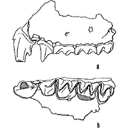
    The locality of St.-Victor-la-Coste (Gard) has yielded, rather abundantly, teeth of two glirids hitherto very poorly known: Glirudinus praemurinus (Freudenberg) and Glirudinus glirulus (DEHM). It has permitted, moreover, new views on the evolution of Peridyromys murinus (POMEL). Study of these forms confirms the late Oligocene age of the fauna, without allowing, however, further precision. 


  PV article infos

Published in Vol. 02, Fasc. 1 (1968)

PDF
Les Paramyidae (Rodentia) de l'Eocène inférieur du bassin de Paris.
Jacques Michaux
Published online: 15/07/1968

Keywords: Ailuraviinae; Eocene; Paramyinae; Rodents

https://doi.org/10.18563/pv.1.4.135-193

  Abstract

    The exploitation of new early Eocene localities in the Paris Basin has resulted in the collecting of  numerous mammalian remains, among which are about 300 isolated teeth representing the rodents. They belong, for the most part, to the paramyid group. Only the latest level of the early Eocene has yielded rodents belonging to the pseudosciurid group. The paramyids, the object of this study, are represented by at least 5 genera and 10 species; they are distributed among 4 clearly dilferentiated subfamilies : Paramyinae Simpson 1945, Pseudoparamyinae Michaux 1964, Ailuraviínae n. subf., Microparamyinae Wood1962.
    It results from this study that the principal types of rodents in the middle and late Eocene of Europe are clearly related to the forms described here: Plesiarctomys Bravard 1850 is related to Pseudoparamys Michaux 1964, Ailuravus Rütimeyer1891 to Meldimys n. gen., Gliravus hammeli Thaler 1966 to Microparamys nanus (Theilard1927), and some Masillamys Tobien 1954 to Microparamys russelli Michaux 1964 and to M. sp. 1. Gliravus and Masillamys are the oldest representatives of the Gliridae and the Pseudosciurídae, respectively, families which will progressively replace the Paramyidae in the course of the middle and late Eocene.
    Two stages can be recognized in the history of te European Paramyidae fauna during the course of the early Eocene: the older is characterized by the Mutigny fauna, the younger by the Cuis fauna.
    The Mutigny fauna appears already rather diversified and does not completely correspond, point by point, to the homologous fauna of North America. A geographic differentiation seems to have been manifested rapidly, unless the fauna established in Europe was already a little different from that which established itself in North America. 


  PV article infos

Published in Vol. 01, Fasc. 4 (1968)

PDF
Les Chiroptères du Miocène inférieur de Bouzigues. 1- Etude systématique.
Bernard Sigé
Published online: 17/04/1968

Keywords: bats

https://doi.org/10.18563/pv.1.3.65-133

  Abstract

    In recent years, the techniques of chemical preparing have permitted a rich paleontologic material to be obtained from the phosporitic sediment of Bouzigues (Hérault, France). The fauna of this locality is comprised of quite varied microvertebrates, amphibians, reptiles, birds, mammals. Twenty five species of the latter, belonging to seven orders, are today known from the site. Among them, the numerous rodents have allowed L. Thaler to chronologically situate this fauna in the Zone of Laugnac (<< late Aquitanian ›> of some authors).
    The chiropterans are, with the rodents, the best represented of the locality's mammals. Three families comprise the bat fauna, with nearly complete dominance by one of them (Hippoxideridae) over the two others (Megadermatidae and Vespertílionidae)
    Six forms are described, of which three are new species and one a new sub-genus.
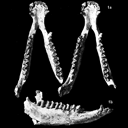
    Megaderma braillomi n. sp., an animal of rather large size, shows like the Miocene megaderms several evolved dental characters, translating the adaptation of these animals to a partially carnivorous regime. The Bouzigues species seems, however, to represent a particular lineage.
    Hipposideros (Brachipposideros n. subgen.) dechaseauxi n. sp. and Hípposideros (Brachipposideros) cf. collongenris Depéret, small sized forms, belong to a group rather well represented in the late Oligocene and early Miocene of Europe, and not distinguished until now within the genus Hipposideros.
    Hipposideros (Pseudorhinolophus) bouziguensis n. sp., is the most abundant mammal in the locality and, occuring at the Oligocene-Miocene limit, the last representative known of the subgenus Pseudorhínolophus, common in Europe from the middle Eocene.
    However, beyond Neogene and Quaternary times, certain among the numerous living species of Hipposideros are close to Pseudorhinolophus and others to Brachipposíderos. 'This fact would in the future justify a global revision of the genus, on the basis of comparative anatomy of the squeleton and of the teeth.
    The bat fauna of Bouzigues is completed by two small Vespertilionidae, rare forms, Myoris sp. I and sp. II.


  PV article infos

Published in Vol. 01, Fasc. 3 (1968)

PDF
 Contributions à l'étude de l'anatomie crânienne des rongeurs. 1- Principaux types de cricétodontinés
Jean-Louis Hartenberger
Published online: 25/09/1967

Keywords: Cricetodon; Cricetodontinae; Miocene

https://doi.org/10.18563/pv.1.2.47-64

  Abstract

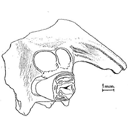
    Description, for the first time, of the skull of Ruscinomys Depéret on the basis of a nearly complete specimen, and description of a new facial part of a Megacricetodon Fahlbusch skull (material from upper Miocene, Spain). New description of the skull (facial part) of " Cricetodon" incertum Schlosser on the basis of the specimen from the Oligocene of Quercy phosphorites already published by S. Schaub.
    Comparison of the skull of “ C.incertum with that of the asiatic genus Cricetops Matthew and Granger and that of the North-American Eumys Leidy. These three genera of similar age display very distinct characteristics; their common origin must go back to the Eocene, as Wood believed.
    Comparisons of the auditory regions of Ruscínomys and of Megacricetodon where important differences are noted. Comparison of the Cricetodontines from European Miocene with contemporary Cricetines. Contrary of the opinion held by Schaub, their anatomical differences do not seem suflicient to warrant the contention that none of the Cricetines derive from a form close to one of the known Cricetodontines. 


  PV article infos

Published in Vol. 01, Fasc. 2 (1967)

PDF
Les Palaeotheridae (Perissodactyla) de la faune de Mammifères de Fons 1 (Eocène supérieur).
Jean-Albert Remy
Published online: 15/06/1967

Keywords: Anchilophus; Eocene; Pachynolophus; Palaeotheriidae; Perissodactyla

https://doi.org/10.18563/pv.1.1.1-46

  Abstract

    The locality of Fons 1, one of the fossiliferous outcrops in the late Eocene limestones of Fons-outre-Gardon (Gard), has yielded varied remains of mammals. The specimens were prepared by dilute acetic acid attack on the rock and by impregnation with an acrylic resin.
    This fauna, rich with about 20 species, can be included in the biochronologic zone of Euzet. The Palaeotheridae (sensu Simpson 1945), represented by 6 species, occupy a predominant place; Plagiolophus annectens is particularly abundant, comprising 55% of all the specimens found.
    The abundance of this species has permitted a detailed comparative study with the corresponding form from Euzet. The quantitative tests brought out a slight but highly sígnificant difference between the average dimensions of the teeth in the two populations. Moreover and in spite of the feeble rate of evolution in the Plagialophus dentition, diverse archaic particularities can be seen which permit the conclusion that the form from Fons 1 is a little the older. This conclusion is corroborated by observations on the other palaeotherids, particularly Lophiotherium aff. cervulum, whose dental evolutionary stage is intermediate between those of the corresponding forms known from Robiac and Euzet.
    A new species of Pachynolophus is described, P. garimondi n.sp., the last representative known of the genus. lts teeth are distinguished by their size, a great heterodonty, and the weakness
    of their cingula. 


  PV article infos

Published in Vol. 01, Fasc. 1 (1967)

PDF

Page 19 of 19, showing 5 record(s) out of 365 total